Biomass finds its application as feedstock to produce biofuels and other value-added products, which finds usage in energy and environmental areas with particular focus on bioenergy production from different biomass and high-volume, medium-value industrial products. This book investigates problems of controlled synthesis of these materials and the effect of their morphological, physical, and chemical characteristics on their adsorption or desorption capacity and recent progress in green catalysts derived from biomass for various catalytic applications. Socioeconomic impacts on environment and climate regarding waste biomass are discussed as well.
Features
Covers recent progress on green catalysts derived from biomass
Explores the biomass conversion to different resources
Introduces the utilization of biowaste in environmental aspects
Discusses the biomass applications in different types of energy
Proposes microbial waste biomass as a resource of renewable energy
This book is aimed at professionals and senior undergraduate students in environmental sciences, energy studies, and environmental and chemical engineering.
Trusted by 375,005 students
Access to over 1.5 million titles for a fair monthly price.
1Agricultural Waste Biomass Utilization as a Bio-AdsorbentActivated Carbon for Dye Removal
Avdesh Singh Pundir1, Kailash Singh2 and Sunil Rajoriya1
1Department of Chemical Engineering, Meerut Institute of Engineering and Technology, Meerut, Uttar Pradesh, India
2Department of Chemical Engineering, Malaviya National Institute of Technology, Jaipur, Rajasthan, India
DOI: 10.1201/9781003196358-1
Contents
1.1Introduction
1.2Dye
1.3Agricultural Waste Biomass Sources
1.3.1Peanut Shell
1.3.2Bagasse
1.3.3Peat
1.3.4Rice Husk
1.3.5Coconut Shell
1.3.6Activated Carbon
1.3.7Preparation of AC
1.4Adsorption Model
1.5Process Parameters, Decolorization and COD Reduction
1.6Adsorption Surface Characterization Technique
1.6.1X-Ray Spectroscopy (SEM/TEM)
1.7Conclusions
References
1.1Introduction
Industrialization and urbanization are essential for enhancing human living standards. This is one side of the coin. On the other side, these have resulted in polluted wastewater in the environment. It is well known that effluent dyes have been identified as one of the polluted water resources (Somasekhara Reddy et al., 2017). Wastewater effluent from pulp and paper, tannery, textile, food, pharmaceutical and electroplating industries have high levels of synthetic dye pollutants. This high level of dye pollutants must be reduced within the range of regulatory limits. Literature shows that there are more than a thousand synthetic dyes have been used in industries (Ukanwa et al., 2019).
Despite the existence of a large number of dye wastewater treatment scheme, challenges in treating wastewater still exist in respect to their economic aspects. Major difficulties out of them include improper dye removal and COD reduction (Şayan, 2006). Industrial applied technologies consist of various biological and chemical treatment, adsorption, and membrane-based filtration techniques. One way to enforce the wastewater problem is to introduce a number of policies at the state and central level. The challenges to monitoring its implementation are mainly due to associated treatment costs (Boumchita et al., 2017).
The word “adsorption” was coined in 1881 by German physicist Heinrich Kayser. He described this word to make the difference between the surface phenomena vs intermolecular penetration. Bio-adsorption is an important process in which the waste water is treated on the surface of biological material, which may contain live or dead micro-organism, agricultural waste, industrial waste, etc. However, chemical adsorption is strictly reserved for chemically attachment of adsorbate, needing to be removed to solid a waste surface, called adsorbent. In broad classification, the adsorption process can be divided into physical and chemical processes. The physical adsorption process, as its name suggests, is controlled by the physical forces available at the surface, in general. The major physical forces available are dipole-dipole interaction, van der Waals forces, hydrogen bond, polarity, static interaction hydrophobicity, etc. When some foreign species come in contact with the surface, adsorption takes place and the contacted species attaches to the surface by means of strong chemical interactions called chemisorption. The extent to which the adsorption process takes place strongly depends on the physical and chemical properties of the adsorbent such as molecular structure, molecular size, polarity, etc.
The primary artificial dye, Mauveine, was searched with the aid of Perkin in 1856. As a result, the dyestuffs industry can rightly be defined as mature. Figure 1.1 shows the chemical structure of Mauveine. It remains a colorful, challenging industry requiring a continuous stream of new products due to the fast converting global wherein we live. Environmental regulations are getting stronger day by day in the developing countries such as India. Effluent from the dye industries is restricted to treating within allowable limits, especially to color removal and chemical oxygen demand (COD). These are changeling issue to handle dye industry wastewater. However, many dyes have microbial resistance and natural light resisting characteristic which make them difficult to treat, in general. Therefore, the treatment of dye wastewater is necessary to comply the national environmental regulations (Wu et al., 2019).
Figure 1.1Synthetic chemical structure of Mauveine.
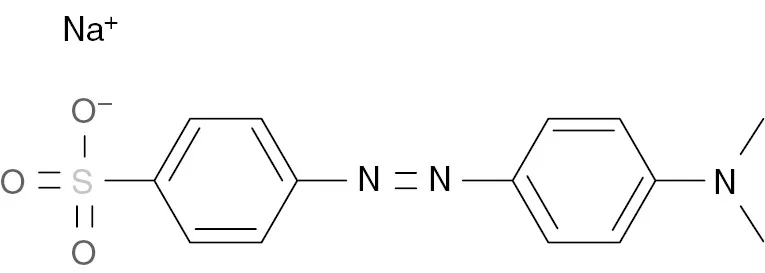
Subbaiah and Kim (2016) have investigated the adsorption of methyl orange from aqueous solution by aminated pumpkin seed powder. Figure 1.2 shows the chemical structure of methyl orange. They have reported that aminated pumpkin seed powder can efficiently remove the dye (maximum adsorption capacity of 143.7 mg/g) at an optimum temperature of 298 K. This study has shown the high efficiency of natural bio-adsorbent based on aminated pumpkin seed powder for the treatment of dye wastewater.
Figure 1.2Synthetic chemical structure of methyl oranges.
Yu et al. (2018) have investigated the utilization of biochar adsorbent prepared from chicken manure for the adsorption of methyl orange dye. They have rep...
Table of contents
Cover
Half-Title Page
Series Page
Title Page
Copyright Page
Contents
Preface
Editors
Contributors
1 Agricultural Waste Biomass Utilization as a Bio-Adsorbent: Activated Carbon for Dye Removal
2 Agricultural Waste Biomass Utilization in Waste Water Treatment
3 Phytochemical Extraction from Waste Biomass
4 Biomass (Agricultural Waste) as Sustainable Reinforcement in Polymer Composite
5 Biomass Accretion and Control Strategies in Gas Biofiltration
6 Enzymatic Biodiesel Production from Biomass
7 Catalytic Cracking of Jatropha curcas Non-Edible Oil to Hydrocarbons of Gasoline Fraction: Optimization Studies through the Box-Behenken Method
8 Production of Hydrogen from Waste Biomass
9 Microbial Mediated Waste Management and Bioenergy Production
10 Use of Waste Biomass as Remediator for Environmental Pollution
11 Recent Trends in Biomass Conservation and Management
12 Revalorization of Waste Biomass for Preparing Biodegradable Composite Materials
13 Biomass of Microalgae as Potential Biodiesel Source for Future Energy Needs
14 Waste Biomass Pretreatment Using Novel Materials
15 Corporate Social Accountability in Waste Production and Management
Index
Frequently asked questions
Yes, you can cancel anytime from the Subscription tab in your account settings on the Perlego website. Your subscription will stay active until the end of your current billing period. Learn how to cancel your subscription
No, books cannot be downloaded as external files, such as PDFs, for use outside of Perlego. However, you can download books within the Perlego app for offline reading on mobile or tablet. Learn how to download books offline
Perlego offers two plans: Essential and Complete
Essential is ideal for learners and professionals who enjoy exploring a wide range of subjects. Access the Essential Library with 800,000+ trusted titles and best-sellers across business, personal growth, and the humanities. Includes unlimited reading time and Standard Read Aloud voice.
Complete: Perfect for advanced learners and researchers needing full, unrestricted access. Unlock 1.5M+ books across hundreds of subjects, including academic and specialized titles. The Complete Plan also includes advanced features like Premium Read Aloud and Research Assistant.
Both plans are available with monthly, semester, or annual billing cycles.
We are an online textbook subscription service, where you can get access to an entire online library for less than the price of a single book per month. With over 1.5 million books across 990+ topics, we’ve got you covered! Learn about our mission
Look out for the read-aloud symbol on your next book to see if you can listen to it. The read-aloud tool reads text aloud for you, highlighting the text as it is being read. You can pause it, speed it up and slow it down. Learn more about Read Aloud
Yes! You can use the Perlego app on both iOS and Android devices to read anytime, anywhere — even offline. Perfect for commutes or when you’re on the go. Please note we cannot support devices running on iOS 13 and Android 7 or earlier. Learn more about using the app
Yes, you can access Utilization of Waste Biomass in Energy, Environment and Catalysis by Dan Bahadur Pal,Pardeep Singh in PDF and/or ePUB format, as well as other popular books in Technology & Engineering & Biotechnology. We have over 1.5 million books available in our catalogue for you to explore.