Twice-Exceptional Gifted Children, Second Edition provides informed recommendations for improving screening, identification, and services for gifted students with disabilities. This essential resource equips educators with an overview of who these students are, how teachers can tap into their strengths and support their weaknesses, and educational strategies to help them succeed in school and beyond.
Thoroughly revised and updated to reflect the latest research and advances in the field, the Second Edition includes new content outlining the positive and negative impacts of Response to Intervention (RtI) on twice-exceptional learners and recommends comprehensive assessments to identify their strengths and challenges, determine significant discrepancies in abilities, and evaluate any impacts on their learning and academic performance. This new edition also includes revised recommendations for screening and identifying twice-exceptional students, critical insights for understanding and supporting mental health issues, and updated analysis from the DSM-5 for Autism Spectrum Disorder, Specific Learning Disorder, and ADHD.
Ideal for teachers, coaches, and administrators looking to better understand their most talented learners, the fresh strategies, updated definitions, and comprehensive assessments included in this book will ensure that twice-exceptional gifted students don't just survive in the classroom, but thrive.
Twice-exceptional learners are unique individuals with learning characteristics that are atypical of gifted students or students with disabilities. There is no federal definition to guide the identification of this special population of gifted students. As a result, misconceptions and stereotypical notions hinder the identification of twice-exceptional learners. This chapter will examine the characteristics of twice-exceptional learners and their unique learner profiles. It will scrutinize misconceptions and stereotypical beliefs that hinder identification, leaving students vulnerable in an education system that does not understand their unique needs.
Characteristics
Twice-exceptional learners have the “characteristics of gifted students with potential for high performance, along with the characteristics of students with disabilities who struggle with many aspects of learning” (Brody & Mills, 1997, p. 282). They have “remarkable strengths and significant challenges that require a different approach” (Behrens, 2020, p. 3). The extremes of their abilities and disabilities can create academic, social, and emotional conflicts.
Characteristics of Gifted Learners
Typically, twice-exceptional learners have a superior vocabulary (Nielsen, 2002; Reis et al., 1995), penetrating insights into complex issues (Nielsen, 2002), and a wide range of interests (Nielsen & Higgins, 2005). They can develop consuming interests in a particular topic and develop expertise beyond their years (Nielsen, 2002). Twice-exceptional learners are highly creative (Baum et al., 2017; Reis et al., 1995), divergent thinkers with a sophisticated sense of humor. Their sense of humor can at times be viewed as “bizarre” (Nielsen, 2002). With other gifted students they share a propensity for advanced-level content, task commitment in areas of interest, a desire for creating original products, enjoyment of abstract concepts, and a nonlinear learning style (Renzulli, 1978; Tannenbaum & Baldwin, 1983; VanTassel-Baska, 1991; Whitmore, 1980). They learn concepts quickly and hate “drill and practice” assignments, preferring open-ended assignments and to solve real-world problems (Baum et al., 2017). These learners have a high energy level and tend to be more interested in the “big picture” than the details. Twice-exceptional learners are curious and constantly questioning to gain a more in-depth understanding of issues and concepts.
Characteristics of Students with Disabilities
Twice-exceptional children lack the skills they need to be successful in school even though they have the characteristics of gifted students. The academic performance of twice-exceptional learners can be inconsistent with reported problems with reading, expressive language, writing, and math skills (Nielsen, 2002; Reis et al., 1995). Cognitive processing deficits in auditory processing, visual processing, and processing speed decreases their ability to process information and negatively influences their academic achievement. Lack of organizational skills results in messy desks, backpacks, lockers, and problems keeping track of papers. Deficits in prioritizing and planning make it difficult for them to complete assignments in a timely manner. They are easily distracted and experience difficulties in focusing and sustaining attention (Reis et al., 1995). Problems with gross and fine motor coordination are evidenced by poor handwriting and lack of coordination when playing sports (Weinfeld et al., 2002). Many twice-exceptional learners experience short- and long-term memory deficits, making it difficult to memorize math facts and remember names of letters and grammar and spelling rules. They have difficulty thinking in a linear fashion and may be unable to follow directions (Nielsen, 2002).
Social and Emotional Characteristics
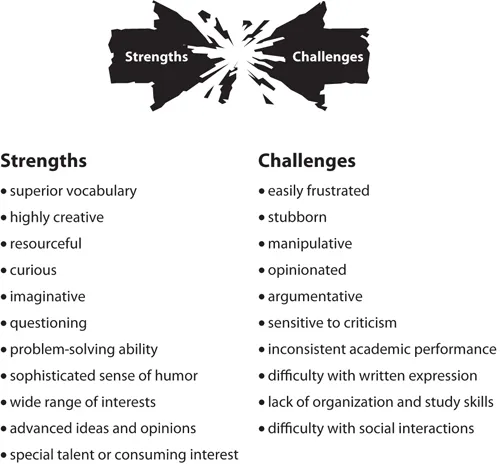
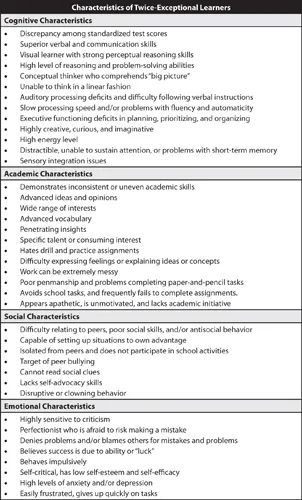
Their unique characteristics can thrust twice-exceptional children into emotional frustration (Nielsen & Higgins, 2005). Twice-exceptional learners struggle to achieve in areas impacted by their disability, but find it easy to achieve in areas not associated with their disability which is confusing to the student, their parents, and teachers (Maddocks, 2018). The extreme frustration these gifted learners feel when they cannot meet their own or others’ expectations, combined with the frustration of teachers who cannot understand why a bright child does not achieve, leads to conflict, misunderstandings, and failure in school. They can appear stubborn, opinionated, and argumentative, yet they also can be highly sensitive to criticism. Many twice-exceptional learners have limited social and/or emotional skills (Nielsen, 2002; Reis et al., 1995) and can become the target of peer bullying, which leads to feelings of isolation when they are unable to experience normal peer relationships. In an effort to avoid failure, twice-exceptional learners may try to manipulate the situation. A refusal to complete assignments may be an attempt to avoid failure. When faced with failure, twice-exceptional learners can become very anxious, angry, and depressed. It is the contrast between the student’s abilities and disabilities that creates conflicts and tends to makes school a frustrating experience for the twice-exceptional learner, their parents, and teachers. Figure 1.1 provides a visual representation of the combination of contrasting strengths and challenges that creates academic, social, and emotional problems for twice-exceptional learners. Use this figure to help students, parents, and teachers understand how the strengths and challenges influence the achievement and behavior of twice-exceptional learners. Figure 1.2 provides a more extensive list of twice-exceptional characteristics. Copy this list and ask teachers and parents to identify specific strengths and challenges of a twice-exceptional learner. This information will be used to identify needs in the Twice-Exceptional Planning Continuum, presented later in this book.
Figure 1.1 Frustrations result from conflicting strengths and challenges. Adapted from Nielsen, 1993.
Figure 1.2 Characteristics of twice-exceptional learners. Adapted from Nielsen, 1993.
Different Perspectives
Historically, the academic, social, and emotional needs of twice-exceptional students have been overlooked because of stereotypical notions (Baum et al., 2017; Whitmore, 1981). Widespread beliefs that gifted students score uniformly high on tests of intelligence and are teacher pleasers have prevailed since the early 20th century when Lewis Terman began using the Stanford-Binet IQ test, an intelligence test, to identify students with mental retardation (now called intellectual disabilities) who would not benefit from education and to identify students with superior mental abilities (Rimm et al., 2018). Gifted students and students with intellectual disabilities were believed to be at opposite ends of the intellectual spectrum. The early focus of gifted education was on students with superior IQ scores and the focus of special education was on children with intellectual disabilities.
Education of Gifted Students
Early research brought empirical and scientific credibility to the field of gifted education. Terman became known as the father of gifted education for his longitudinal study of 1,528 gifted students that began in 1921. This study concluded that gifted students had superior mental abilities and were physically, psychologically, and socially healthier than their peers (Burks et al., 1930; Oden, 1968; Terman, 1925; Terman & Oden, 1947, 1959). Students were selected for the study based on their IQ scores. Rimm et al. (2018) were critical of the selection process used for this study because classroom teachers selected the students who would participate in IQ testing. Students selected for the study were more likely to be teacher pleasers. It should be noted that two students, Luis Alvarez and William Shockley, were not included in the study because their IQ scores were not high enough, yet years later they achieved distinction as Nobel Prize winners. The description of the gifted child as the “near perfect child” is not an accurate picture of many gifted children, and it continues to place destructive internal and external pressures on students who are gifted but do not fit the perfect mold (Rimm et al., 2018).
The field of gifted education has experienced many ups and downs. When Russia launched the satellite Sputnik in 1957, American education was criticized for the lack of a challenging curriculum. This triggered an effort to improve education and paved the way for the development of a challenging curriculum for gifted students who were capable of completing advanced study in math and science (Housand, 2010). Later, elitism characterized by the belief that gifted students are inherently superior led to an anti-intellectual backlash directed toward gifted education (Colangelo, 2003). In 2002, the No Child Left Behind legislation amended the Elementary & Secondary Education Act (ESEA) of 1965. It placed greater emphasis on students who are not performing at acceptable levels (VanTassel-Baska, 2006).
Education of Students with Disabilities
Students with intellectual disabilities were excluded from public education, forcing parents to keep their children at home or put them in an institution. In 1954, Brown v. Board of Education ended separate but equal education and opened the doors for similar gains by special education. Because many students with disabilities continued to be denied a public education, parents began to lobby for a free, appropriate public education (FAPE) for their children in 1960. The Elementary and Secondary Education Act (ESEA) addressed inequities of students in 1965. Congress established the Bureau for the Education of the Handicapped in 1966 with the Title VI amendment to the Elementary and Secondary Education Act (ESEA) and provided a small amount of federal funds for the education of students with disabilities.
Parents lobbied for state laws requiring local education agencies (LEAs) to provide special education services to their children with disabilities. Two federal court cases focused attention on students with disabilities. Pennsylvania Association for Retarded Citizens (PARC) v. Commonwealth of Pennsylvania (1971) and Mills v. Board of Education of District of Columbia (1972) found under the Fourteenth Amendment of the United States Constitution that it was the responsibility of state and local school districts to educate students with disabilities. The Education for the Handicapped Act (EHA) combined several initiatives to provide limited financial assistance under one law in 1972. States joined advocates to seek passage of federal legislation to subsidize the cost of special education. FAPE for special education students became a reality with the 1975 Education for All Handicapped Children Act (EAHCA). It was renamed the Individuals with Disabilities Education Act, or IDEA, in 1990. IDEA was reauthorized with substantive changes in 1997 and again in 2004.
Converging Ideas
During the 1970s, definitions of both gifted education and special education broadened. In 1972, the Marland Report definition for gifted included intellectual, specific academic, leadership, creative and productive thinking, visual and performing arts, and psychomotor abilities (Marland, 1972). Special education services were expanded to include more students with less severe disabilities. The Education for all Handicapped Children Act (EAHCA) now known as Individuals with Disabilities Education Act (IDEA) established a federal mandate to identify, educate, evaluate the success of efforts, and provide due process protections (U.S. Department of Education, n.d.). Each time IDEA was reauthorized, more services and disability categories were added. With the expanded definitions in the 1970s came the realization that gifted students could have disabilities and the categories of gifted and disabled were not mutually exclusive (Rimm et al., 2018; Grimm, 1998).
The Council for Exceptional Children formed a committee in 1975 to discuss twice-exceptional students (Coleman, 2005). That year, two twice-exceptional projects received federal funding. A project in Chapel Hill, NC, was based on Bloom’s taxonomy and a project at the University of Illinois focused on Guilford’s Structure of the Intellect (SOI). In 1976, the Council for Exceptional Children and the Connecticut Department of Education sponsored the first conference on twice-exceptionality. About this time, Maker (1977) hypothesized that the incidence of giftedness should occur at the same rate in the population of students with disabilities as it did in the population of students without disabilities. She estimated that 3% of special education students were gifted. In 1993, The National Research Center on the Gifted and Talented reported that 2%–7% of the special education population was comprised of twice-exceptional learners, based on data collected by the center (see Nielsen, 1993). Today, we are still unsure of how many twice-exceptional learners there are. The latest estimates from various sources suggest there were 360,000 twice-exceptional learners in America’s schools National Education Association, 2006).
In a seminal article, Whitmore (1981) indicated a new area of professional specialization was beginning. She calculated that between 120,000 and 180,000 handicapped students were gifted. However, in 1982, the U.S. Supreme Court in Board of Education of Hendrick Hudson Central School District v. Rowley found that Amy Rowley, a hearing-impaired student, was performing adequately and progressing through the grades. The Supreme Court held that the law did not require states to develop the potential of students with disabilities (La Morte, 2005). This decision has negatively influenced the education of gifted students with disabilities and prevented students who performed at grade level from receiving special education services. From 1990 to 1996, the Jacob K. Javits Gifted Education Grant funded the Twice-Exceptional Child Project (Nielsen, 1989, 1993) that continues to guide the education of twice-exceptional students. In addition, Project High Hopes (Baum et al., 2017), funded from 1993 to 1996, focused on authentic projects and the importance of developing the strengths of twice-exceptional students.
The Individuals with Disabilities Education Improvement Act (IDEA) of 2004 and the Response to Intervention (RtI) model reflected new ideas related to the way educators assess, identify, and provide services to students with disabilities. The reauthorization of IDEA in 2004 mentioned gifted students with disabilities for the first time as a priority group whose needs can be funded in U.S. Department of Education grants for research, personnel preparation, and technical assistance. This was a major step forward in advocating for the needs of twice-exceptional students (Coleman et al., 2005). Another important provision of IDEA is the change in the way educators identify students with learning disabilities. The presen...
Table of contents
Cover
Half-Title
Title
Copyright
Contents
Preface
Introduction
CHAPTER 1 Unique Learners
CHAPTER 2 Collaborative Process
CHAPTER 3 Intervention Continuum
CHAPTER 4 Nurture Gifted Potential
CHAPTER 5 Support Cognitive Patterns
CHAPTER 6 Encourage Academic Achievement
CHAPTER 7 Foster Social Relationships
CHAPTER 8 Promote Emotional Understanding
CHAPTER 9 Self-Actualization
Conclusion
References
Appendix: Planning Continuum for Helping Twice-Exceptional Gifted Students Succeed
About the Author
Trusted by 375,005 students
Access to over 1.5 million titles for a fair monthly price.
Study more efficiently using our study tools.
Frequently asked questions
Yes, you can cancel anytime from the Subscription tab in your account settings on the Perlego website. Your subscription will stay active until the end of your current billing period. Learn how to cancel your subscription
No, books cannot be downloaded as external files, such as PDFs, for use outside of Perlego. However, you can download books within the Perlego app for offline reading on mobile or tablet. Learn how to download books offline
Perlego offers two plans: Essential and Complete
Essential is ideal for learners and professionals who enjoy exploring a wide range of subjects. Access the Essential Library with 800,000+ trusted titles and best-sellers across business, personal growth, and the humanities. Includes unlimited reading time and Standard Read Aloud voice.
Complete: Perfect for advanced learners and researchers needing full, unrestricted access. Unlock 1.5M+ books across hundreds of subjects, including academic and specialized titles. The Complete Plan also includes advanced features like Premium Read Aloud and Research Assistant.
Both plans are available with monthly, semester, or annual billing cycles.
We are an online textbook subscription service, where you can get access to an entire online library for less than the price of a single book per month. With over 1.5 million books across 990+ topics, we’ve got you covered! Learn about our mission
Look out for the read-aloud symbol on your next book to see if you can listen to it. The read-aloud tool reads text aloud for you, highlighting the text as it is being read. You can pause it, speed it up and slow it down. Learn more about Read Aloud
Yes! You can use the Perlego app on both iOS and Android devices to read anytime, anywhere — even offline. Perfect for commutes or when you’re on the go. Please note we cannot support devices running on iOS 13 and Android 7 or earlier. Learn more about using the app
Yes, you can access Twice-Exceptional Gifted Children by Beverly A. Trail in PDF and/or ePUB format, as well as other popular books in Education & Inclusive Education. We have over 1.5 million books available in our catalogue for you to explore.