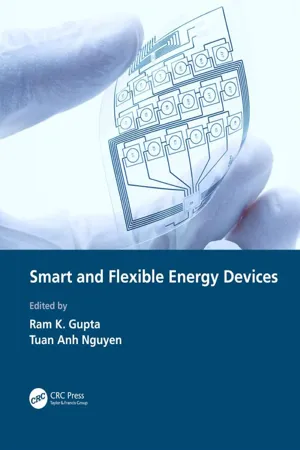
Smart and Flexible Energy Devices
eBook - ePub

Smart and Flexible Energy Devices

  1. 606 pages
  2. English
  3. ePUB (mobile friendly)
  4. Available on iOS & Android
eBook - ePub

Smart and Flexible Energy Devices

About this book

The scientific community and industry have seen tremendous progress in efficient energy production and storage in the last few years. With the advancement in technology, new devices require high-performance, stretchable, bendable, and twistable energy sources, which can be integrated into next-generation wearable, compact, and portable electronics for medical, military, and civilian applications.

Smart and Flexible Energy Devices examines the materials, basic working principles, and state-of-the-art progress of flexible devices like fuel cells, solar cells, batteries, and supercapacitors. Covering the synthesis approaches for advanced energy materials in flexible devices and fabrications and fundamental design concepts of flexible energy devices, such as fuel cells, solar cells, batteries, and supercapacitors, top author teams explore how newer materials with advanced properties are used to fabricate the energy devices to meet the future demand for flexible electronics.

Additional features include:

• Addressing the materials, technologies, and challenges of various flexible energy devices under one cover

• Emphasizing the future demand and challenges of the field

• Considering all flexible energy types, such as fuel cells, solar cells, batteries, and supercapacitors

• Suitability for undergraduate and postgraduate students of material science and energy programs

This is a valuable resource for academics and industry professionals working in the field of energy materials, nanotechnology, and energy devices.

Trusted by 375,005 students

Access to over 1.5 million titles for a fair monthly price.

Study more efficiently using our study tools.

Information

Publisher
CRC Press
Year
2022
Print ISBN
9781032033266
9781032033242
Edition
1
eBook ISBN
9781000543803

1 Smart and Flexible Energy Devices: Principles, Advances, and Opportunities

Tenzin Ingsel and Ram K. Gupta
Department of Chemistry, Kansas Polymer Research Center, Pittsburg State University, Pittsburg, Kansas, USA
DOI: 10.1201/9781003186755-1
CONTENTS
  1. 1.1 Introduction
  2. 1.2 Flexible supercapacitors
  3. 1.2.1 Flexible supercapacitors based on carbon
  4. 1.2.2 Flexible supercapacitors based on metal oxides and sulfides
  5. 1.2.3 Flexible supercapacitors based on nanocomposites
  6. 1.3 Flexible batteries
  7. 1.3.1 Flexible Li-ion and Li-sulfur batteries
  8. 1.3.2 Flexible metal–air batteries
  9. 1.4 Flexible proton exchange membrane fuel cells
  10. 1.5 Flexible solar cells
  11. 1.5.1 Dye-sensitized flexible solar cells
  12. 1.5.2 Perovskite-based flexible solar cells
  13. 1.6 Conclusion
  14. References

1.1 Introduction

Flexible devices are an essential group of electronics with versatile and innovative applications. Flexible electronics can function normally, even when subjected to various deformations such as stretching, bending, and twisting. Their potential applications range from wearable devices, renewable energy storage and production, medical care, consumer electronics, and many more. Electronics for flexible applications require reliable manufacturing to develop suitable materials, innovative technology, and tools to carry advanced research [1]. From a scientific perspective, materials that can power flexible devices remain a bottleneck for their development. For the past few years, multiple studies have been carried out to actualize power source materials that are mechanically flexible, strong, and suitable for versatile applications. Despite all the technological advances in the flexible device area, development in flexible energy conversion and storage systems is still in its infancy [2]. Ideal flexible energy conversion and storage device or power source materials for electronics exhibit suitable deformation properties; these include being bendable, stretchable, foldable and having operational safety and secure electrical functioning. Figure 1.1 illustrates an example of a futuristic, smart wearable glove that can sense, convert, and store various energy forms [3].
Figure 1.1 (a) Sensors and readout circuit schematics. (b) Piezoresistive multisensory. (c) Example of sensor response. (d) Example of patterned sensor configuration employed for application in each finger for characterization. Adapted with permission [3]. Copyright (2018) American Chemical Society.
The following subsections will explore principles of different flexible energy storage and conversion devices, their recent advances, and growth opportunities. The first section will cover flexible supercapacitors based on carbon material, metal oxides, sulfides, and nanocomposites. A few concepts to look forward to in the flexible supercapacitors include two common types of supercapacitors based on their energy storage mechanism and wearable textile-based supercapacitors; in addition, comparisions are made in energy and power density of pristine carbon materials and nanocomposites comprised of carbon and metal oxides. The flexible battery section discusses flexible lithium-ion, lithium-sulfur, and metal-air. Some recent progress in flexible battery technologies is explained, where unique electrode design prototypes pave the way for their large-scale production and practical applications. The flexible fuel cell part presents motivation for exploring their advantages. For the flexible solar cell part, third-generation low-cost, flexible dye-sensitized solar cells and perovskite solar cells are reviewed.

1.2 Flexible supercapacitors

1.2.1 Flexible supercapacitors based on carbon

Supercapacitors (SC) are energy storage devices known for their relatively simple assembly, high power density, quick charge-discharge rates, and high cyclic performance. Such properties make supercapacitors suitable for their use in flexible electronics. Supercapacitors can be divided into two categories based on how the charge is stored in the device. In electrical double-layer capacitors (EDLCs), electrical energy is stored via ion adsorption and desorption at the electrode/electrolyte interface. In pseudocapacitors, power is mainly generated and accumulated by redox reactions occurring at the surface [4,5]. Different types of materials are suitable for supercapacitors functioning via these two distinct charge-storage principles. Carbon-based materials are widely known to be applied in EDLCs, while pseudocapacitors use metal sulfides, metal oxides, and conducting polymers. EDLCs and pseudocapacitors have their advantages and disadvantages. For instance, EDLCs have high cycling stability, but only moderate capacitance. On the other hand, pseudocapacitors have poor cycling stability but high capacitance. This brings us to hybrid supercapacitors, which are made up of selectively chosen and synthesized nanomaterials for nanocomposites that show enhanced energy density without compromising their power density and cyclic life. This is a perfect segue into the subsections on discussions about flexible supercapacitors based on carbon, metal oxides, metal sulfides, and nanocomposite materials [2].
When it comes to carbon-based materials for flexible supercapacitors, carbon materials of different morphology and structure, such as graphene, carbon nanotubes (CNTs), and carbon fiber, are widely investigated [6]. Due to their high conductivity, large surface area, and desirable mechanical properties, such carbon materials are fit for applications in flexible devices. Graphene is a two-dimensional structure with monolayers of carbon atoms where the carbon bonds are sp2 hybridized. Graphene represents a distinguished group of carbon materials because of its outstanding electrical and thermal conductivity, mechanical flexibility, and relatively low production cost [7]. Supercapacitors based on graphene can deliver a decent specific capacitance of about 550 F/g, theoretically. However, due to the restacking of graphene sheets during the fabrication process and the cutback in their specific surface area, the specific capacitance delivery is lower than the theoretical limit. Laser reduction of graphene oxide generated graphene with heavily reduced restacking of graphene sheets [8]. The supercapacitor device was constructed by employing two identical laser-reduced graphene film (LSG) electrodes sandwiched with a polymer gel electrolyte. An extremely thin device was obtained with a thickness of less than 100 μm. The LSG electrode showed a high specific surface area and high specific capacitance of 204 F/g, with high energy and power density. The LSG electrode displayed outstanding cycle stability. The device proved highly flexible, with its bending having no adverse effect on the electrochemical performances [9].
Carbon-based materials have also been used as capacitive sensors, a subset of strain sensors where mechanical strain gets converted to electrical output [10]. In fact, in an ideal capacitive strain sensor, a strain is proportional to the capacitance. Equation 1.1 represents the strain-capacitance relationship.
C=ε0εrS/d(1.1)
Where ε0 is the vacuum dielectric constant (F/m), εr denotes the dielectric constant of the electrolyte, S is the size of the electrode accessible to ions (m2), and d is the thickness of the dielectric layer [10]. A carbon-based capacitive strain sensor was fabricated as knittable fiber. The core was made up of rubber and played a role as a dielectric layer, and carbon nanotube served as the active material [11]. The fiber supercapacitor device effectively absorbed shear and tensile stresses and converted them to capacitance during deformation. The device showed high capacitance, strain linearity, and high sensitivity to mechanical force. Figure 1.2 shows a schematic image of the twisted and stretchable fiber, as well as the actual fiber sewn into a glove, where it shows high structural reversibility (stretched up to 60%) [11]. The fiber was also helically wrapped around a glass tube to demonstrate no fiber damage or delamination. The scanning electron microscopes (SEM) further displayed the surface microstructure of the fiber-based sensor. Such design can potentially be applied in wearable energy devices, such as flexible solar cells, batteries, and supercapacitors, among many others.
Figure 1.2 (a) Schematic image of a twisted sandwich-structured fiber device composed of two CNT electrodes with silicon rubber as the core. Digital images of (b) the fiber sewn into a glove and enlarged images of (c) before and (d) after subjecting the test sample to 60% tensile strain with a scale bar (8 mm). (e) Photograph of helically wrapped fiber on a glass tube with scale bar (50 mm). Microstructural mapping of fiber during its relaxation after an applied strain at low magnification (f) and high magnification (g). Adapted with permission [11]. Copyright (2016) American Chemical Society.
A textile-based EDLC was fabricated where an activated carbon was screen printed onto a carbon fiber cloth. The carbon cloth was knitted with patterns and acted as a current collector, as shown in Figure 1.3 [12]. The textile EDLC showed suitable capacitance, performance, and mechanical stability to be stret...

Table of contents

  1. Cover
  2. Half Title
  3. Title Page
  4. Copyright Page
  5. Contents
  6. Preface
  7. Editors
  8. Contributors
  9. Chapter 1: Smart and Flexible Energy Devices: Principles, Advances, and Opportunities
  10. Chapter 2: Innovation in Materials and Design for Flexible Energy Devices
  11. Chapter 3: Basics and Architectural Aspects of Flexible Energy Devices
  12. Chapter 4: Characterization Techniques of Flexible Energy Devices
  13. Chapter 5: Micro- and Nanofibers-Based Flexible Energy Devices
  14. Chapter 6: 3D Printed Flexible Energy Devices
  15. Chapter 7: Environmental Impact of Flexible Energy Devices
  16. Chapter 8: Metal Oxide-Based Catalysts for Flexible and Portable Fuel Cells: Current Status and Future Prospects
  17. Chapter 9: Flexible Fuel Cells Based on Microbes
  18. Chapter 10: Flexible Silicon Photovoltaic Solar Cells
  19. Chapter 11: Flexible Solar Cells Based on Metal Oxides
  20. Chapter 12: Inorganic Materials for Flexible Solar Cells
  21. Chapter 13: Efficient Metal Oxide-Based Flexible Perovskite Solar Cells
  22. Chapter 14: Flexible Solar Cells Based on Chalcogenides
  23. Chapter 15: Perovskite-Based Flexible Solar Cells
  24. Chapter 16: Quantum Dots Based Flexible Solar Cells
  25. Chapter 17: A Method of Strategic Evaluation for Perovskite-Based Flexible Solar Cells
  26. Chapter 18: Flexible Batteries Based on Li-Ion
  27. Chapter 19: Flexible Batteries Based on Na-ion
  28. Chapter 20: Flexible Batteries Based on K-ion
  29. Chapter 21: Flexible Batteries Based on Zn-Ion
  30. Chapter 22: Fabrication Techniques for Wearable Batteries
  31. Chapter 23: Carbon-Based Advanced Flexible Supercapacitors
  32. Chapter 24: 2D Materials for Flexible Supercapacitors
  33. Chapter 25: Flexible Supercapacitors Based on Metal Oxides
  34. Chapter 26: Recent Advances in Transition Metal Chalcogenides for Flexible Supercapacitors
  35. Chapter 27: MOFs-Derived Metal Oxides-Based Compounds for Flexible Supercapacitors
  36. Chapter 28: Textile-Based Flexible Supercapacitors
  37. Chapter 29: Current Development and Challenges in Textile-Based Flexible Supercapacitors
  38. Chapter 30: Flexible Supercapacitors Based on Nanocomposites
  39. Chapter 31: Textile-Based Flexible Nanogenerators
  40. Index

Frequently asked questions

Yes, you can cancel anytime from the Subscription tab in your account settings on the Perlego website. Your subscription will stay active until the end of your current billing period. Learn how to cancel your subscription
No, books cannot be downloaded as external files, such as PDFs, for use outside of Perlego. However, you can download books within the Perlego app for offline reading on mobile or tablet. Learn how to download books offline
We are an online textbook subscription service, where you can get access to an entire online library for less than the price of a single book per month. With over 1.5 million books across 990+ topics, we’ve got you covered! Learn about our mission
Look out for the read-aloud symbol on your next book to see if you can listen to it. The read-aloud tool reads text aloud for you, highlighting the text as it is being read. You can pause it, speed it up and slow it down. Learn more about Read Aloud
Yes! You can use the Perlego app on both iOS and Android devices to read anytime, anywhere — even offline. Perfect for commutes or when you’re on the go.
Please note we cannot support devices running on iOS 13 and Android 7 or earlier. Learn more about using the app
Yes, you can access Smart and Flexible Energy Devices by Ram K. Gupta, Tuan Anh Nguyen, Ram K. Gupta,Tuan Anh Nguyen in PDF and/or ePUB format, as well as other popular books in Technology & Engineering & Chemistry. We have over 1.5 million books available in our catalogue for you to explore.