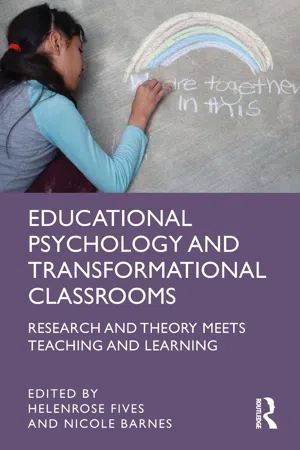
Educational Psychology and Transformational Classrooms uniquely positions teachers' transformational experiences as central to understanding and implementing educational psychology research. Across three well-developed case studies using narrative inquiry methods, this volume explores moments of significant change, learning, and evolution in teaching and learning. Each case is followed by analyses from educational psychologists focusing on the three central actors in the learning experience—students, teacher, and context—and is then concluded with case authors' responses to the analyses provided. Showcasing the holistic experience of teaching before unpacking it with theory and research, this book centers classroom life and posits educational psychology as an ideal and accessible lens for its examination.
eBook - ePub
Educational Psychology and Transformational Classrooms
Research and Theory Meets Teaching and Learning
- 128 pages
- English
- ePUB (mobile friendly)
- Available on iOS & Android
eBook - ePub
Educational Psychology and Transformational Classrooms
Research and Theory Meets Teaching and Learning
About this book
Information
1 INTRODUCTION Educational Psychology’s Response to Transformational Experiences in the Classroom
DOI: 10.4324/9781003276098-1
There is a truism that there are always three sides to any story: yours, theirs, and the truth. In our experience, this notion holds true for what happens in classrooms as well. There are always multiple perspectives on what occurs in learning contexts—at the very least there are the perspectives of the students, the teacher, and the context. However, in most investigations into classroom life, the focus is on one of these actors and typically on a single aspect of one of these roles. Thus, the published research typically overlooks the complexity of classroom life that is rife with conflict, intersectionality, and competing goals—in other words a sound recognition of the human experience.
This edited volume positions teachers’ transformational experiences as central to understanding and using research in educational psychology. The volume centers around three well-developed case studies of transformational experiences of teaching and learning informed by the research methodology of narrative inquiry (Clandinin et al., 2007). Following each case are three analyses by educational psychologists representing relevant perspectives in the field (e.g., cognition, motivation, identity development). The authors of each analysis focused on a specific actor in the case: the student, the teacher, or the context. Our goal in developing this edited volume was to make visible the complex, human, and personal reality of classroom life while offering analyses informed by theory and empirical research to help explain the transformational experiences described. A challenge to the fields of educational psychology and teacher education is the complexity of what we know (and do not) as it manifests in classroom reality. Typical educational psychology texts tackle a key theory (e.g., cognitive constructivism) or practice (e.g., classroom management) one at a time, but in reality, these things happen synchronously and somewhat haphazardly. In this volume we showcase the holistic experience of teaching and then unpack it with theory and research from educational psychology. That is, rather than putting research and theory first and using examples from classroom life, in this book we put classroom life first and seek to understand it through the various lenses offered by research and theory in educational psychology.
Why Should You Read This Edited Volume?
Educational psychology is a complex field spanning multiple theoretical constructs, methodological processes, and contextual applications. Educational psychologists study a span of topics including (but not limited to) how people learn, cognition, motivation, individual differences (e.g., special needs), classroom assessment, instructional practices, and the use of technology—to name a few. What holds educational psychology together as a discipline is a shared focus on the “psychologizing of education” (Alexander, 2018, p. 148). That is, applying the tools of psychology—theories and methods—to understand, explain, and predict the ways that learners and teachers situated in contexts come to make meaning, construct knowledge, and begin the process of lifelong learning (hopefully). Underlying any investigation into the educational process must be a goal for education that serves as a touchstone for what might be. Piaget (as cited in Duckworth, 1964) offered two goals for education that suggest an expanse of topics the field of educational psychology must explore in order to help teachers, learners, and school communities achieve it:
The princip[al] goal of education is to create [people] who are capable of doing new things, not simply repeating what other generations have done—[people] who are creators, inventors, and discoverers. The second goal of education is to form minds which can be critical, can verify, and do not accept everything they are offered. The great danger today is from slogans, collective opinions, ready-made trends of thought. We have to be able to resist individually, to criticize, to distinguish between what is proven and what is not. So we need people who are active, who learn early to find out by themselves, partly by their own spontaneous activity and partly through material we set up for them; who learn early to tell what is verifiable and what is simply the first idea to come to them.(Piaget as cited in Duckworth, 1964, p. 175)
If educational psychologists are to help in the achievement of these goals, our research must—and does—span an array of content areas, approaches, and topics. Educational psychologists specialize in such things as motivation, memory, reading, epistemic cognition, as well as specific learning and/or instructional strategies such as note taking, cooperative learning, and dialogic teaching. The field has an expansive array of topics and an accumulated mass of research that can support sound decisions for both educational policy and practice. However, for years instructors of educational psychology have lamented about the lack of interest in the field by the very professionals who should be taking up and using these research findings—teachers (e.g., Berliner, 1992; Patrick et al., 2011; Woolfolk, 2000). Reasons for this lack of interest may be attributed to things such as the theoretical nature of the field or the use of general recommendations devoid of content and context specificity. Berliner (1992) commented:
I have come to believe that most of what we teach in educational psychology is taught like phonics and vocabulary in reading, or like logarithms and geometry in mathematics; that is, it is taught in a decontextualized manner. Perhaps, much of our research lies fallow because we often fail to give it the quality of a tool. We fail to embed it in meaningful contexts; we fail to embed it in stories that teachers and policy makers can use.(p. 155)
On the other side of the issue are stories of teaching and recommendations for practice based on the experience of one or two teachers. Memoirs of teaching (e.g., Clark, 2003, 2019; Codell, 2001; Logan, 2010; McCourt, 2005; Michie, 2009) can offer rich powerful stories that inspire, motivate, humor, and horrify readers. Such stories can provide rich descriptions of the work of teachers and the multitude of challenges and decisions they make in the course of a day or unit of study. For instance, Logan (2010) described several different learning experiences that she devised and implemented with and for her students. The opening story of her book tells of a unit on women’s history for sixth-grade students and the construction of a class quilt and associated text that would honor women selected by her students. Through a series of artful decisions made by Logan the class ends up with two quilts: one honoring women from the past and the other honoring women from the present. Logan told a story of teaching most teachers would aspire to emulate, yet she did not offer an explanation for why this project was so successful, such as the underlying psychological processes of autonomy, competence, and belonging which support self-regulation and development (e.g., Ryan & Deci, 2000). Such connections to theory allow for problem abstraction that can then be applied in new or differing contexts. Further, in these personal accounts of practice there is always a question of how authors of popular press texts position themselves in their own stories. For instance, one Amazon reviewer of Logan’s memoire claimed that her husband was a student in Logan’s class and that he remembers the stories, projects, etc. quite differently.
In this edited volume, we draw on the strengths of educational psychology research and teachers’ storytelling. In doing so we address the problematic issues of each. Specifically, the decontextualized, almost antiseptic nature of educational psychology writing and the overly personal story telling of teachers’ memoires. Kiewra and Gubbels (1997) offered several strategies for addressing the issue of making educational psychology research relevant for practice, among these were recommendations to (1) re-focus educational psychology instruction onto teaching models and (2) provide an integration of theory and practice. In this edited volume we address Berliner’s concern by taking up the suggestions of Kiewra and Gubbels. That is, in this text, teaching models, experiences, and learning in the context of classroom life take the forefront. Following these complex real-life stories, educational psychologists offer analyses drawing on sound research and theory to illustrate the ways that this work can be used to advance and support teachers’ practice.
What to Expect from This Edited Volume
This volume includes three case studies written by practicing teachers, followed by three analyses written by educational psychologists, and a response to the analyses prepared by the case authors.
The Cases
We invited practicing teachers to offer a case study of a transformational experience or series of experiences involving themselves and their students. Each case showcases transformational experiences of classroom teaching and learning. By transformational we mean stories from lived classroom experiences that our teacher-authors point to as moments of change, learning, and evolution for themselves, their students, and/or both as situated in a classroom community. Each case tells the story of one real-life teacher’s experience from their practice. For purposes of the text some of the details were reframed or extended to ensure that the case flowed and conveyed enough information for analysis. For example, elaboration was offered in the third case on how cooperative learning was implemented. Each case was authored by two practicing teachers, the first author provided the story and the second served as a critical writing friend, who pushed for more details (sometimes adding them from their own experiences) and helped with the overall structure of the piece. Rich in detail, reflection, and description, the authors provide their first person experience as well as their understanding of the student experience(s) and the cultural context framing each case.
Chapter 2 (Case 1): “The Year of Isaiah”
Case authors Wright and Saiz de la Mora take readers on a journey over the course of a school year providing a close look at the relationship between a prekindergarten teacher and a student with challenging behaviors. These authors highlight the interrelationship between school, home, and community. Wright’s story explores the resources accessible to teachers and parents for supporting young children with social and emotional issues. Using an analogy from the children’s book Not a Box by Antoinette Portis (2006) as a framework, the teacher is positioned inside, outside, and on top of the classroom. Looking at the classroom, where Ms. Wright and Isaiah engage and interact, gives a holistic view of this transformational experience. The classroom, what it is, what it represents, and its possibilities, plays a pivotal role in transformational experiences. From inside the classroom to outside of it, family, school administrators, intervention specialists, and classmates form a web of support for Ms. Wright and Isaiah as they experiment with strategies to meet his social and emotional needs to promote learning. The case exposes how teachers are prepared to address challenging behaviors in students. The interior thoughts and emotional life of the teacher are exposed as Ms. Wright struggles to find balance with a student in dire need, the needs of her other students, frustrated family members, sleepless nights, and more. Ultimately, Ms. Wright learns that students are not the only ones who need to feel the sense of community and security in their classrooms, but that teachers have that need as well.
Chapter 7 (Case 2): “Sounding Out: From ‘a-u says /aw/’ to Critical Conversations”
Case authors Pollitt and Riley-Lepo describe Pollitt’s experience, as an English Special Education teacher, teaching three female students in a basic skills reading class. Initially, instruction followed 50-minute scripted lessons: the teacher would introduce a sound, prompt students to echo it back, and conclude with a passage with words containing that sound. The material felt dull, and the slightest pause in instruction became an excuse for everyone to chat. Throughout the fall, Ms. Pollitt and her students went through the motions of saying “a-u says /aw/” 100 times so that they could put their pencils down to talk. When Ms. Pollitt learned that the students were reading To Kill a Mockingbird (Lee, 1960) in their English class, she took one of those pencil-down moments to ask: What was it like in the South during the 1930s? Were you uncomfortable with the way Black people were described? This prompted one student, Nivia, to say, “I wish we read and spoke more about race in school.” Defensively, Ms. Pollitt asked, “Didn’t yo...
Table of contents
- Cover
- Half Title
- Title
- Copyright
- Dedication
- Contents
- List of Contributors
- 1 Introduction: Educational Psychology’s Response to Transformational Experiences in the Classroom
- 2 The Year of Isaiah: Classrooms as Transformational Places of Learning
- 3 What Happened to Isaiah?
- 4 Social Influences on the Year of Isaiah
- 5 Using Situated and Inquiry-Based Frameworks to Contextualize “the Year of Isaiah”
- 6 Response to the Analyses
- 7 Sounding Out: From “a-u says /aw/” to Critical Conversations
- 8 Using Constructivism and Racial Identity Development to Explore Dear Martin
- 9 Ms. Pollitt: A Novice Teacher’s Varying and Interacting Experiences and Sources of Self-Efficacy Beliefs
- 10 Creating a Climate for Critical Consciousness Sounding Out: Contextual Analysis
- 11 Case Author Response
- 12 The Annex: A Place In-Between
- 13 The Impact of Communal Learning on Students’ Sense of Belonging in The Annex
- 14 Developing Autonomy, Competence, and Relatedness at The Annex
- 15 The Power of Context
- 16 Response
- Index
Trusted by 375,005 students
Access to over 1.5 million titles for a fair monthly price.
Study more efficiently using our study tools.
Frequently asked questions
Yes, you can cancel anytime from the Subscription tab in your account settings on the Perlego website. Your subscription will stay active until the end of your current billing period. Learn how to cancel your subscription
No, books cannot be downloaded as external files, such as PDFs, for use outside of Perlego. However, you can download books within the Perlego app for offline reading on mobile or tablet. Learn how to download books offline
We are an online textbook subscription service, where you can get access to an entire online library for less than the price of a single book per month. With over 1.5 million books across 990+ topics, we’ve got you covered! Learn about our mission
Look out for the read-aloud symbol on your next book to see if you can listen to it. The read-aloud tool reads text aloud for you, highlighting the text as it is being read. You can pause it, speed it up and slow it down. Learn more about Read Aloud
Yes! You can use the Perlego app on both iOS and Android devices to read anytime, anywhere — even offline. Perfect for commutes or when you’re on the go.
Please note we cannot support devices running on iOS 13 and Android 7 or earlier. Learn more about using the app
Please note we cannot support devices running on iOS 13 and Android 7 or earlier. Learn more about using the app
Yes, you can access Educational Psychology and Transformational Classrooms by Helenrose Fives, Nicole Barnes, Helenrose Fives,Nicole Barnes in PDF and/or ePUB format, as well as other popular books in Education & Classroom Management. We have over 1.5 million books available in our catalogue for you to explore.