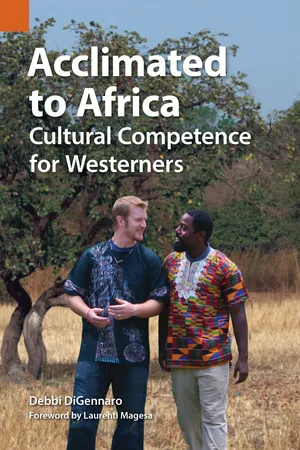
Misunderstood: one thing foreigners never want to be! But Africans and Westerners, interpreting the world through different cultural lenses, misunderstand each other with alarming regularity. This is sometimes funny, sometimes scandalous, but always damages credibility. This book is designed to promote cultural competence among Westerners working in Africa and among Africans living in the West.
- 164 pages
- English
- ePUB (mobile friendly)
- Available on iOS & Android
eBook - ePub
About this book
Information
Topic
CommerceSubtopic
Prise de décision1# On Our Way to a New Culture
Until the moment you go abroad, you have no reason or basis for believing that other people, including foreigners, might not behave like you.
(Storti 2007:68)
A matter of snakes
There was once a certain British man who went with his company to Nigeria. He immediately noticed about Nigerians that the men did not step back to allow ladies to enter a room ahead of them. This bothered him very much. As a proper gentleman, whenever he approached a doorway at the same time as a Nigerian woman, he courteously motioned for her to pass through the door ahead of him.
After several months of this, he mentioned it one day to a Nigerian male colleague. “Don’t you know how impolite it is,” he said, “to barge ahead of a lady?”
His colleague looked at him strangely. “Sir,” he said. “It’s a matter of snakes. The man must enter first so that, if there are snakes behind a doorway, he will get bitten but the lady will be safe.”
This book is written for Westerners who want to develop cross-cultural competence in for relating with African friends and colleagues. Cultural competence is knowing what one needs to know in order to act in a manner that is acceptable to the members of a given society. By behaving in acceptable ways, and correctly interpreting the behavior of others, we become socially mature in a given environment, worthy of trust, and able to engage new friends in genuine relationship.
Developing Cross-Cultural Competence
To become truly human is to learn a culture and understand what is going on. It is to know what to expect in life and what is expected of us.
(Hiebert 1986:57)
Most likely you are already very competent in one culture—your home culture—just like you are probably very fluent in your native language. Competency in a new culture develops much like the original competency did, through experience and the feedback of people around you.
Knowing what it is to understand and be understood in our own social environment, we desire to feel the same level of proficiency in new situations, whether relating to immigrants in our home country or traveling abroad. In this way, our established competency pulls us toward aptitude in new cultures. However, our established competency also has a pushing effect and can actually undermine our ability to perceive the world in new ways. As adults, our mental map of reality is firmly ingrained; only with difficulty can its marks and labels be re-drawn.
A foreigner sees only what he already knows.
(African proverb)
When we humans encounter new information, our brains run the information through a set of validity tests, checking it against what we already know. When the new information aligns with what we already know, with what we already recognize, we add it to our storage system. But if it does not ring true with the old data, the new data is quietly discarded. This process of validity-testing happens in a flash and usually below the level of our conscious awareness.
The British man saw Nigerian behavior, and navigating by European standards, thought he understood what was going on, when in fact he misunderstood completely. When the Nigerian courtesy was explained to him, he added new data to his storage system and afterwards was suddenly able to see and perceive the graciousness of behavior that had been there all along, invisible while in plain sight.
I am telling you about this process because I am hoping that, as you read this book, you can put your validity-testing process on pause. Just briefly. I am about to tell you some incredible things—things which are true but may not make any sense if you can test them only against realities you have experienced in your home culture. I am going to tell you that, although cows walk across the highways, and sometimes Xhosa people snip off the end of their children’s pinky fingers, Africa’s cultures are as normal as any other culture. Africa is organized, and its people behave in ways that are totally logical within their culture.
Redefining right-of-way
Traffic in Nairobi is notoriously maddening. Public buses lurch in and out of rows of bumper-to-bumper traffic, sometimes piled high with luggage and occasionally a chicken or goat. There appear to be no protocols for right-of-way, merging, passing, or slamming to a stop to drop off passengers.
One of the first questions I am asked by visiting Westerners is, “How ever do you manage to drive in this?” If traffic patterns in the United States went the way of Nairobi, it would indicate that something was very wrong.
In actual fact, driving in Nairobi is really quite predictable. The public buses are consistent in their lurching and slamming. Right-of-way is defined differently but reliably—basically, the biggest car goes first. Or maybe it’s the most aggressive driver goes first. Actually, most of all, the protocol is “just don’t get killed,” which is a remarkably effective way to organize traffic.
It’s not that there are no rules or traffic patterns; there are. But they look so different from what visitors are used to that they may not recognize them. Westerners can be so busy watching for what’s familiar that they can’t register the unfamiliar, unwritten system, and conclude that Nairobi’s traffic has gone completely crazy.
Unfamiliar systems do make us uncomfortable. Freshly-arriving visitors to Nairobi clutch their car handles and turn pale; they are terrified; they are uncomfortable. But just because it’s uncomfortable doesn’t mean it’s bad.
Foreigners in Africa, especially short-term workers, may be tempted to dismiss the importance of learning about African culture, eager to jump in and get to work. With any luck, we reason, real cultural differences are insignificant enough that they can be generally ignored. After all, we know how to be courteous: just let ladies go first.
Although a certain instinct may prompt visitors to minimize cultural differences, in fact, a greater appreciation of difference helps us forge a way forward. Notice what happens when we operate with the assumption that a person from another culture is basically like me: immediately my world and my experiences become central. To say that “we are basically the same,” is to assume that the way I see things is the way they are.
This is the opposite of cultural competence. It is a projection. In attributing my own perspectives and feelings to others, I deny their reality. The assumption that other people are like us is, in fact, the source of most cross-cultural tension. Although it may feel backward, an honest recognition of other cultures and realities makes cross-cultural relationships more navigable, not less.
It turns out that one behavior can have different meanings. A behavior and its meaning are not one thing; they are two things—behavior and meaning. Letting ladies go first may be interpreted as kind, or as unkind. When we cross into a new culture, we will find that the people there may match behavior and meanings differently than we do. It is unnerving how local people interpret our behavior through their lenses, and not according to ours.
Competency in my home culture does not equal competency in other cultures, but by educating ourselves about another group’s culture we can increase our likelihood of knowing what is going on and what is expected of us.
Establishing Credibility
Why does cultural competence matter? Because, as our saying goes, “When in Rome, do as the Romans do.” That is to say, we adjust our behavior to fit the new context. It’s easier on the “Romans,” and ultimately, it’s easier on us.
We expect no less of foreigners in our own countries. Consider the difference in your receptivity if a Somali woman dressed in Western clothes approaches you, speaking your language, and shakes your hand, compared with your receptivity to another Somali woman speaking Somali, dressed in a full black abaya, who is awkward with our style of greeting. It is easier to be receptive to foreigners who demonstrate behavior appropriate to our context.
Several days before a trip into Somalia, I had lunch with an American friend who was visiting Kenya. By way of conversation, I mentioned the preparations I was making for the Somalia trip, how I was practicing eating exclusively with my right hand, and had several new dresses sewn ...
Table of contents
- Foreword
- Acknowledgements
- How This Book Works
- 1 On Our Way to a New Culture
- 2 Clocks and Calendars: Navigating Concepts of Organization
- 3 Sharing, Hiding, and Hoarding: Navigating Concepts of Finance
- 4 Allies and Obligations: Navigating Concepts of Friendship
- 5 Magic, Morality, and Entities in the Air: Navigating Concepts of Spirituality
- 6 Riddles and Gifts: Navigating Concepts of Communication and Conflict
- 7 Standards, Status, and Resources: Navigating Concepts of Leadership
- 8 Labor, Loyalty, and Lounging Around: Navigating Concepts of Work
- Epilogue
- Appendix A: Cultural Adjustment Process
- Appendix B: Data Points for Travelers
- References
- About the Author
Trusted by 375,005 students
Access to over 1.5 million titles for a fair monthly price.
Study more efficiently using our study tools.
Frequently asked questions
Yes, you can cancel anytime from the Subscription tab in your account settings on the Perlego website. Your subscription will stay active until the end of your current billing period. Learn how to cancel your subscription
No, books cannot be downloaded as external files, such as PDFs, for use outside of Perlego. However, you can download books within the Perlego app for offline reading on mobile or tablet. Learn how to download books offline
Perlego offers two plans: Essential and Complete
- Essential is ideal for learners and professionals who enjoy exploring a wide range of subjects. Access the Essential Library with 800,000+ trusted titles and best-sellers across business, personal growth, and the humanities. Includes unlimited reading time and Standard Read Aloud voice.
- Complete: Perfect for advanced learners and researchers needing full, unrestricted access. Unlock 1.5M+ books across hundreds of subjects, including academic and specialized titles. The Complete Plan also includes advanced features like Premium Read Aloud and Research Assistant.
We are an online textbook subscription service, where you can get access to an entire online library for less than the price of a single book per month. With over 1.5 million books across 990+ topics, we’ve got you covered! Learn about our mission
Look out for the read-aloud symbol on your next book to see if you can listen to it. The read-aloud tool reads text aloud for you, highlighting the text as it is being read. You can pause it, speed it up and slow it down. Learn more about Read Aloud
Yes! You can use the Perlego app on both iOS and Android devices to read anytime, anywhere — even offline. Perfect for commutes or when you’re on the go.
Please note we cannot support devices running on iOS 13 and Android 7 or earlier. Learn more about using the app
Please note we cannot support devices running on iOS 13 and Android 7 or earlier. Learn more about using the app
Yes, you can access Acclimated to Africa by Debbi DiGennaro in PDF and/or ePUB format, as well as other popular books in Commerce & Prise de décision. We have over 1.5 million books available in our catalogue for you to explore.