- 204 pages
- English
- ePUB (mobile friendly)
- Available on iOS & Android
eBook - ePub
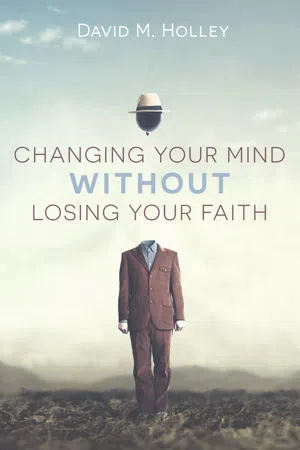
Changing Your Mind Without Losing Your Faith
About this book
This book is written for people who are tempted to leave the church because the message they have been hearing has come to seem intellectually unacceptable, morally objectionable, or spiritually deadening, maybe even all three. Often, these people see no alternative to the version of Christian faith that they now find difficult to accept. They have been told that rejecting anything they have been taught means ceasing to be a Christian.
What they have been told is wrong. But seeing new possibilities means reconsidering assumptions that are often taken for granted, and it can be difficult to imagine on your own a form of faith different from what you are used to. This book provides some help. It can be thought of as a guide for those who see the need to let go of some of what they have been taught, but don't know how to replace it with something better.
Rethinking your faith can be scary. But giving up on what is unbelievable can help to clear the way for the kind of faith that is more believable and ultimately more satisfying. Changing your mind can be a way of saving your faith.
Information
Topic
Theology & ReligionSubtopic
Christian TheologyPart 1
Holding Fast and Letting Go
Chapter 1
Two Dangers
We typically think of proverbs as sources of guidance about how to live. However, the kind of guidance you can get from a proverb is tricky, since different proverbs appear to give conflicting advice. There’s the admonition to “Look before you leap,” but we are also told, “He who hesitates is lost.” There’s a proverb that suggests, “Better safe than sorry,” but another one urges, “Nothing ventured, nothing gained.” We are instructed, “Don’t cross that bridge until you come to it,” but we also hear, “Don’t put off for tomorrow what you can do today.” In many cases you could follow the instruction of one of these proverbs only by doing what another proverb warns against.
Once we notice proverbs can give us conflicting advice, we might conclude they are pretty worthless as sources of guidance. However, such a conclusion is too hasty. While it is simplistic to imagine that having a store of traditional proverbs is enough to tell a person precisely what to do in each situation, proverbs might help in a different way. They might serve as reminders of common mistakes to avoid. Such reminders can be useful, but it takes judgment to decide how relevant or important a reminder is in a particular case. Proverbs cannot take the place of good judgment.
Good judgment often requires you to be alert to more than one kind of danger. For example, you might see what you are doing in terms of not letting others take advantage of you, but if you are attending only to that danger, you may not let your guard down enough to build strong friendships. Or you might pride yourself on disciplined work habits that keep you focused on the task at hand, but fail to notice that your habits sometimes block more creative ways of performing an assignment. In these instances excessive concern with one kind of danger actually increases the risk of an outcome that may be just as undesirable.
Firmness and Flexibility
My concern in this book is with two opposite dangers that arise for someone who embarks on a life of Christian faith. One is the danger of losing your faith by ceasing to affirm some essential Christian teaching. The other is the danger of holding so tightly to what you have affirmed that there is no room for welcoming new understandings and rethinking your faith in the light of greater knowledge or fuller experience. Both dangers are real, but it is easy to treat one as all-important while not paying enough attention to the other. You can think that the vital thing is to hold tightly to your beliefs and fail to recognize the need to develop a more mature or a more defensible faith. Or you might think that a willingness to adjust your beliefs in the light of new insights is the paramount concern and change your mind too easily when your faith affirmations are challenged or when they don’t fit well with the spirit of the age.
Trying to make sure your beliefs don’t change typically results in a faith that can’t be examined too closely. To keep your beliefs from changing, you have to guard against ideas that might undermine your ways of thinking. Doing so likely involves refusing to think about views that don’t fit well with what you have affirmed or distorting those views into a caricature you don’t have to take seriously. What you have to sacrifice is the ability to reflect honestly. You might imagine this kind of approach will keep your faith secure, but a faith with unalterable beliefs is actually very susceptible to collapse. Maintaining your beliefs by closing your eyes to what you don’t want to recognize generally produces an internal tension that can be difficult to sustain. It is sometimes with considerable relief that someone who has been trying to hold together a very inflexible faith gives up the project altogether.
On the other hand, the opposite extreme of being too ready to adjust the content of faith tends to result in a faith that is too thin. Sometimes people don’t want to give up calling themselves Christians, but they water down Christianity to an extent that it becomes virtually indistinguishable from what non-Christians could accept. They continue using Christian language but empty it of the kind of theological substance that makes a Christian understanding distinctive. Usually some alternative to the Christian message becomes a substitute for what is left behind. For example, Christianity is identified with a particular political agenda, or it is made into a vehicle for affirming the clichés of popular self-help books. When this sort of shift occurs, it is not always noticed. It is possible to lose any genuinely Christian faith without even realizing it has happened.
The ideal is to steer a course between these extremes, striving for a faith that is neither too rigid nor too thin. But what would it mean to recognize both of these dangers? Can you really be tenacious about holding onto your faith affirmations, but also open to changing your mind when you need to? The short answer is, “Of course, you can.” However, doing so calls for recognizing when to be tenacious and when to let go of what is blocking you from a more resilient and better-informed faith. Judgment of this kind is often not easy, and there is no foolproof way that I know of to avoid mistakes. You can be tenacious when you should have been more flexible, and you can be receptive to change when you should have stood firm. On the other hand, sometimes you can be fairly confident in the judgment that a particular affirmation needs to be maintained or that a particular faith claim needs to be rethought, and even when it is not entirely obvious which way to go, it is often clear when you should err on the side of being tenacious or err on the side of being open to change.
The Larger Christian Community
It helps to realize that you do not face this task alone. Other reflective Christians have engaged in the same struggle to hold onto their faith, while reflecting on it in ways that sometimes results in altered beliefs. Of course, you should not let others do all your thinking for you. However, it is appropriate to seek out role models who seem to you more advanced. Some paths that you might consider on your own are actually well trodden, and it would be unwise to try to create alone what others have already carefully considered. Discovering how others have tried to think deeply about their faith can also help you to imagine possibilities that were not on your radar at all.
One young man who grew up in a church that emphasized God’s judgment and the danger of going to hell was tied up in knots by trying to hold onto what he thought he should believe. He found the picture of a wrathful and vindictive God to be oppressive and hard to square with what he had heard about the love of God. It is likely this young man would have abandoned his faith altogether had he not started reading C. S. Lewis. In The Great Divorce Lewis painted a very different picture of hell than the unending torture this young man had been taught to fear. Lewis’s fictional account of the afterlife portrayed hell as the result of a choice people make between the only available options: moving closer to God or moving farther away from God.1 In the story residents of the dreary city, which represents life away from God, can visit the outskirts of heaven and stay if they like. They can choose to be closer to reality, which means being closer to the Love that is the source of all things. Or they can move farther away from reality by building their lives around self-centered desires, a choice that ultimately leads to disintegration, leaving eventually only the remnants of what used to be a person. However, accepting life in God’s presence comes with a cost; it involves leaving behind the things that would keep you from participating in a community built on love. If we are unwilling to give up what keeps us from our own fulfillment, God lets us have what we choose. There are only two kinds of people, says Lewis. There are those who in the end say to God, “Thy will be done,” and those to whom God in the end says, “Thy will be done.”2 A revised understanding of ideas of hell and judgment enabled this young man to maintain his Christian commitment, even if his beliefs changed in ways that many in his church of origin would have found unacceptable.
I don’t mean to suggest that an individual’s rethinking can’t be misguided. We shouldn’t imagine that Christianity means whatever you decide it means or that an idiosyncratic rethinking of Christian ideas can’t be seriously flawed. But we should recognize that Christianity is often communicated to us in forms that are deficient. Sometimes we should conclude that the way we have understood the faith is a product of flawed ways of understanding the Bible or of theological ideas that are inconsistent with fundamental Christian claims or of distortions arising from self-serving biases combined with presumptions that people in our social class tend to make. Often, we need to let go of questionable assumptions that are acting as filters to keep us from genuinely hearing the Christian message. Discovering reflective Christians with a wider knowledge of the tradition who have attempted to rethink problematic claims can help us recognize when our thinking ought to be reevaluated, as well as providing guidance about alternative ways of understanding the faith.
Receiving help from reflective Christians in revising what has become troublesome depends on recognizing that the particular teachings you have received from your local congregation amount to only one version of the Christian story. As a university professor, I have found it striking how often students who identify themselves as Christians know very little about the wider Christian community or the historical development of the faith they affirm. They identify Christianity with the teachings of their local church or denomination and think of the differences they are aware of between Christian groups as places where the other groups need to be enlightened. It is a shift to begin to think of your individual group as part of a larger community of faith and to realize that you can’t assume the answers you have learned from this part of the Christian community are the final truth. In the light of an expanded knowledge of Christian thought, it is often possible to appreciate the strengths of the version you are most familiar with, but also to recognize its deficiencies.
It is not just Christians who display ignorance of the wider community of faith. When I encounter students who are militant atheists, I often discover they came from Christian backgrounds that they rebelled against, typically from churches I would call fundamentalist. When these students launch into tirades about the falsehood and the harmfulness of Christian belief, they often display feelings of anger that are fueled by their personal disappointments with churches that represent to them what Christianity is about. However, when they refer to Christianity or to belief in God, they are usually talking about what would be seen by intelligent and reflective Christians with some knowledge of the wider tradition as a particularly narrow version of the faith. These students are often unable to envision forms of Christianity other than the kind they have judged and found wanting.
Doesn’t the Bible Settle What Christians Believe?
Both kinds of students, those who accepted what they were told and those who rejected it, were assured that the version of Christianity they learned was simply what the Bible teaches. They were not encouraged to think that the teaching they received reflected a particular way of interpreting what the Bible says and that there might be alternative interpretations. It was simply the only way to understand things. No doubt there are some things the Bible teaches that no one who makes a serious effort could misunderstand, but anyone who looks honestly at the range of ideas people attribute to the Bible has reason to recognize that our interpretations of biblical texts are about more than what is on the page. In some cases, we see what we want to see. But mostly we see what we have been prepared to see. We read biblical texts through interpretive lenses we have learned to use that dispose us to notice some things and filter out others. We rely on assumptions th...
Table of contents
- Title Page
- Preface
- Acknowledgments
- Part 1: Holding Fast and Letting Go
- Part 2: Rethinking Biblical Interpretation
- Part 3: Rethinking Christian Teaching
- Part 4: Substantive Faith
- Bibliography
Trusted by 375,005 students
Access to over 1.5 million titles for a fair monthly price.
Study more efficiently using our study tools.
Frequently asked questions
Yes, you can cancel anytime from the Subscription tab in your account settings on the Perlego website. Your subscription will stay active until the end of your current billing period. Learn how to cancel your subscription
No, books cannot be downloaded as external files, such as PDFs, for use outside of Perlego. However, you can download books within the Perlego app for offline reading on mobile or tablet. Learn how to download books offline
Perlego offers two plans: Essential and Complete
- Essential is ideal for learners and professionals who enjoy exploring a wide range of subjects. Access the Essential Library with 800,000+ trusted titles and best-sellers across business, personal growth, and the humanities. Includes unlimited reading time and Standard Read Aloud voice.
- Complete: Perfect for advanced learners and researchers needing full, unrestricted access. Unlock 1.5M+ books across hundreds of subjects, including academic and specialized titles. The Complete Plan also includes advanced features like Premium Read Aloud and Research Assistant.
We are an online textbook subscription service, where you can get access to an entire online library for less than the price of a single book per month. With over 1.5 million books across 990+ topics, we’ve got you covered! Learn about our mission
Look out for the read-aloud symbol on your next book to see if you can listen to it. The read-aloud tool reads text aloud for you, highlighting the text as it is being read. You can pause it, speed it up and slow it down. Learn more about Read Aloud
Yes! You can use the Perlego app on both iOS and Android devices to read anytime, anywhere — even offline. Perfect for commutes or when you’re on the go.
Please note we cannot support devices running on iOS 13 and Android 7 or earlier. Learn more about using the app
Please note we cannot support devices running on iOS 13 and Android 7 or earlier. Learn more about using the app
Yes, you can access Changing Your Mind Without Losing Your Faith by David M. Holley in PDF and/or ePUB format, as well as other popular books in Theology & Religion & Christian Theology. We have over 1.5 million books available in our catalogue for you to explore.