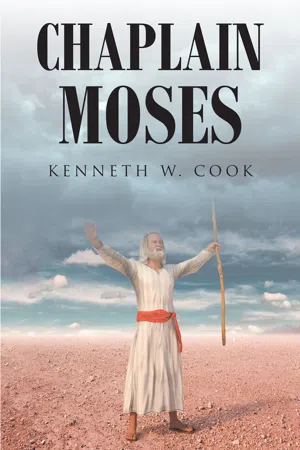
Moses is widely seen as one of the most significant persons of all time. The extensive correlation between Moses' work and the work of modern-day chaplains is highly instructive. Vastly different cultures and many centuries of time do not diminish the connection. Moses faced many challenges throughout his life. Chaplains today face almost all the same challenges. Many of these issues are explored in this book. Chaplains and other readers may find insights, perspective, encouragement, and guidance as well as some practical ways of dealing with issues.
- 128 pages
- English
- ePUB (mobile friendly)
- Available on iOS & Android
eBook - ePub
About this book
Information
Topic
Theology & ReligionSubtopic
Christian MinistryAcknowledgments
I want to thank the following people who have contributed their insights:
Chaplain Richard Dayringer, for believing that I could become an effective chaplain.
Chaplain (COL) Matthew McGowan, for urging me to take the long view and not resign from the Army Reserve when busily pursuing my doctorate.
Rev. Dan Scott, my pastor, for visiting me at every setting I served except one. His availability to listen to me for twenty-five years helped me find perspective. He thoroughly grasped the value of chaplain ministry.
Lynn Cook Dobbs and Julie Cook Faught, for checking grammar, spelling, punctuation, etc.
Randy Cook, for extensive suggestions regarding the transitions and flow.
Tim Cook, for the drawings of Moses’ face.
Mike Dobbs, for proofreading.
Martha Cook, for deciphering my scrawl and typing numerous revisions. Most of all, I appreciate her encouragement.
Introduction: Moses, My Hero
Moses, My Hero
Moses is my hero. I discovered a deep appreciation of Moses through a song I heard in the 1970s. The song called “Moses” was composed by Ken Medema and sung by him at Carson Newman College. The singing was inspiring, and the words were relevant.
The words are courtesy of Word Music Inc.1
Moses
Old Moses, way back there in the wilderness. Saw some smoke, came to the bush, and the bush was burning. God said, “Take off your shoes, Moses, you’re on holy ground. Moses, I’ve chosen you to be my man. Moses, way down in Egypt’s land. Moses, I’ve chosen you to work for me. Moses, I’ve chosen you to set my people free.”
“Not me, Lord! Don’t you know I can’t talk so good? I stutter all the time. Do you know my brother, Aaron? He can sing like an angel, talk like a preacher. Not me, Lord! I can’t talk so good, and another thing, how will they know that I’ve been here with you? How will they know what you’ve sent me to do?
Don’t you know in Egypt they want little Moses’ head? Don’t you know in Egypt they want little Moses dead? Don’t you know they’ll never hear a single word I say? Maybe you better get your dirty work done another way. Not me, Lord!”
“What’s in your hand, Moses?”
“It’s just a rod.”
“Throw it down, Moses.”
“You mean like on the ground?”
“Yes, I said throw it down, Moses.”
“Lord, don’t take my rod away from me. Don’t you know it’s my only security? Don’t you know when you live here all alone a man’s gotta have something he can call his own. Not me, Lord!”
“Throw it down, Moses!”
“But, Lord, I…”
“Throw it down, Moses”
Moses threw the rod on the ground and the rod became a hissing snake.
Well Moses started running! Well maybe you’d run! Well maybe I’d run.
He was running from a hot rod. Running from a hissing snake. Running scared of what God’s gonna do. Running scared he’ll get ahold of you.
And the Lord said, “Stop! Pick it up by the tail.”
“Lord, you have not been here very long. Lord, you’ve got the whole thing wrong. Don’t you know that you never pick up a hissing snake by his…”
“Pick it up Moses!”
Oh, God, it’s a rod again! It’s a rod again!
“Do you know what it means, Moses? The rod of Moses became the rod of God. With the rod of God, strike the rock and the water will come. With the rod of God part the waters of the sea. With the rod of God you can strike old Pharaoh dead. With the rod of God you can set the people free. Do you know what I’m trying to say, Moses?”
What do you hold in your hand this day? To whom or to what are you bound? Are you willing to give it to God right now? Give it up! Let it go! Throw it down!
Medema’s depiction of the burning bush event when God confronted Moses identified four critical issues. Ministers must consider these same issues when planning a career in chaplaincy. Issues from the song included surrender to God’s will, God’s power to make things happen in unexpected ways, the use of personal skills already present, and awareness that God will continue to guide and direct.
- Surrendering to God was a necessary first step in the process. Surrendering usually portrays a negative, unwelcome event as when a soldier is captured. Another side of surrender can be seen. Voluntarily giving up something, even something highly valued, is a form of surrender. Moses gave up the solitary, maybe peaceful life of a shepherd. He strongly resisted this surrender but eventually relented. Doing what God wanted rather than what Moses wanted set the stage for following God’s leadership. He turned his life and his work over to God. For the rest of his life, Moses strived to do what God wanted him to do. This focus became his primary motivation.
- God demonstrated His dynamic power through a bush burned but not consumed. Moses quickly recognized that he would not have the power, skills, insights, energy, and other attributes to accomplish this mission. God’s power would make the difference. Moses, having seen his rod change, gained strong confidence that God could act in unexpected ways.
- A rod was an important possession to every man in Moses’ time. Rods were the essential tool for shepherds. The shepherd’s rod and staff enabled him to control, guide, and protect the sheep. A rod symbolized power and authority. Moses’ rod would become instrumental in future events, such as striking a rock with the rod to get water at Mount Horeb (Exodus 17:3–-6).
- Moses witnessed the power of God and became fully convinced of God’s actions. He had no idea of the numerous additional ways God’s power would be displayed in the future. He could not have anticipated the plagues, the Red Sea, the manna, or other momentous events, but he believed God would be with him. God’s call continued to be vitally present in Moses’ awareness. He never forgot his call. God sought out Moses, not the other way around. A demand, not a suggestion, was God’s instruction to go forth and set the people free.
Reading and reflecting on the life of Moses, I soon realized that the issues and struggles I faced as a chaplain were like the ones faced by Moses. Over the next fifty-plus years, I gained numerous insights into Moses’ work. Reading the scripture passages and reflecting on the song has helped me apply Moses’ experiences to my own calling. These insights have often helped me to respond appropriately to varied situations.
Notes were jotted down and stuffed in a file. The correlation between Moses’ experiences and my life became clearer. Occasionally, I would scribble down some ideas. Sometimes, I experimented with an outline. After retiring, I began to give serious consideration to sharing these ideas. I think of this work as a way to give back in gratitude for the joy I have experienced as a chaplain.
I was privileged to serve in seven different organizations with widely differing environments. I have served in a suburban general hospital, a large state mental hospital, a youthful offender prison, a close security prison, a progressive mental health institute, the US Army Reserve (including a prisoner of war camp in Saudi Arabia), and a hospice. Despite large differences in these environments, the basic principles I learned from Moses have been applicable to all them. I believe that the study and application of these principles can be helpful to chaplains serving in their specific settings.
Moses served in a variety of roles. These included lawgiver, counselor, advocate with pharaoh, organizer, guide in the desert, disciplinarian, interpreter of God’s message, and others.
Chaplains work in unique settings and may often be misunderstood or ignored by other ministers. The recipients of a chaplain’s ministry sometimes ask, “Are you a real minister?” Church members, coworkers, and volunteers make sweeping assumptions about the value of their chaplains. Even many supervisors have difficulty conceptualizing the value of their chaplain. These misunderstandings emphasize the critical necessity of clear and comprehensive guidance for chaplains. I hope this book will facilitate that effort.
Many Christians assume that chaplain ministry is simply an extension of the pastoral ministry of a church. There are numerous similarities; there are also important differences that affect how a chaplain approaches the ministry. Four differences are unity, beliefs, programming, and supervision.
Unity
Unity is that sense of belonging that comes from common elements in the life of participants. Spiritual disciplines and activities are meaningful when there is a sense of togetherness. We say that we “belong” to a certain congregation or faith.
Unity emerges when the group has things in common. A church has history, traditions, expectations, and other unifying elements they share. Chaplains serve in environments where unity nearly always comes from something else. All are prisoners, all are military persons, all are patients, or all have some other characteristic in common.
Community church members usually worship in family groups. Sometimes, three and four generations of families attend the same church at the same time. Often, a history of participation goes back many years. A high degree of commitment results in a sense of permanence. Family groups foster a diversity of ages in the church. Social, economic, and educational similarities are common.
Chapel participants display a quite different pattern. Generally, participants in chapel programs are not considered members, though some refer to the chapel as their church. Individuals make up the majority of participants. Family members may be welcomed, but few attend. While many participants are similar in age groups, their ethnicity may have much diversity.
Short-term ministry becomes the norm in most setting...
Table of contents
- Acknowledgments
Trusted by 375,005 students
Access to over 1.5 million titles for a fair monthly price.
Study more efficiently using our study tools.
Frequently asked questions
Yes, you can cancel anytime from the Subscription tab in your account settings on the Perlego website. Your subscription will stay active until the end of your current billing period. Learn how to cancel your subscription
No, books cannot be downloaded as external files, such as PDFs, for use outside of Perlego. However, you can download books within the Perlego app for offline reading on mobile or tablet. Learn how to download books offline
Perlego offers two plans: Essential and Complete
- Essential is ideal for learners and professionals who enjoy exploring a wide range of subjects. Access the Essential Library with 800,000+ trusted titles and best-sellers across business, personal growth, and the humanities. Includes unlimited reading time and Standard Read Aloud voice.
- Complete: Perfect for advanced learners and researchers needing full, unrestricted access. Unlock 1.5M+ books across hundreds of subjects, including academic and specialized titles. The Complete Plan also includes advanced features like Premium Read Aloud and Research Assistant.
We are an online textbook subscription service, where you can get access to an entire online library for less than the price of a single book per month. With over 1.5 million books across 990+ topics, we’ve got you covered! Learn about our mission
Look out for the read-aloud symbol on your next book to see if you can listen to it. The read-aloud tool reads text aloud for you, highlighting the text as it is being read. You can pause it, speed it up and slow it down. Learn more about Read Aloud
Yes! You can use the Perlego app on both iOS and Android devices to read anytime, anywhere — even offline. Perfect for commutes or when you’re on the go.
Please note we cannot support devices running on iOS 13 and Android 7 or earlier. Learn more about using the app
Please note we cannot support devices running on iOS 13 and Android 7 or earlier. Learn more about using the app
Yes, you can access Chaplain Moses by Kenneth W. Cook in PDF and/or ePUB format, as well as other popular books in Theology & Religion & Christian Ministry. We have over 1.5 million books available in our catalogue for you to explore.