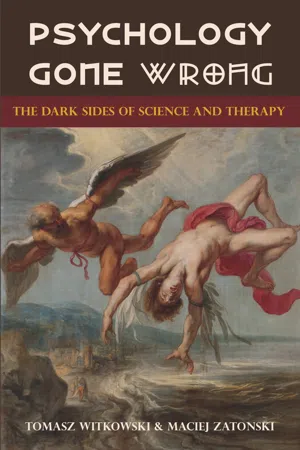
Psychology Gone Wrong: The Dark Sides of Science and Therapy explores the dark sides of psychology, the science that penetrates almost every area of our lives. It must be read by everyone who has an interest in psychology, by all those who are studying or intend to study psychology, and by present and potential clients of psychotherapists. This book will tell you which parts of psychology are supported by scientific evidence, and which parts are simply castles built on sand. This is the first book which comprehensively covers all mistakes, frauds and abuses of academic psychology, psychotherapy, and psycho-business.
- 304 pages
- English
- ePUB (mobile friendly)
- Available on iOS & Android
eBook - ePub
About this book
Information
PART I
FRAUDSTERS IN THE TEMPLE OF SCIENCE:
SOME SINS OF ACADEMIC PSYCHOLOGY
CHAPTER 1
IN SEARCH OF THE SUPER HUMAN:
WANDERINGS OF EUGENICS
Why do makers of commercial film images pertaining to science rarely use their imagination? Why are they so often ignorant of history, the history of science in particular? Why, whenever a thriller movie is made, a “mad scientist,” usually a medic, chemist or experimental physicist, has to star in it? Some mutated organism escapes from mad the scientist’s laboratory, reproduces at an incredible pace, and threatens the entire human race. Or it could be an alien substance that allows humans to cross beyond their ordinary capabilities. Or a device that provides some sort of significant advantage that falls into the wrong hands.... The conventionality of those scenarios is unbearably boring to anyone who has ever had anything to do with science or to anyone who understands where some intriguing discoveries can actually be made. Why hasn’t a single director ever dared to put a truly intelligent character in the main role? What is wrong with a hero who has access to nothing but a pen and a piece of paper?
Psychologists are scientists who, until very recently, did not need anything more than a sheet of paper and a pen or a pencil to do all their work. With those simple tools, they have managed to create disasters that many directors and screenwriters wouldn’t even imagine. Some of those scientists armed with writing tools could even be charged with genocide. All this happened in the name of scientism, using simple tools such as the afore mentioned piece of paper, pencil and few columns of figures only.
It all started pretty harmlessly with a man who wasn’t even a scientist, although the methodology he adopted affected numerous scientists. Obsessed with quantifying anything and everything that he could see, and blessed with a bright, insightful mind, Francis Galton was looking for regularities and patterns everywhere he could. He used to count which people in the audience fidget in their seats trying to measure the spectators’ interest in the show. He counted waves during his baths to check if they formed any patterns. Most of his findings sound ridiculous now, but among them are some that proved to be actual correlations that survived up to today. Not many remember that it was Galton himself who established the basis for weather forecasting; he also discovered the fact that human fingerprints are unique and could be used to identify an individual.
Some of Galton’s observations significantly affected other scientists, and in consequence, influenced the fates of hundreds of thousands of people worldwide. By analyzing biographical dictionaries, encyclopedias and the genealogies of 415 outstanding poets, artists, authors, scientists, explorers, judges and military officials, he concluded that the majority of them came from the same genealogical lines. Based on this observation, he postulated a hypothesis that we inherit more than only physical features (such as a color of our hair, height, etc.), also our emotional, intellectual and creativity-related traits. He calculated that 48% of the sons of those outstanding individuals, 7% of their grandsons and only 1% of their great-grandsons were also exceptional people. He published his observations in a work entitled Hereditary Genius.1
Galton did not stop there. From these observations, he drew the conclusion that human development, guided by a marriage control system that would pair together talented individuals, would yield talented people, just as it is done when breeding animals where farmers select the best individuals for reproduction at their own discretion. He decided to give a new name to this area of knowledge. The archives of University College London still hold a sheet the size of a palm on which Galton inscribed the Greek letters combining two words good and born. This is how the term eugenics originated – a word that inspired Galton’s contemporaries and also the one word that became an obsession of his numerous followers. This one word was written into the credo of numerous institutions and broke the continuity of generations in the name of law, deprived thousands of basic human rights and brought death and misery to millions.
We do not want to put the entire blame on Galton. There were many historical reasons that contributed to spread of eugenics, but it was Galton’s fault to draw far-reaching conclusions from insufficient and lacking research materials. It was his unacceptable impatience and desire to test his mere assumptions on a large scale. The imitators, adopters, successors and followers of eugenics are guilty of not conducting reliable investigation and research on heredity. They did not bother to verify or question Galton’s hypotheses, did not try to replicate his results. Instead, they started a giant social experiment, an experiment in which psychologists played a significant role. After all, the enhancement of intellectual capabilities of the human race was at stake. In order to achieve this goal, a measurement of these capabilities was required. From that moment on, until today, the development of eugenics is inseparably connected to the history of measurements of human intelligence. The catastrophic campaigns that followed depended on the reliability of intelligence measurements provided by psychologists. All their methodological mistakes had significant and direct impact on thousands of people. Let’s have a closer look at this marriage.
The first known attempts to assess intelligence were performed by Galton himself. During the International Health Fairs in the South Kensington Museum, he had set up a booth where all visitors could test their intellectual capabilities for the moderate price of three pence. Approximately nine thousand men and women participated in this pioneering project. The tests measured the time it took for the subjects to respond to auditory, visual, or touch stimuli, and also to other aspects of sensory-motor functioning that could have been easily and precisely measured. Galton believed that intelligence is a general trait. He expected outstanding individuals to score better in all measurements. Unfortunately, specific measurements did not correlate with each other; there was also no correlation with independent indicators of intelligence. The project failed to produce the expected results and researchers were forced to develop intelligence measuring tests in a more direct way.
The first useful test measuring intelligence was developed in France in 1905 by Alfred Binet, a psychologist, and Theodore Simon, a physician. It was the first known public contract addressed to psychologists. As commissioned by the Ministry of Education, they prepared a test that consisted of 30 increasingly difficult questions, which allowed assessment of the intellectual capability of the person tested. Binet emphasized several times that the test results were not permanently conclusive, as a child’s measured intelligence levels may change. He developed a unique set of exercises and teaching methods for children to improve their intellectual performance. Binet openly opposed the hypothesis of a hereditary nature of intelligence.2 Unfortunately, his concepts soon got distorted and used for the purpose of eugenic “improvement” of the human race.
The German psychologist William Stern introduced the concept of the intelligence quotient (IQ) in 1912. He noticed that the intellectual age of a tested person accurately represents the intelligence of an individual only when it is related to the current, chronological age of a given person. Let’s consider three hypothetical people: Peter, Mark and Mary. Assessment of their intellectual capability test indicated they were 10 years old. Let’s assume their biological age is 20, 10, and 5 years, respectively. In such scenario Peter displays severe mental retardation, Mark has an average intelligence, and Mary is a genius. Therefore, Stern suggested that the ratio between the level of intellectual development and biological age would be much more accurate. He called this ratio an intelligence quotient. The popular abbreviation IQ was introduced later by the American psychologist, Lewis Terman, who further suggested multiplying the calculated ratio by 100 to express the quotient as a percentage and avoid inconvenient fractions. According to this formula that soon became broadly accepted, Peter’s IQ was (10/20) x 100 = 50, Mark’s IQ (10/10) x 100 = 100 and Mary’s – (10/5) x 100 = 200. According to such representation, the intelligence quotient close to or equal to 100 represents average value of the current population at this age. In the case of an IQ lower than 100 we are dealing with mental underdevelopment and retardation, while results above 100 indicate progressively more capable and outstanding individuals.3
Binet’s method of measuring intelligence and Stern’s concept of calculating the intelligence quotient were welcomed in the US with great enthusiasm. Lewis Terman from Stanford University adapted the Binet-Simon scale, known today as Stanford-Binet, and it soon became a prototype for all IQ tests developed later. Intelligence tests soon fell into the hands of scientists blinded by various ideologies. Two psychologists are worth mentioning here: Henry Goddard from New Jersey and Robert Yerkes from Harvard University, (then the acting chairman of the American Psychological Association). They were deeply convinced that those tests measure intelligence as a permanent and congenital predisposition. It is also worth mentioning that they both were active members of eugenic associations. They spread a concept that was greatly opposed by Alfred Binet. They claimed that genetically inferior people represent a threat to the social, economic and moral condition of the country. Tests measuring intelligence became a tool for identifying, and consequently, for eliminating “inferior” individuals. Goddard and Yerkes were joined by Terman in 1916, who stated that the ultimate result of the common use of intelligence tests would be to free society from tens of thousands of mentally retarded people – African Americans and representatives of other racial minorities in particular.
Very quickly, the fact that measuring intelligence became possible provided the basis for the introduction of laws that enabled one of the most rigorously concealed events in modern history: the mass sterilization of thousands of people. A test result provided an “objective” basis for making a judgment on who had the right to reproduce. In over 30 states, laws were passed that allowed forced sterilization as a means of preventing the reproduction of people with low intelligence in order to support the “enhancement” of the human race. The first legal act that allowed sterilization was passed in Pennsylvania in 1905, but it was vetoed by the governor and never came into force. The first law became effective in Indiana in 1907. New Jersey followed track in 1911? and later the same year, the state of Iowa implemented a law depriving criminals, mentally retarded, and so forth of the possibility to reproduce. The sterilization bill passed in the state of Washington was appealed in the Supreme Court in 1912, but the court unanimously upheld its lawfulness, making reference to research on eugenics available at that time. The law passed in California in 1918 allowing compulsory sterilization, provided it was approved by a team of experts. The teams had to include a psychologist with a PhD, (at that time, Terman was one of a very few people who actually had such qualifications in California). A similar law passed in Virginia led to over 7,500 forced sterilizations in the years 1924 – 1972. A scalpel was in constant use, but the people subjected to these procedures were rarely aware of what was going on. Doris Buck Figgins, a young woman sterilized in 1928 against her will in accordance with effective legislation, was informed that she actually underwent an appendectomy. She finally discovered that she was sterilized in 1980: “I never knew anything about it.… I am not mad, just broken hearted is all. I just wanted babies bad.…I don’t know why they done [sic] it to me. I tried to live a good life.”4
Since the first law was passed, by 1940, a total of 35,878 people in the United States had been sterilized against their will or even without their knowledge. At least, that is the number of cases that had been accurately documented. It was not the end, though. Today, the number of all sterilized people amounts to approximately 60,000. Not so long ago, between 1972 and 1976, hospitals in only four cities in the USA sterilized 3,406 women and 142 men, mainly Native Americans.5 The numbers may be quoted endlessly, but they will never reflect the suffering of the victims of “science” built on insufficient or misinterpreted evidence. Compulsory sterilization of the mentally ill is rare nowadays (if practiced at all), but there are still some states where sterilization laws are in effect. In North Carolina for example, the laws were even updated in 1973, and then again in 1981.6
Give me your tired, your poor, your huddled masses yearning to breathe free; The wretched refuse of your teeming shore. This is the inscription with which the Statue of Liberty welcomes travelers disembarking from ships in New York. In 1912, a scary shadow appeared between the harbor and the Statue: the shadow of a psychologist obsessed with the idea of the improvement of the human race – Henry Goddard. Before they left the harbor, immigrants had to solve intelligence tests. Goddard’s conclusions were that 79% of the Italians, 87% of the Russians and 83% of the Jews are mentally retarded. Publication of these findings not only fuelled the existing prejudices, but also led to tightening of immigration legislation. The Immigration Act of 1917 provided an option to reject people considered mentally inferior, barring them from entering into the US. In the same year, Goddard reported with pride that h...
Table of contents
- Cover Page
- Praise for Psychology Gone Wrong
- About the Authors
- Half Title
- Full Title
- Copyright
- Dedication
- Table of Contents
- Introduction
- Part I - Fraudsters in the Temple of Science: Some Sins of Academic Psychology
- Part II - Conquering Patients’ Souls: Sins of Psychotherapists
- Part III - Beyond Control: Psychobusiness
- To be Continued…
Trusted by 375,005 students
Access to over 1.5 million titles for a fair monthly price.
Study more efficiently using our study tools.
Frequently asked questions
Yes, you can cancel anytime from the Subscription tab in your account settings on the Perlego website. Your subscription will stay active until the end of your current billing period. Learn how to cancel your subscription
No, books cannot be downloaded as external files, such as PDFs, for use outside of Perlego. However, you can download books within the Perlego app for offline reading on mobile or tablet. Learn how to download books offline
Perlego offers two plans: Essential and Complete
- Essential is ideal for learners and professionals who enjoy exploring a wide range of subjects. Access the Essential Library with 800,000+ trusted titles and best-sellers across business, personal growth, and the humanities. Includes unlimited reading time and Standard Read Aloud voice.
- Complete: Perfect for advanced learners and researchers needing full, unrestricted access. Unlock 1.5M+ books across hundreds of subjects, including academic and specialized titles. The Complete Plan also includes advanced features like Premium Read Aloud and Research Assistant.
We are an online textbook subscription service, where you can get access to an entire online library for less than the price of a single book per month. With over 1.5 million books across 990+ topics, we’ve got you covered! Learn about our mission
Look out for the read-aloud symbol on your next book to see if you can listen to it. The read-aloud tool reads text aloud for you, highlighting the text as it is being read. You can pause it, speed it up and slow it down. Learn more about Read Aloud
Yes! You can use the Perlego app on both iOS and Android devices to read anytime, anywhere — even offline. Perfect for commutes or when you’re on the go.
Please note we cannot support devices running on iOS 13 and Android 7 or earlier. Learn more about using the app
Please note we cannot support devices running on iOS 13 and Android 7 or earlier. Learn more about using the app
Yes, you can access Psychology Gone Wrong: by Tomasz Witkowski in PDF and/or ePUB format, as well as other popular books in Psychology & Psychotherapy Counselling. We have over 1.5 million books available in our catalogue for you to explore.