For the first time, this ground-breaking book tells the forgotten story of the true genesis of the June 25, 1876 disaster along the Little Bighorn, "Custer's Last Stand." The failure of the southern column to continue to advance north after the battle of the Rosebud set the stage for the annihilation of George Armstrong Custer and his five companies of the 7th Cavalry at the Little Bighorn. For nearly 150 years, almost everything possible already has been written about the fascinating story of "Custer's Last Stand" except the analysis and new views that have been emphasized in this most revealing book: the true causes and culprits of the bloody fiasco at the Little Bighorn on June 25, 1876 that shocked the American nation like no other post-Civil War event. Phillip Thomas Tucker, Ph.D., the author of nearly 30 books and including award winners, has contributed many fresh and new views about "Custer's Last Stand, " revealing what has long been most often left out of the historical record. Where possible, Tucker has relied on primary source material, including period newspapers, to enlighten readers about the most forgotten and overlooked causes of Lieutenant George Armstrong Custer's and his command's annihilation in the bloody showdown along the Little Bighorn. These new explanations and fresh interpretations about how and why the battle of the Little Bighorn, perhaps the most controversial battle in American history, ultimately played out so disastrously like a Greek tragedy. Therefore, the author has exposed those individuals, America's leading military and civilian officials, who were most responsible for the greatest military disaster in the post-Civil War period. Dr. Tucker has presented the unvarnished truths about what really happened and exactly why by revealing the Machiavellian currents and dark threads of a needless war that had been artificially manufactured against the Sioux by America's top leaders, including the president, to gain their territory, especially the Black Hills. Tucker has presented the most forgotten story (literally the story inside the story) of the 1876 Sioux Campaign and "Custer's Last Stand." In this way, he has provided us with a new understanding of exactly why Custer died on a lonely hilltop beside his most faithful followers, revealing the most overlooked truths that have been long ignored. Even more, this ground-breaking book has demonstrated how Custer became the convenient scapegoat for the monumental disaster, while the true culprits in contrast successfully maintained their reputations and paths to career advancement. With considerable insight and a long-demonstrated penchant for myth-busting, Tucker has demolished the myth which stubbornly persists to this day that Custer was the foolish glory hunter, who deserved sole blame for the fiasco along the Little Bighorn. This book has overturned some of the oldest misconceptions and falsehoods to present a fresh look of George Armstrong Custer and one of the most controversial campaigns and battles in American history. For the first time and despite all of the voluminous amount of literature about Custer and the famous last stand, this book brings the reader of today much closer to a more accurate and truer understanding of how and why Custer and his five companies of the 7th Cavalry were wiped out to the last man on a hot summer afternoon in the Montana Territory.
eBook - ePub
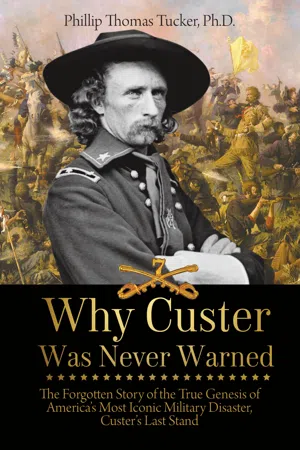
Why Custer Was Never Warned
The Forgotten Story of the True Genesis of America's Most Iconic Military Disaster, Custer's Last Stand
- 240 pages
- English
- ePUB (mobile friendly)
- Available on iOS & Android
eBook - ePub
Why Custer Was Never Warned
The Forgotten Story of the True Genesis of America's Most Iconic Military Disaster, Custer's Last Stand
About this book
Information
Topic
StoriaChapter I
The Emboldened Sioux and Cheyenne

On May 17, 1876, Lieutenant Colonel George Armstrong Custer and his famed 7th Cavalry rode out of Fort Abraham Lincoln, Dakota Territory, with confidence for an easy success in a new campaign against the defiant Sioux. These troopers, including a good many recent immigrants, could not imagine that this ambitious expedition headed deep into the heart of Indian country of the remote Montana Territory would be the last for so many of these young men and boys of the 7th Cavalry. With colorful battle-flags flying in the Dakota sunlight of mid-May and a resplendent Custer leading the way while mounted on his favorite war horse, the 7th Cavalry troopers rode toward a rendezvous with disaster along the Little Bighorn River.
The tragedies and pathos of “Custer’s Last Stand” and how one of America’s national heroes met a tragic end on a barren hillside in the remote Montana Territory have been long immortalized in the annals of American history. The saga of “Custer’s Last Stand” has become one of America’s most iconic stories, because it was an unprecedented disaster that no one expected and Custer had been a national hero since the Civil War, when this young, dashing cavalier and “boy general” had captured the imagination of the American public. At the time that he was killed, Custer symbolized America’s expansion westward to an entire generation of Americans.
What has not become so well known to the American public and historians was the fact that Custer and his immediate command might well have been saved from annihilation by relatively easy means and only minimal effort. It was not just a cruel fate that drew Custer and his men like a magnet toward their ultimate destruction at the hands of a larger number of Cheyenne and Sioux warriors than they had ever seen before. Instead, the disaster was due primarily to the considerable failings and miscalculations of the campaign’s primary architects at headquarters: America’s leading officers, including the most respected, Generals William Tecumseh Sherman, the United States Army’s commander, and Philip Henry Sheridan, Sherman’s trusty right arm, and their top lieutenants, including General George Crook. They cunningly manufactured a war because the tribes had not met (as planned) an unrealistic deadline to return to the reservations when it was impossible to do so because of an impossible deadline. It was left to Custer and his men to fulfil the cynical ambitions of corrupt leaders at the highest levels.
How easily Custer and his command could have been warned and saved is the most forgotten story about the hidden history of this famous 1876 Sioux Campaign that resulted in the deaths of more than 200 members of the 7th Cavalry on a hot June afternoon deep in the Montana Territory.
Perhaps no one was more deserving of blame in setting the stage for this monumental fiasco on June 25 than General George Crook, who had graduated from West Point in 1852. Ironically, he possessed the reputation as one of America’s greatest Indian fighters, but he was more responsible for the Little Bighorn defeat than the traditional scapegoat, Custer. Crook’s key actions that paved the way for the Little Bighorn disaster has been part of the hidden history of “Custer’s Last Stand.” Despite commanding the largest column in the campaign, the general failed miserably to live-up to this lofty reputation as a capable general, not to mention a great Indian fighter, which was his popular image, though it was based more on hype than reality, as fully demonstrated in June 1876.
In advancing north since May 29 with his Wyoming column from Fort Fetterman in the southeast region of the Wyoming Territory, and in his over-eagerness to win a great victory to catapult his name into newspaper headlines across America, General Crook hoped to deliver a surprise attack on a reported Sioux village under Sitting Bull that was thought to be in the upper reaches of the Rosebud River (also known as Rosebud Creek). Though he advanced his “fighting column” on the previous day (June 16) from his main camp on the south fork of Goose Creek (where the wagons and supplies were left behind) just over 200 miles northwest of Fort Fetterman, he failed to find the Indians. Instead in a preemptive strike before Crook could unleash his planned June 18 morning attack on the village that allegedly was located on the Rosebud but has since moved west to the Little Bighorn Valley, the Sioux and Cheyenne rode forth from their village located to the northwest and west of the ridge that separated the Little Bighorn and Rosebud River Valleys managed not only to find him, but to surprise him on the upper reaches of the Rosebud River. Crook’s plan was to strike a blow to the village reportedly on the Rosebud from the south, but instead he was struck on mid-morning of June 17 by the Sioux and their Cheyenne allies in a spoiling attack. After attacking the village and reaping a success, Crook then planned to continue north to join the northern column.
Worst of all, this highly-respected general never fully recovered from the surprise attack. After suffering a sharp setback but only light losses at the battle of the Rosebud, he then failed to perform his fundamental assignment as expected by Generals Sherman and Sheridan to continue advancing north in order to close the vise on the Indians from the south. Crook’s southern column was to have held the Indians in place so that the hammer, Custer and his 7th Cavalry of the northern column under General Alfred H. Terry, would be able to deliver a crushing blow.
Low of ammunition and supplies after the fight on the Rosebud, Crook could have retired a short distance and remained in an advanced position, while sending a detail to bring up supplies from Goose Creek in order to continue to advance north. But most of all, Crook actually possessed more reason to continue north down the Rosebud River Valley to link with Terry to most easily solve his logistical limitations, because he could gain ample supplies and ammunition from the northern column that was logistically supported by the steamboat Far West on the Yellowstone.
However, after having been caught by surprise, Crook was left thoroughly shaken by the Sioux and Cheyenne attack, which was led by the most formidable Sioux chief, Crazy Horse, when he had unwisely stopped his march in a vulnerable location of the low-lying river valley of the Rosebud surrounded by high hills. Worst of all, he dismissed a timely warning from his large number of Indian scouts who had been dispatched ahead and on the flanks for protection; instead, Crook merely assumed that the sighted Sioux were nothing more than a small hunting party in pursuit of buffalo. He was entirely wrong. Around 8:00 a.m., General Crook made the mistake of ordering his men to rest, eat a late breakfast, unsaddle their horses, and then allowed the animals time to graze among the lush grasslands filling the picturesque river bottom. Crook was focused on resting his men in preparation for the attack on the village now that he believed he was well within range of Sitting Bull’s encampment that was allegedly located on the Rosebud.
Ironically, by ignoring the warnings from his own Shoshone and Crow scouts and remaining overly-focused on the upcoming attack on the village, Crook set the tactical stage for his own defeat. Having pushed ahead and deeper into a pristine buffalo country in his eagerness to strike Sitting Bull’s village, he had advanced to the headwaters of the Rosebud in overconfidence—ironically, swollen by having so many invaluable Indian allies with him—without his reserves of ammunition. They had only what horses could carry, yet he still decided to camp in a vulnerable location in the picturesque valley, creating a perfect tactical situation for Crazy Horse to strike.
When Crazy Horse struck, he hit hard and skillfully employed clever military tactics. However, the tribes’ aggression led Crook to the mistaken belief that this was a preemptive strike to protect their village, which had just moved west to the Little Bighorn River Valley, the opposite of the true situation. Therefore, he attempted to push Crazy Horse’s warriors aside in preparation to charge the presumed location of Sitting Bull’s village, which was not actually situated where Crook believed it to be. Close-range combat ensued on both sides of the Rosebud and on the commanding hilltops as Crook realized that he had met his match, thanks to the Indians’ aggressive tactics and the blazing of so many repeating rifles that his own troops lacked. Crook believed that he was fighting the entire Sioux nation, when in fact, the Sioux and Cheyenne attackers were only an independent war party that had ridden forth from the main Sitting Bull village to the northwest. With pressure growing, therefore, Crook had ordered his men to fight defensively early in the battle, sacrificing the initiative. This premature decision only emboldened the Indian warriors who viewed any withdrawal of the bluecoats as a tactical opportunity to be exploited. When Crook repositioned his men for a concentrated strike on the village, the Sioux believed that it was a retreat, which caused them to advance and hit even harder. Quite simply, it seems as though General Crook lost his nerve during the battle, especially after his horse was shot right from under him.
After having been chastised to his utter shock on the upper reaches of the Rosebud, Crook employed the excuse that the targeted village had now moved beyond striking distance and quickly returned to his Goose Creek (a tributary of the Tongue River) encampment more than forty miles to the south. He then promptly exited the campaign for an extended period on the flimsy excuse that his small number of wounded men needed to be taken rearward. It was a mere handful of wounded, and less than 10 of his men were killed in the battle, certainly not a sufficient number to warrant withdrawing all the way back to the Wyoming Territory. In keeping with a self-serving style that had played a large part in manufacturing his Indian fighter reputation, Crook attempted to portray the battle of the Rosebud as a victory.
Most unfortunately for Custer and his men, Crook decided on his own to abandon the campaign (along with the 7th Cavalry and the rest of the northern column), despite having the largest force in the field, a sizeable southern column from the Wyoming Territory. Even more, he was the one man in America who possessed the opportunity and authority to have dispatched a timely warning to the northern column under General Terry and Lieutenant Colonel Custer. After having met his match among the pristine hills at the Rosebud’s headwaters, not a single Indian scout or white scout was sent by Crook, some of whom were the best white, Indian (Shoshone and Crow) and mixed raced scouts and guides in the service. No one in Crook’s large command was ordered to ride the relatively short distance north and down the Rosebud Valley in an attempt to warn Custer and his men. Consequently, the troopers of the 7th Cavalry, General Terry’s advance strike force that was later dispatched south before the main column, would shortly be literally riding to their deaths in total ignorance of what awaited them.
During an ambitious campaign in which separate columns had been designated to act together in a coordinated fashion, the key requirement for communications to have been maintained between separate forces and the relaying of intelligence about the most recent developments was vital not only for success, but also necessary to avoid disaster. General Crook thought otherwise about how to conduct this campaign, making no attempt to communicate with the northern column after his June 17 setback along the Rosebud.
Quite simply, there was absolutely no excuse for Crook to have not even attempted to send word of the Indian’s greatly increased strength and new aggressiveness to the northern column. This was a most ironic failure because Crook’s large number of Indian scouts—more than 200—were experienced Crow and Shoshone warriors, and his white scouts were western frontiersmen, including dark-skinned Frank Grouard, who dressed like an Indian wore his hair long and “braided” like a Sioux warrior. They all knew this territory along the Rosebud and all the way to the Yellowstone well. All in all by riding down the Rosebud Valley toward the Yellowstone, a good many members of Crook’s column could have reached the Terry-Custer column in relatively short time with the most valuable intelligence about their opponent’s new combat prowess and lethality, if they had been only ordered by Crook to do so.
A Soldier’s Wife’s Intuition
Sensing that this far-flung, but overly-optimistic campaign was soon going all wrong, which was certainly the case, one increasingly distraught woman at Fort Abraham Lincoln had attempted to sound a warning in order to save the 7th Cavalry, which continued to push ever-deeper into the heart of Indian country once unleashed from Terry’s column. She had good reason for her growing concerns because her own husband was leading the way for the Dakota column farther into the Montana Territory. Worried that her thirty-six-year-old husband “Autie” and his men were about to meet with disaster in the remote region below the Yellowstone River so far from their home base of Fort Abraham Lincoln along the Missouri River, Elizabeth “Libbie” Page Bacon Custer wrote a letter to her soldier-husband in urgent haste, before it was too late.
In the Dakota Territory in late June, she penned a frantic warning that never reached Custer since by then he was on the grueling campaign that took him and his troopers more than 400 miles to the southwest, deep in the Montana Territory. Not paying attention to some newspapers that trumpeted Crook’s fight as a victory, Libbie had learned the shocking truth. A telegram had arrived at the fort on June 22, which told of Crook’s June 17 fight on the Rosebud, just southeast of where her husband was destined to meet his final end along the Little Bighorn, a tributary of the Bighorn River to the west, more than a week later.
Libbie’s excessive concerns were fully justified because Crook had been defeated by the same leader, Crazy Horse, his Sioux warriors and their Cheyenne allies, and they would shortly destroy her husband and his men in systematic fashion, simply by employing the same winning formula: an unprecedented fighting spirit, superior numbers and modern weaponry. Most importantly, in overall strategic terms, Crook’s defeat ordained that his southern column would never unite with General Terry and his northern column as planned. What she did not know was that Custer was fated to never receive any warnings from Crook, whose large column stopped moving north on the Rosebud and then turned back to where it had come in the far-away Wyoming Territory. Thus, an overconfident Custer and his troopers rode to their doom in total ignorance of the true tactical situation. A far more powerful opponent now lay before Custer than anyone imaged, not what he had been led to believe by headquarters—who had not been updated by Crook either. These were the harsh realities of the most recent developments in Indian country that Crook had learned first-hand in the June 17 fighting at the Rosebud.
After having narrowly escaped disaster at the battle of the Rosebud, despite commanding the “best” and strongest column of the 1876 Campaign, Crook realized that it was only a matter of time before his old arch-rival Custer, the spearhead of Terry’s column, faced the greatest concentration of Sioux and Cheyenne warriors. What was clear was that the warriors now possessed a new determination, if not fanaticism, to defend their ancestral homeland and way-of-life. Hundreds of these veteran Indian warriors demonstrated at their Rosebud victory that they were now fighting in the same tactical manner of white professional soldiers, including flank and rear attacks in bold tactical attempts to encircle Crook’s command and ensure its destruction, boding ill for Custer and his men eight days later. As Crook learned, these seasoned fighters and lifelong hunters were now more formidable than ever before because they were armed with far more of the most modern and fastest-firing weapons than anyone in a blue uniform imagined possible, the Winchester and Henry Repeating Rifles. These fast-firing weapons were vastly superior to the single-shot carbines that the government had issued to the now outgunned troopers, who were now at a considerable disadvantage in consequence. Quite simply, the Native American warriors had won the arms race in stealthy fashion.
Overwhelmed with a dark sense of impending doom from the increasingly-tense atmosphere of Fort Abraham Lincoln where she and over nervous army wives had watched their husbands, friends, and relatives of the 7th Cavalry ride away just over a month before, Elizabeth (Libbie) Page Bacon Custer felt an inordinate amount of anxiety. Libbie’s concern only continued to grow, seemingly with each passing day. The stunning news of Crook’s fight on June 17 revealed to her that her worst fears were valid. Astounded by the fast-paced and shocking developments in the far-away Montana Territory, she wrote prophetically to Custer in her letter, “I cannot but feel the greatest apprehensions for you on this dangerous scout. Oh, Autie … the papers told last night of a small skirmish between General Crook’s Cavalry and the Indians [in the Montana Territory]. They called it a fight. The Indians were very bold. They don’t seem afraid of anything” (Merington 1950, 303).
But Libbie did not know even half of the truth about the ugly realities and hard truths of the battle of the Rosebud on June 17. One of General Crook’s Indian scouts knew intimately of the defeat during which he had barely survived the wrath of the ancestral enemies of his people. He was a high-ranking Crow named Plenty Coups, who had been born in the Montana Territory when the white threat had been far away. Motivated to fight to the death, in his own words, Plenty Coups knew Custer by the name of “Son-of-the-morning-star,” and Crook as “Three-stars.” Like many of his fellow warriors, he served Crook because “he had many soldiers and with them we shall whip our old enemies [and] this is a fight for future peace” (as quoted in Linderman 1962, 124, 153–155). He was shocked by what had happened at the Rosebud’s headwaters on that hot Saturday in June, when some “of the most reckless feats of equestrianism imaginable were performed by” the Sioux and Cheyenne warriors, wrote reporter Robert F. Strahorn, in the July 5, 1876 issue of the Weekly Rocky Mountain News, Denver, Colorado. Plenty Coups, warrior-scout of the Crow Mountain band who still “hated the Sioux,” because in the past they “had kept pushing us [the Crow] back, away from the Black Hills,” emphasized the undeniable truth about the battle of the Rosebud: “we all got whipped good on the Rosebud” (Linderman 1962, 49, 153–154, 160).
Indeed, Crook’s confidence about what he assumed would be an easy success over the Sioux was shaken to the core by what happened along the Rosebud on June 17, after having been caught by surprise by swarms of attackers. Perhaps messenger Ben Arnold, who was in the midst of the hard-fought battle, said it best in regard to exactly why the general had lost his nerve on June 17, that a rattled “Crook thought he had met the whole Sioux nation, but as a matter of fact it was only a hunting [war] party of Sioux and Cheyenne numbering four or five hundred lodges, under the distinguished chief, Crazy Horse” (as quoted in Crawford 1999, 250). Impressed by the audacious courage of the Sioux and Cheyenne fighting men, scout Ben Arnold admitted how such demonstrations of bravery stunned the bluecoats and inspired the Indians to win the victory.
Despite little basis to support such convictions that revealed the extent of his hubris, General Crook had even believed that the Sioux, the largest and most fierce hostile tribe on the Northern Great Plains, would be easier to conquer than the far less numerous Apache, who he had subdued in Arizona. Therefore, his large ego and bloated sense of accomplishment had been badly bruised at the Rosebud, which was a greater psychological blow than the physical damage inflicted by the warriors. For him, it was the bursting of an inflated bubble and extreme humiliation at the hands of Indian opponents. This humbling experience for a West Pointer and decorated Civil War veteran caused him to realize that he was way in over his head. During the lengthy battle that consumed most of the day, thi...
Table of contents
- Cover Page
- Half Title
- Full Title
- Copyright
- Table of Contents
- Introduction
- Chapter I - The Emboldened Sioux and Cheyenne
- Chapter II - Custer’s Confidence Stemming From His Ignorance of Harsh Realities Led Him to His Doom
- Chapter III - The Great Massing of Weaponry and Massive Numbers of Warriors
- Chapter IV - Fatal Showdown at the Little Bighorn
- Conclusion
- References
Trusted by 375,005 students
Access to over 1.5 million titles for a fair monthly price.
Study more efficiently using our study tools.
Frequently asked questions
Yes, you can cancel anytime from the Subscription tab in your account settings on the Perlego website. Your subscription will stay active until the end of your current billing period. Learn how to cancel your subscription
No, books cannot be downloaded as external files, such as PDFs, for use outside of Perlego. However, you can download books within the Perlego app for offline reading on mobile or tablet. Learn how to download books offline
Perlego offers two plans: Essential and Complete
- Essential is ideal for learners and professionals who enjoy exploring a wide range of subjects. Access the Essential Library with 800,000+ trusted titles and best-sellers across business, personal growth, and the humanities. Includes unlimited reading time and Standard Read Aloud voice.
- Complete: Perfect for advanced learners and researchers needing full, unrestricted access. Unlock 1.5M+ books across hundreds of subjects, including academic and specialized titles. The Complete Plan also includes advanced features like Premium Read Aloud and Research Assistant.
We are an online textbook subscription service, where you can get access to an entire online library for less than the price of a single book per month. With over 1.5 million books across 990+ topics, we’ve got you covered! Learn about our mission
Look out for the read-aloud symbol on your next book to see if you can listen to it. The read-aloud tool reads text aloud for you, highlighting the text as it is being read. You can pause it, speed it up and slow it down. Learn more about Read Aloud
Yes! You can use the Perlego app on both iOS and Android devices to read anytime, anywhere — even offline. Perfect for commutes or when you’re on the go.
Please note we cannot support devices running on iOS 13 and Android 7 or earlier. Learn more about using the app
Please note we cannot support devices running on iOS 13 and Android 7 or earlier. Learn more about using the app
Yes, you can access Why Custer Was Never Warned by Phillip Thomas Tucker in PDF and/or ePUB format, as well as other popular books in Storia & Storia della guerra civile americana. We have over 1.5 million books available in our catalogue for you to explore.