This book focuses on the events that took place in late 1944 and 1945 in Croatia and Slovenia when the intensity of violence was strongest. At that time, the Communist Party of Yugoslavia (KPJ), assisted by the People's Liberation Army of Yugoslavia, the Yugoslav Army, the Department for the Protection of the People (OZNA) and the Corps of People's Defence of Yugoslavia (KNOJ) conducted organized terror not only by intimidation, persecution, torture and imprisonment, but also by the execution of a large number of citizens perceived by the KPJ as disloyal, passive, ideological enemies or class enemies. However, investigating war and post-war crimes committed by communist regime was not possible until 1990, after the democratic changes in Yugoslavia. This book is based on documents kept in the archives of Croatia, Slovenia, the UK, and Serbia. Many of them, especially those in Croatia, recently became available to the public, which makes them extremely valuable source of data to the academics and students in this field and which shed new light on these historical events.°The Communist Party in the former Yugoslavia was an organization which used all available means to seize and keep power, including terror and mass murder, especially between autumn 1944 and summer 1945 when mass killings occurred across the country. However, in the Soviet sphere of influence, investigating war and post-war crimes committed by communist regimes was not possible until 1990. This project not only covers new ground in the research into communist war crimes at the end of and after the Second World War, but also contributes to coming to terms with the past in the successor states of Yugoslavia by studying one of the most controversial episodes in the contemporary history of the Balkans.°Since the October Revolution, when for the first time in history a Marxist party seized state power, communist regimes have influenced the lives of more than a billion people, caused millions of deaths and violated the human rights of countless people. However, in the Soviet sphere of influence and in Yugoslavia, investigating war and post-war crimes committed by communist regimes was not possible until 1990, after the democratic changes in Eastern Europe. Resolution 1481/2006 of the Council of Europe Parliamentary Assembly strongly condemned human rights violations committed by totalitarian communist regimes and the 2008 Prague Declaration on European Conscience and Communism stated that these crimes were comparable with Nazi crimes but, very few people have been tried for committing such crimes. Nevertheless, 25 years later, in former Yugoslav republics this topic is still a matter of political and scientific debates.
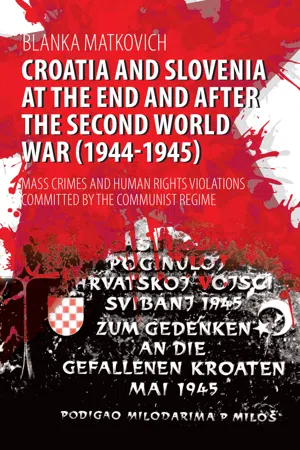
eBook - ePub
Croatia and Slovenia at the End and After the Second World War (1944-1945)
Mass Crimes and Human Rights Violations Committed by the Communist Regime
- 224 pages
- English
- ePUB (mobile friendly)
- Available on iOS & Android
eBook - ePub
Croatia and Slovenia at the End and After the Second World War (1944-1945)
Mass Crimes and Human Rights Violations Committed by the Communist Regime
About this book
Trusted by 375,005 students
Access to over 1.5 million titles for a fair monthly price.
Study more efficiently using our study tools.
Information
Subtopic
Baltic HistoryCHAPTER TWO
YUGOSLAVIA AND THE COMMUNIST PARTISAN MOVEMENT IN THE SECOND WORLD WAR (1941–1944)
In the 20th century, two Yugoslav states were established, but none of them survived long enough to solve the internal problems and meet expectations of their nations.1 The first one—the Kingdom of Serbs, Croats, and Slovenes, was created in December 1918, and in 1929 it was renamed the Kingdom of Yugoslavia. As Naimark states, it was fatally flawed from the moment of its birth.2 The first Yugoslavia was basically an extension of the Serbian state and Serbs controlled all visible levers of force and power. Combined with an ideology of a unitary state and centralized governance, the reliance on the foundations of the pre-war Serbian state was a recipe for Serbian dominance.3 ‘Interwar Serbian domination’, writes Gale Stokes, ‘proved that Yugoslavia would remain unstable unless the issue of equity was squarely faced’.4 Some historians believe that the first serious attempt to balance Croat and Serb interests, the Cvetković-Maček Agreement of 1939 which ceded to Zagreb a variety of budgetary and administrative powers, might have saved Yugoslavia from destruction if the war had not quickly followed.5 However, as Ivo Banac concluded, the Agreement itself contained the seeds of future conflict by including large Serb and Muslim minorities in the newly created Banovina of Croatia.6
The Agreement was signed only several days before the Second World War broke out and while the rest of Europe was already at war; Yugoslavia was struggling with the attempt of reorganization and federalisation which was interrupted in spring 1941. After being pressured by the Germans, on 25 March 1941 Dragiša Cvetković, the Yugoslav Prime Minister, signed the Tripartite Pact in Vienna. However, only two days later the regime was overthrown by a military coup d’état with the support of the British SOE in Belgrade, and the 17-year old King Petar II seized power.7 General Dušan Simović became the new Prime Minister and he tried to assure Germany that the new government would adhere to the Pact. Nonetheless, Hitler decided to invade Yugoslavia stating that the ‘military Putsch in Yugoslavia has changed the political situation in the Balkans’ and on 6 April the German Luftwaffe bombed Belgrade killing over 5,000 civilians.8 The invasion, also known as the April War or Operation 25, showed how fragile the kingdom really was and the Royal Yugoslav Army surrendered unconditionally after only ten days. Meanwhile, Petar II went with his government to Greece, then to Jerusalem and to Cairo. In June 1941, he moved to the United Kingdom where he completed his education at Cambridge and later joined the Royal Air Force (RAF). The Government-in-Exile (in London) was only recognised by the Allied powers and it existed until 29 November 1945 when Petar II was deposed by the Yugoslav Constituent Assembly.
Yugoslav territory was partitioned between Germany, Italy, Hungary and Bulgaria. On the larger part of the Croatian and Bosnian territory the NDH led by Ante Pavelić and the Ustasha movement was established on 10 April 1941. In reality, it was divided into an Italian sphere of interest and a German occupation zone. In the areas under Italian control, such as the ones in Dalmatia and Istria, the Ustasha’s power was restricted and these regions were controlled by the 228,845-strong Italian Army.9
Despite the presence of foreign armies on Yugoslav territory, there was no organized resistance from the moment the invasion took place until 22 June 1941. The Soviets had been preparing the communists for a guerrilla war in Yugoslavia during the 1930s and hundreds of future prominent Yugoslav communist leaders completed special ‘Partisan courses’ organized by the Soviet military intelligence in the Soviet Union and in Spain.10 At the outset of the Second World War, the Party had 3,500 members along with another 3,500 well organized members of the League of Communist Youth of Yugoslavia (abbreviated SKOJ—Savez komunističke omladine Jugoslavije) out of a total population of around 16 million. In 1939, the KPJ declared itself neutral stating that ‘German fascism has been compelled to capitulate before the strength of victorious socialism, the USSR, and to conclude a non-aggression pact with it’. Moreover, ‘the Soviet Union…will never go to war for any imperialist interest, nor force the working masses of any other country to fight for such interests.’11
However, many party members condemned the Soviet invasion of Poland and the attack on Finland. Some left the KPJ while others were expelled. In 1940, the KPJ was cleansed and ‘the factions had been defeated’.12 Moreover, the 5th KPJ Conference, held in Zagreb in October 1940, denounced the Axis powers and the Western democracies as equally responsible for the ‘imperialist war’ emphasizing that the English and French ‘imperialists’ unleashed the conflagration of war ‘in order to defend their own colonial dominions and hegemony’ and that they ‘have been doing everything through their different machinations to draw the Soviet Union into the war’.13 On 5 April 1941, the Soviet Union signed a Friendship and Non-Aggression Pact with Yugoslavia.14 The German attack on Belgrade found the local communist leaders busily preparing popular rallies to celebrate the conclusion of the new alliance.15 On 6 April 1941, Pravda concluded that the Pact ‘denotes the common efforts of the USSR and Yugoslavia for strengthening the peace and preventing the spread of war’.16
In 1941, the KPJ took over the leadership of the resistance movement, but not before Hitler invaded the Soviet Union and ended the Molotov-Ribbentrop Pact, signed in August 1939. That same day, 22 June 1941, the Comintern ordered the KPJ to organize resistance to the occupation stating that ‘Germany’s treacherous attack on the USSR is not only a blow against the land of socialism, but also against the freedom and independence of all peoples’ and that ‘it is essential to take all measures to support and facilitate the rightful struggle of the Soviet people’. However, ‘bear in mind that, at this present stage, what you are concerned with is liberation from fascist oppression, and not socialist revolution’, cautioned the Directive.17 Roberts underlines that, although the KPJ did not rise against the Axis, it did make preparations for war because it knew from various sources that Germany would attack the Soviet Union, and Tito actually believed these reports more than Stalin.18 The remark about ‘liberation’ instead of ‘socialist revolution’ meant that the task of the preservation of Communist power in the Soviet Union was to be given precedence and the main goal was to relieve pressure on the Soviet front.19
Vodušek Starič emphasizes that many non-communists refused to cooperate after the KPJ declined to allow the resistance to become a proper coalition of all political groups which already had joined the resistance movement.20 They were labelled as ‘white guardists’ (Catholics), ‘blue guardists’ (those loyal to the Yugoslav Royal Government-in-Exile), ‘reactionaries’ and ‘fifth columnists’. Very soon the Communists declared them ‘traitors of the people’ and thus subject to punishment, including execution.21 Therefore, it can be concluded that ‘socialist revolution’ was very much in the mind of the KPJ despite the directive from Moscow. In March 1942, the Comintern informed Tito that there is an ‘impression that the adherents of Great Britain and the Yugoslav government have some [justification] in suspecting the Partisan movement of acquiring a communist character, and aiming at the sovietization of Yugoslavia’ and asked why, for example, it was necessary to form a special Proletarian Brigade. ‘Are there really no other Yugoslav patriots—apart from communists and communist sympathizers—with whom you could join in a common struggle against the invaders?’, questioned the Comintern Tito’s approach.22 To this criticism Tito reacted explaining that ‘the proletarian brigades are not fighting for sovietisation, but their heroism is an example to our people how to fight…for one’s freedom and independence’.23
Beginning with the uprising in Croatia in June 1941, there was continuous resistance to the Axis armies in Yugoslavia. However, the exact date of the uprising was a matter of debates. Following the decision of the District Committee of the Communist Party of Croatia, the Sisak People’s Liberation Partisan Detachment, also known as the 1st Sisak Partisan Detachment, was founded in the Brezovica forest near Sisak, Croatia, on 22 June 1941.24 That unit was the first armed anti-fascist resistance unit in Yugoslavia and therefore, that event marked the beginning of armed resistance although the Supreme Headquarters of the National Liberation Partisan Detachments of Yugoslavia (abbreviated NOPOJ—Narodnooslobodilački partizanski odredi Jugoslavije) was established on 27 June 1941. Therefore, events that took place on 22 June 1941 were ignored in official Yugoslav historiography.25 That does not surprise given the fact that it happened before the Comintern ordered the organization of the Partisan detachments and the beginning of their actions in early July 1941.26
Today, 22 June is commemorated in Croatia every year as a public holiday called Day of the Anti-Fascist Struggle. However, in the former Yugoslavia another date was celebrated as the Day of the Uprising of the Peoples of Croatia. It was 27 July 1941 when guerrilla units from Donji Lapac, Croatia, carried out attacks on the police station in Srb, demolished the railway between Knin-Drvar and executed the Ustasha detachment near Srpski Klanac. These attacks followed the decision...
Table of contents
- Cover Page
- Half Title
- Full Title
- Copyright
- Contents
- Acknowledgements
- Abstract
- Abbreviations
- 2 - Yugoslavia and the Communist Partisan Movement in the Second World War (1941–1944)
- Bibliography
Frequently asked questions
Yes, you can cancel anytime from the Subscription tab in your account settings on the Perlego website. Your subscription will stay active until the end of your current billing period. Learn how to cancel your subscription
No, books cannot be downloaded as external files, such as PDFs, for use outside of Perlego. However, you can download books within the Perlego app for offline reading on mobile or tablet. Learn how to download books offline
We are an online textbook subscription service, where you can get access to an entire online library for less than the price of a single book per month. With over 1.5 million books across 990+ topics, we’ve got you covered! Learn about our mission
Look out for the read-aloud symbol on your next book to see if you can listen to it. The read-aloud tool reads text aloud for you, highlighting the text as it is being read. You can pause it, speed it up and slow it down. Learn more about Read Aloud
Yes! You can use the Perlego app on both iOS and Android devices to read anytime, anywhere — even offline. Perfect for commutes or when you’re on the go.
Please note we cannot support devices running on iOS 13 and Android 7 or earlier. Learn more about using the app
Please note we cannot support devices running on iOS 13 and Android 7 or earlier. Learn more about using the app
Yes, you can access Croatia and Slovenia at the End and After the Second World War (1944-1945) by Blanka Matkovich in PDF and/or ePUB format, as well as other popular books in Politics & International Relations & Baltic History. We have over 1.5 million books available in our catalogue for you to explore.