The book revives literary theory, which was popular at the end of the 20th century, with the purpose of showing how useful it is in the current century in opening the minds of students to the dangers of claiming to have a fixed identity. The book shows that in Western cultures identity is a construct that always sees individuals as lacking something (being fallen) that can be retrieved or gained at the expense of an Other, an adversary seen as standing in the way of identity fulfillment. The book shows the history of "fallenness" through an analysis of Melville's Billy Budd, Faulkner's Absalom, Absalom!, Pynchon's The Crying of Lot 49. It also shows ways to heal identity through an analysis of Toni Morrison's Beloved and Rudolfo Anaya's Tortuga.
eBook - ePub
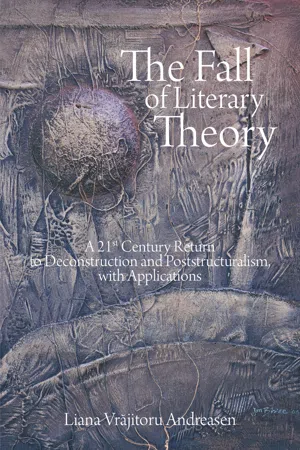
The Fall of Literary Theory
A 21st Century Return to Deconstruction and Poststructuralism, with Applications
- 264 pages
- English
- ePUB (mobile friendly)
- Available on iOS & Android
eBook - ePub
The Fall of Literary Theory
A 21st Century Return to Deconstruction and Poststructuralism, with Applications
About this book
Information
Subtopic
Literary CriticismIndex
LiteraturePART I
BRINGING BACK THEORY
INTRODUCTION
WHERE HAS THEORY GONE?
In times of confusion, people want answers and seek comfort in the strength of conviction. Whenever there is uncertainty and a shift in the precarious balance of power, there are many who will embrace those with the strongest statement. It is no wonder that, along with the advance of new ideas, there is a parallel stream of terrified people swimming against the current and trying to hold on to their respective versions of social values. They conjure, mostly from an idealized past, their preferred methods of re-centering the axis mundi, or rather a retroactively-proclaimed golden age that would turn back the clock and erase the confusion brought by change. In the United States, “Make America great again”—the campaign catchphrase that, no doubt, had some contribution to Donald Trump winning the electoral vote in 2016—reassured a lot of people that the center can push back the racial, gender-based, or other threats. At the dawn of the 21st century, such threats have been edging closer with the advent of a black presidency, or the legalization of gay marriage, among other manifestations of the unrelenting need for change. In every age, power pushes back when the disempowered take steps toward that mythical center, and the tug-of-war, just like earthquakes, exposes fault lines of absolutist thought.
The fault lines need to be turned into momentum, or else when the quaking subsides a new “greatness” emerges, resurrected from the past, congealing power anew in its appearance of absolute stability. After, say, an event such as Vietnam, once the fault lines of imperialistic ideology were forgotten, it was easy to plunge the country into other unjustifiable wars, such as the post-9/11 wars targeting questionably defined enemies in the name of re-stabilizing Western values.
Who, one may ask, is responsible with exposing the fault lines? Who makes sure the center does not recoil and regain its appearance of eternal stability? In the 60s, the academia managed to shift from the dry terrain of abstract dialectics and various philosophical critiques of idealism to a more practical incarnation that broadly gained the name “theory.” Drawing from psycho- and socio-linguistics and earning legitimacy through applications in literary analysis, “theory” quickly spilled over into the streets, with Jacques Derrida marching along with the hippies and demanding the de-centering, de-construction of traditional structures of power. The fault lines, or rather, the cracks that expose the constructed nature of power have always been there in one form or another, and people are quick to cover them up if the change seems too abrupt. In the middle of the second decade of the new millennium, many rushed to embrace the phrase “Make America great again” because it is frightening to think the center is unstable. A sweeping, purist, idealistic phrase such as “great again” implies both the fear of being insignificant (falling from an assumed former greatness), and the belief that the past holds the key to regaining significance. I have no doubt that, if society today seems in danger of becoming too certain of its center again, “theory” can be useful once more (after falling into a slight disgrace), as it was in the 60s and 70s, as the tool for exposing the constructed—and violent—nature of power.
At the height of its popularity, literary theory, or criticism, seemed to have taken over English departments to the chagrin of those who believed it to be a fad. Poststructuralism was expanding in different fields, shattering walls and causing confusion, while its close kin, deconstruction, was the ultimate test for true scholarship: does one, or does one not “understand” it? Is one able to talk about diffèrance, phallogocentrism, and signifiers in academic circles, as well as at the bar where all graduate students congregate? Yet “theory” was all but abandoned and almost everyone was quick to disavow it before the cock crew thrice: 9/11 happened and “proved” that the world is still structured in binaries of good and evil; then Jacques Derrida died in 2004 and apparently he was resurrected as a philosopher, so literary studies could breathe a sigh of relief, and then English and American departments rushed to embrace the much more reasonable, practical teaching of paper-writing as a disembodied skill without content that can be quantified and assessed without the need, even, for human interaction.
In other words, we have fallen from theory, or theory itself has been exposed as a fallen, failed project dripping with nihilistic relativism. Or so we have been led to believe by the more vocal detractors. Even in the late 80s and in the 90s, when theory was the golden child of literary studies, there was a lot of resentment due to the imposition of unreadable essays and books in the analysis of literary texts, seemingly rendering them meaningless and a free for all of interpretation. In Against Deconstruction, known detractor of Derrida, John M. Ellis, was bent on proving that deconstruction is needlessly complicated, and what its obscure language hides is that, in fact, it offers no new idea: instead of dismantling Saussure’s ethnocentrism, for example, it reasserts it. Following Ellis, Denis Dutton was “debunking” deconstruction, as if it were simply a pesky conspiracy theory with the sole purpose of creating books, and books about books.
In more conservative circles, such as in the words of British professor of Aesthetics, Roger Scruton, “Derridizing a text” turns readers away from the meaning of a text and imposes a sort of metalinguistic dictatorship, by virtue of the fact that, apparently, deconstruction is closely related to other words that start with de-: decrepitude, depravity, derision, destruction. That was written back in 1993. Terry Eagleton has long mocked postmodernism and deconstruction in particular for being deluded enough to believe they could “crack” the tyranny of social totality. In fact, Eagleton claims, the theorists themselves have been inside that totality all along, but in their comfortable chairs in Ithaca or Irvine, where they could afford to be “deliciously indeterminate” without really having much to offer. In the end, he dismisses it as methodologically incoherent and even dangerous to literary studies, as it encourages dilettantism for the sake of trying to keep up with more legitimate studies that have true depth of knowledge.1
Sometimes, it was only hear-say that kept people away from exploring these challenges to Western thought. Various critics were making claims about the failure of poststructuralism and deconstruction without having read Jacques Lacan or Jacques Derrida, and dismissed them offhand as altogether too French for the sound American or English mind to accept. What is more, such second-hand critique of “deconstructionist” thought, as they called it, drew attention to an assumed relativism and claimed that deconstruction tried to level all values, all texts, all audiences and so forth, making them all equally meaningless.
In a book that came out in 1999, Catherine Burgass doubts that literary theory truly can (or did) have an impact on politics, and even scolds impotent (though sincere) theory for its political failures, as “there is a certain amount of bad taste in the failure to attend closely to the world outside text or conceptual structure while claiming to address its social, political or economic problems.”2 Again, the claim is that postmodern thought is too relativistic to have political power; in other words, there is no reconstruction offered after deconstruction.
Moreover, there was a real concern that deconstructing the center would only take power away from those at the margins, who would be discouraged from participating in the structure of society if they were persuaded of the arbitrary nature of power; the powerful, on the other hand, would most likely not be willing to relinquish their power. The gap between the rich and the poor, or between any other powerful/powerless pairs is not, however, caused by the skepticism of deconstruction. Contrary to some interpretations, deconstruction has never encouraged marginalized groups to give up identity (as a source of power)—a suggestion that belongs in a Buddhist temple. To be clear, while I use deconstruction’s concepts to critique deeply rooted ways to understand identity (and I add the concept of the fall, as will be seen), taking power away from the marginalized is not even remotely my purpose. The issue at stake in deconstruction (and by extension in this book) is not to see who will blink first and inadvertently let the Other grab the reins. The issue is this: the self and the Other must find ways to end the judgment of each other’s (and their own) identities for allegedly being fallen, corrupted. That judgment, I believe, is the essence of conflict, and my approach will show the process by which such judgment occurs.
Back to challenging traditional social systems, anyone who knows what deconstruction in effect deconstructs should realize that an attempt to offer a specific system in return for the one it poked holes in would amount to yet another return to the potential for systemic violence. “Changing the world” is a gross misrepresentation of the shift in mentality that is encouraged by poststructuralist thought, which can have positive effects if pursued in a subtle way and over decades. Burgass claims that what she (mistakenly) calls relativistic thought cannot work in the real world because it asks for a suspension of judgment. Not one poststructuralist thinker that I have read has asked for institutions of law and order to be taken down and everything and everyone to be declared equally valuable, never to be weighed in judgment again. The changes that a theorist would hope for are internal shifts, an internal questioning of the rationale for judgment and different, possibly new but at the very least rethought ways to interact in the world. That is not revolutionary thought, and it needn’t be seen, then, as a failure, since it has never ceased taking place, and has been taking place before it was even given a name (such as deconstruction).
Yet whatever denomination one prefers—postmodernist theory, poststructuralist analysis or deconstruction—the debunking of this line of inquiry has finally been itself debunked. As I mentioned before, one way in which deconstruction and Derrida in particular have been redeemed in academic circles was that philosophers, not English scholars, have come to the rescue. This is ironic, of course, given that Derrida himself was called a charlatan and kept away from the cookie jar philosophers were apparently hiding in the pantry. Simon Critchley, English philosopher who came to Derrida’s defense in the ‘90s, recalls the scandal that erupted when Cambridge tried to offer Derrida an honorary doctorate, and eighteen respected philosophers from all over the world signed a letter protesting this, citing his lack of clarity and rigor and likening him to the Dadaists. In the end, Cambridge did award him the doctorate, but with very few philosophers on board.3
Today, Derrida has been embraced by philosophers (when the dust settled in the departments of literary studies). David Wood places him in the long line of Platonists, and in more direct kinship with the thinkers who challenged self-identity (when it is stripped of relationality), such as Nietzsche, Heidegger or Derrida’s friend Levinas.
But this book is not about Derrida and his detractors, or the fact that now he is a “legitimate philosopher,” or even particularly about Derrida. Nor is this book an attempt (and there have been many) to give another definition to deconstruction or poststructuralism, though of course clarifications, when needed, will be offered. My first task is to ask new questions. Why, first of all, have we divorced “theory” from political action (with a sigh of relief, for some)? Why, on the other hand, are we quick to dismiss this invaluable method of thinking about texts from our English classes, where complex thought is needed? Why, also, should we accept the claim that deconstruction is a failed project and that it did not, does not, and will not ever prove of use outside of writing papers or books? Do we even understand enough what the purpose of deconstruction was to begin with, before we can claim that it has failed? To say that, if it did not trigger a clear revolution, inside or outside the university, then deconstruction did not succeed and should be left to die is to ignore the enormous outreach that the practice of poststructuralist and desconstructive analysis in the classroom has been part of, once the students have left the classroom with a new awareness of what takes place within their lives and at a global scale, I would dare say. To believe that, for example, gay marriage is just a random result of moving around justices in the Supreme Court is a willful blindness to the decades of slowly but surely challenging, in universities, the way students think. With a new set of tools (some taken directly from deconstruction) to challenge patterns of thought, students have been stepping into the real world, where undoubtedly they have made dents in deeply rooted mentalities. And I am not, again, randomly linking causes and effects just to suit an argument.
I also happen to be the product of the dissemination of poststructuralist and deconstructive ideas, as a student of a student of Derrida and having dedicated my graduate years to “theory.” I have no choice but to disseminate these ideas as I teach—it is not even because I have convinced myself that I have a doctrine to preach or because I am an idolater of Lacan and Derrida. Poststructuralist deconstruction is part of my teaching because it is now part of my thinking. This is precisely how I identify the type of impact I believe “theory” has had over a few generations already, and why literary analysis (with the help of theory) is the one bastion of de-centering thought that can never be forced to go away. It will continue to challenge power, no matter how much the funding for liberal arts studies is slashed. “Literature” is the safest way to question the world since, just as an example, the political discussion can be veiled under literary analysis, while students can safely hide behind characters, to avoid escalation during sensitive debates.
I have been teaching for over 15 years, and in all this time I have seen how the classroom offered the (mostly) safe type of environment where people were allowed to hit their own walls of prejudice, see their systemic thought mirrored in other students, dare to listen to different rationales than the ones they had come in with, and in the end, the dialogue has been changing practically before my eyes. At the college in South Texas where I teach, to continue with the convenient example of gay marriage (since it has recently won the legal debate), I have noticed the same gradual change, over the years, that the country has been noticing, until the minority became the majority and the voices of prejudice and intolerance became the exception, not the norm. I myself am the product of classrooms where I learned to deconstruct myself, most of all, and my bicultural identity. My own transformation is still spilling over into my classroom.
There should, therefore, be no question whether the theory of deconstruction or poststructuralist analysis should still be taught in literature classes or not. What should still be debated, perhaps, is how it can help cope with shifts in the political landscape and how “literature” (from the most ancient classic texts to contemporary works) can be made relevant in every new context. It would be up to the readers of this book to decide the way it should be taught, to what extent, and what can still be expected to result from the all-but-dismissed use of theory.
Aside from offering my own approach to theory through new uses of the concept of the fall, I also offer some practical applications. I will not deny that the chapters in the “Applications” section of this book may not seem very practical, as they delve quite deeply (though less abstractly, since they rely on literary texts) into the “theory” with which I challenge absolutist thought. Hopefully, at the end of the day they will show the usefulness (maybe not the easiness) of such a challenge, through a type of literary analysis that I believe can never be irrelevant.
To begin with, before we are ready to abandon concepts to competencies in literary studies and the humanities in general, we need to reexamine the purpose of reading and teaching literature to begin with. Roger Scruton would be happy to return to a formalist unfolding of meaning in front of students since, after all, a metaphor is always a metaphor. We don’t, presumably, want the poor student to wonder what kind of knowledge we possess if we can’t even pinpoint exactly where that meaning can be found, and on what page, and whether it will be on the test.
I am not merely a Derridean deconstructionist. To me, Derrida’s deconstruction is the logical conclusion of a line of thinking that began with the challenge brought to Saussurian structuralism, most notably by Lacan. Lacan’s challenge to the chain of signification and binary thought, combined with his struggle to connect the dots of signification and link them to the alienating desire for signification that founds identity, for which he found tools in Freud’s psychoanalysis, has enabled the different branches of poststructuralist thought to expand: Julia Kristeva’s injection of the feminine into the symbolic order, Jean Francois Lyotard’s interest in history as narrative of legitimation, Jean Baudrillard’s simulacra, Slavoj Žižek’s more politically charged voice as he ref...
Table of contents
- Cover Page
- Half Title
- Full Title
- Copyright
- Contents
- Acknowledgements
- Foreword
- Part I: Bringing Back Theory
- Part II: Applications (Fallenness in American Literature)
- Notes
Trusted by 375,005 students
Access to over 1.5 million titles for a fair monthly price.
Study more efficiently using our study tools.
Frequently asked questions
Yes, you can cancel anytime from the Subscription tab in your account settings on the Perlego website. Your subscription will stay active until the end of your current billing period. Learn how to cancel your subscription
No, books cannot be downloaded as external files, such as PDFs, for use outside of Perlego. However, you can download books within the Perlego app for offline reading on mobile or tablet. Learn how to download books offline
Perlego offers two plans: Essential and Complete
- Essential is ideal for learners and professionals who enjoy exploring a wide range of subjects. Access the Essential Library with 800,000+ trusted titles and best-sellers across business, personal growth, and the humanities. Includes unlimited reading time and Standard Read Aloud voice.
- Complete: Perfect for advanced learners and researchers needing full, unrestricted access. Unlock 1.5M+ books across hundreds of subjects, including academic and specialized titles. The Complete Plan also includes advanced features like Premium Read Aloud and Research Assistant.
We are an online textbook subscription service, where you can get access to an entire online library for less than the price of a single book per month. With over 1.5 million books across 990+ topics, we’ve got you covered! Learn about our mission
Look out for the read-aloud symbol on your next book to see if you can listen to it. The read-aloud tool reads text aloud for you, highlighting the text as it is being read. You can pause it, speed it up and slow it down. Learn more about Read Aloud
Yes! You can use the Perlego app on both iOS and Android devices to read anytime, anywhere — even offline. Perfect for commutes or when you’re on the go.
Please note we cannot support devices running on iOS 13 and Android 7 or earlier. Learn more about using the app
Please note we cannot support devices running on iOS 13 and Android 7 or earlier. Learn more about using the app
Yes, you can access The Fall of Literary Theory by Liana Vrajitoru Andreasen in PDF and/or ePUB format, as well as other popular books in Literature & Literary Criticism. We have over 1.5 million books available in our catalogue for you to explore.