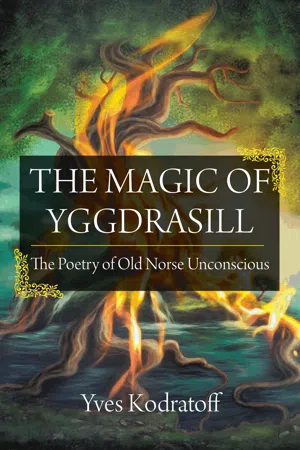
This book took its start with the author's realization that what Old Norse calls 'magic' can be understood as 'unconscious', as stated by C. G. Jung: (we find) 'magical means everything where unconscious influences are at work.' This book reveals the exi
- 204 pages
- English
- ePUB (mobile friendly)
- Available on iOS & Android
eBook - ePub
About this book
Information
Subtopic
European Literary CriticismIndex
LiteratureChapter I
Magic and Divine Beings and Heroes
This chapter deals with eight characters around which magic is gathered in the Poetic Edda:
I-1.Norns as mistresses of örlög
I-2.Yggdrasill [name of the Northern world tree] as a mjötuðr (‘measurer’)
I-3.Yggdrasill and the end of Æsir’s magic [the plural word ‘æsir’ is the name of a family of Northern gods such as Óðinn (‘Odin’), Þórr (‘Thor or Tor’), Freyja etc.]
I-3.1.The six (or seven?) occurrences of the idea of mjötuðr in Völuspá.
I-3.2.Consequence of the six first occurrences of the idea of mjötuðr in Völuspá.
I-4.Óðinn and his handling of the gender problem
I-5.Yggdrasill seen as a provider of Óðinn’s magic
I-6.Humankind’s two weaknesses: Örlöglauss ok lítt megandi
I-7.A female heroic character: Brynhildr (formerly known as Sigrdrífa)
I-8.A male heroic character: Sigurðr as his father’s avenger
I-1.Norns as örlög rulers
At first, here are a few words on the relationship between Roman Parcae and Norse Norns.
Greek mythology calls Moirai the three goddesses who spin our destiny. The word moira means someone in charge of assigning the result of a draw, an ‘allotter’ and also ‘fate’. This recalls Norse mjötuðr who “allots the measure,” often translated as “measurer of destiny.”
The Moirai are Clotho (Spinner), Lachesis (Allotter) and Atropos (Unescapable one). The three corresponding Latin goddesses, Parcae (Fates), are called Nona (she spins our lives, ‘Spinner’), Decima (she measures the thread of our lives and credits us with a lifetime, ‘Measurer’) and Morta (she inexorably cuts the thread of our lives, ‘Unescapable’). The functions of the Parcae thus correspond directly to the Moirai’s from which they derive.
The role of the three Norns is (almost) universally compared to the Moirai’s and Parcae’s, for example in Wikipedia English version: “they roughly correspond to other controllers of humans’ destiny.” A disputed convention connects them to the triplet ‘past, present, future’ because of an academic traditional interpretation of their names.
First, notice that mjötuðr could indeed match Greek Lachesis and Latin Decima. It seems, however, that mjötuðr is a power aside from the Norns and the names of the three Norns are well-known and do not directly imply the notion of measure.
In the second part of this book, in § II-1.4, we will analyze the name of the Norns by commenting on Völuspá stanza 20. We will reach the following conclusions:
–Urðr’s name analysis suggests a person who, as a doctor or a financial controller provides a balance sheet. She is responsible for judging how gods, humankind, or individuals were, are and will be able to manage their existence.
–Verðandi is the “active authority” who decides how all actors of our universe have acted, act and will act in the light of Urðr’s assessments.
–Skuld’s name tells us that, with the help of Verðandi, she takes care that each of the past ‘debts’ will be repaid in the future.
The Latin influence nevertheless appeared as ‘obvious’ to a lot of people, and this explains the mass of drawings representing the Norns as spinners. This popular error should not too much impress us. Basically, the Romans, followed by the Christians, imagined their Fates as spinners and we are naturally under the influence of these two civilizations, much more than ON civilization has been before Christianization.
It seems that, all things considered, the main problem is that, when we think of destiny, we tend to actually think of our personal destiny, which is terribly insignificant: coarsely speaking, we are going to die one day, we know that we cannot do anything against it, and that’s it.
Let us rather think of humankind’s destiny, some features of which were revealed during the 20th century, such as global warming and decline in biodiversity. We are more and more convinced that global warming (among others) is happening right now: in a sense it seems to be humankind’s fate to undergo such a global warming. What can we do about it? Well, there are a thousand global reactions to oppose a catastrophic warming and a thousand other individual ones to live this warming, catastrophic or not, so as to suffer as little as possible.
Ancient Norse people believed that when the Norns had made a decision, nothing could oppose to it. Norns, however, did not decide of each small detail, they did leave some freedom to humankind to decide several aspects of its fate.
We may thus imagine that ON civilization, being unaware of the warming causes, would thus react in attempting to fill up the possible holes in örlög by shaping magic incantations called sköp (‘shapings’), available to their gods and to humankind. This behavior might obviously fail to be approved nowadays, though effectively ‘cursing off human ones’ who are causing global warming may be an efficient way to oppose to them.
On its part, our civili...
Table of contents
- Cover Page
- Half Title
- Full Title
- Copyright
- Contents
- Foreword
- The Magic of Yggdrasill in the Poetic Edda: A Poetry of Old Norse Unconscious
- General Introduction
- Chapter I Magic and Divine Beings and Heroes
- Chapter II Digging Out Magic Behaviors and the Relationships Among Them
- Chapter III How Much Reliable is the Poetic Edda?
- Chapter IV Four Archetypal Images Carried by Hávamál and Völuspá
- Conclusions
- Bibliography
Trusted by 375,005 students
Access to over 1.5 million titles for a fair monthly price.
Study more efficiently using our study tools.
Frequently asked questions
Yes, you can cancel anytime from the Subscription tab in your account settings on the Perlego website. Your subscription will stay active until the end of your current billing period. Learn how to cancel your subscription
No, books cannot be downloaded as external files, such as PDFs, for use outside of Perlego. However, you can download books within the Perlego app for offline reading on mobile or tablet. Learn how to download books offline
Perlego offers two plans: Essential and Complete
- Essential is ideal for learners and professionals who enjoy exploring a wide range of subjects. Access the Essential Library with 800,000+ trusted titles and best-sellers across business, personal growth, and the humanities. Includes unlimited reading time and Standard Read Aloud voice.
- Complete: Perfect for advanced learners and researchers needing full, unrestricted access. Unlock 1.5M+ books across hundreds of subjects, including academic and specialized titles. The Complete Plan also includes advanced features like Premium Read Aloud and Research Assistant.
We are an online textbook subscription service, where you can get access to an entire online library for less than the price of a single book per month. With over 1.5 million books across 990+ topics, we’ve got you covered! Learn about our mission
Look out for the read-aloud symbol on your next book to see if you can listen to it. The read-aloud tool reads text aloud for you, highlighting the text as it is being read. You can pause it, speed it up and slow it down. Learn more about Read Aloud
Yes! You can use the Perlego app on both iOS and Android devices to read anytime, anywhere — even offline. Perfect for commutes or when you’re on the go.
Please note we cannot support devices running on iOS 13 and Android 7 or earlier. Learn more about using the app
Please note we cannot support devices running on iOS 13 and Android 7 or earlier. Learn more about using the app
Yes, you can access The Magic of Yggdrasill by Yves Kodratoff in PDF and/or ePUB format, as well as other popular books in Literature & European Literary Criticism. We have over 1.5 million books available in our catalogue for you to explore.