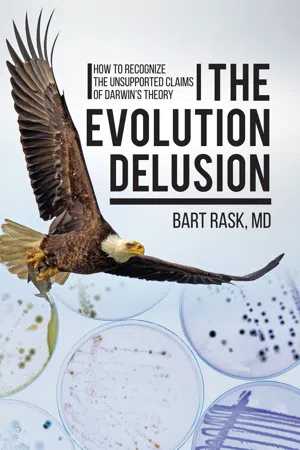
Does the field of evolution differ from other sciences? The author, a reviewer for a major medical journal, scrutinized hundreds of scientific references in evolutionary literature, adopting the same standards used for studies submitted for medical public
- 322 pages
- English
- ePUB (mobile friendly)
- Available on iOS & Android
eBook - ePub
About this book
Information
Chapter 1
Defining Evolution and its Problem
The Theory of Evolution Defined
The theory of evolution is meant to explain the adaptive complexity, diversity, and similarities of life. The National Academy of Sciences describes evolution as a “change in the hereditary characteristics of groups of organisms over the course of generations” (NAS 1998a:13). It answers questions such as, “Why are there so many different kinds of plants and animals?” (NAS 1998b:1). It explains why “even distantly related species share many anatomical and functional characteristics” (NAS 1998b:1).
In Chapter VI of his 1859 book On the Origin of Species, Charles Darwin (2003) defined his foundational theory of evolution as “descent with modification” (p. 160) and later explained in Chapter XIII that “these characters have been inherited from a common ancestor” (p. 441). Darwin’s concepts continue today as the University of California Museum of Paleontology defines “[b]iological evolution, simply put, is descent with modification” (UCB 2020). Smithsonian Institute anthropologist Briana Pobiner describes evolution identically as “descent with modification” (Than 2018). Robert Moss (1999), a biology professor at Wofford College, agrees: “‘Evolution,’ in the context most biologists intend to use it, should be defined simply as ‘descent with modification,’” adding, “That’s the way Darwin used it, and that is the correct way” (p. 111). Evolutionary biochemist Douglas Theobald (2012) describes the same concept with slightly different terminology: “Universal common descent is the hypothesis that all known living, terrestrial organisms are genealogically related. All existing species originated gradually by biological, reproductive processes on a geological timescale.”
The National Center for Science Education (NCSE 2016a) also defines evolution as “common ancestry and descent with modification,” and describes the process for evolutionary change in a population as “natural selection and genetic drift.” Random mutations of DNA* in one or more individuals along with natural selection of the most advantageous mutants is the mechanism for evolution to generate populations of new species. Stony Brook University evolutionary biologist Douglas Futuyma (1986) writes:
The changes in populations that are considered evolutionary are those that are inheritable via the genetic material from one generation to the next. Biological evolution may be slight or substantial; it embraces everything from slight changes in the proportion of different alleles [genes] within a population (such as those determining blood types) to the successive alterations that led from the earliest protoorganism to snails, bees, giraffes, and dandelions. (p. 7)
Michigan State University biology professor Richard Lenski explains that “the most plausible molecular model” for evolution is “natural selection on randomly occurring variation” (Sniegowski and Lenski 1995:553). Mutations are believed to be generated randomly since there are no known natural forces that can produce non-random mutations. Natural selection, on the other hand, is not random but is guided by how well a particular mutation enables its host to thrive in its specific environment. Finally, The National Academy of Sciences also asserts that: “Genetic variation is random, but natural selection is not” (NAS 1998c:16).
For many evolutionists, the theory explains how life developed into different species—but does not speculate about the origin of life per se. Darwin specifically avoided discussing the origin of life in his book, and evolutionists generally (with some exceptions) continue to take the same approach today (Pereto et al. 2009; Paz-y-Mino et al. 2011). The official position of the National Center for Science Education (NCSE 2016b) is that “evolution is a scientific theory that explains the emergence of new varieties of living things in the past and in the present; it is not a ‘theory of origins’ about how life began.”
The theory of evolution is most commonly defined by evolutionists as descent with modification from a common ancestor. The proposed mechanism for these modifications is random genetic mutation in one or more individual descendants, followed by their natural selection by the environment to generate a new species.
The Evolution Problem
“Descent with modification from a common ancestor” means that some ancient creature (the common ancestor) had successive progeny—i.e., children, grandchildren, great-grandchildren, etc.—that gradually developed into different types of creatures (Figure 1-1). The implication is that some simple life form, perhaps a single-celled species, evolved into a multicellular one. Subsequent descendants of this multicellular species then evolved organs, appendages, etc. The theory asserts that new body parts and biochemical systems arose gradually to increase an organism’s complexity with its associated new functions. The problem: Is there evidence that a natural process can create such functional complexity?

Figure 1-1.Descent with modification asserts that over successive generations, the progeny of a single-celled creature (bottom left) will add more functioning body parts, including multicellularity, fins, legs, placenta, and a well-developed frontal lobe.
Darwin (2003) himself addressed the difficulty of conceptualizing the capacity for descent with modification to produce complex structures such as the eye:
To suppose that the eye with all its inimitable contrivances for adjusting the focus to different distances, for admitting different amounts of light, and for the correction of spherical and chromatic aberration, could have been formed by natural selection, seems, I freely confess, absurd to the highest degree. (p. 172)
Darwin’s dilemma regarding the evolution of complex structures was solved for him upon noticing the variation of eye complexities in nature. He rationalized that a complex organ could indeed evolve by means of a succession of smaller structural additions, each favored by natural selection (p. 173).
Nevertheless, biologists Reznick et al. (2002) point to the difficulty of obtaining evidence to support how the eye or other complex structures could evolve:
Visualizing such a process would be easiest if steps in this sequence were preserved in closely related living organisms; however, no such sequence exists for eyes because the intermediate stages have been lost through extinction. Our best alternative is to compare distantly related species that display what appear to be intermediate stages in evolution. (p. 1018)
There is a logical problem with the authors’ rationale. Is the method “to compare distantly related species” valid for showing support for a theory claiming that complex structures originated by “descent with modification”?
This book will show that although there certainly is evidence to support the evolution of some species from a common ancestor, the same cannot be said about the evolution of most species. If there is no evidence to support certain types of evolution involving the vast majority of species, then the theory must be restricted rather than all-encompassing, as it is now. One may be able to reason that various species of the Equus genus (horse, donkey, zebra) had or could have had a common ancestor and are products of evolution, but the claim that a single-celled creature could have progeny with legs and a liver is less obvious and needs to be challenged. These allegations of dramatic changes are justified by scientists who claim that they could have occurred over millions or billions of years, pointing to the fossil record and shared anatomical and biochemical characteristics of modern creatures as evidence. But is this an adequate justification? This book will show that some aspects of the field of evolution involve bending scientific conventions in order to obliquely make its case for scientific compatibility.
My aim is not to challenge the claim of universal common ancestry by trying to disprove it, since it is difficult to prove a negative. Since the theory of evolution is taught as a science, and scientific theories require empirical evidence (according to many evolutionists), the burden of proof is on the evolutionist to provide this evidence, not on the doubter to disprove it nor offer a “better” hypothesis. Evolutionists claim that there is plenty of evidence that supports universal common descent. But is there? Although there is evidence to support the “smaller” evolutionary changes that produced some species, called microevolution, the thesis of this book is that there is no empirical evidence to support the “larger” evolutionary changes, called macroevolution, purported to give rise to most species.
Microevolution versus macroevolution
Evolution is classified as microevolution or macroevolution based upon the presence or absence of empirical evidence, respectively, and is discussed in more detail in Chapter 3. Regarding reproduction in the animal kingdom, empirical evidence shows that for two individuals or populations to have had a common ancestor, interbreeding must have occurred at every generation from that common ancestor to the contemporary population; there are no examples to the contrary.
Microevolution. Microevolution involves a change in the magnitude or transfer of the production or activity of existing components and their functions. A component includes genes, enzymes or other proteins, microstructures, organelles, organ subsections, organs, appendages and other structures. No functions are created which are new to nature, but can be modified to a similar function. Examples include a gene that codes for brown melanin mutates to code for red, the loss of lactose metabolism, or the transfer of antibiotic resistance.
Macroevolution. Macroevolution is production by the host of new, additional, beneficial components compared to its ancestors, or changing an existing component to exhibit a different function. For example, microevolution would be a mutation to an enzyme in a glucose metabolic pathway to allow metabolism of the chemically similar sugar galactose; macroevolution would be a mutation to add an enzyme to the glucose metabolic pathway that allows production of vitamin C. Microevolution would be when an appendage shaped for swimming in water mutates to swim faster; macroevolution would be a mutation of the same appendage to walk on land. Regarding reproduction in the animal kingdom, microevolution would be when one population evolves into separate populations who rarely interbreed, but could. Macroevolution is when one population evolves into separate populations with no ability to interbreed, not even in vitro, i.e., they exhibit reproductive isolation.
The boundaries
The aim of this book is to evaluate evolution on the evolutionists’ own terms, including their definition of evolution, their criteria for science, and their body of scientific literature. Criticisms against “evolution” in this text will refer only to macroevolution, since this is where the debate lies. The method involves evaluating a large cross-section of evolution literature from scientific publications and determining if the data support the macroevolutionary conclusion. References from “creation science” and related perspectives were excluded because the goal of this book is to address the purported evidence presented by the mainstream evolutionist. This book will show how the studies which claim to support the “large” changes of macroevolution really do not. The evolution of plant life and offering alternative theories to the origin of species are beyond the scope of this text.
Thesis: The macroevolution of most species is not supported by empirical evidence and is not a scientific theory. Offering alternative hypotheses to macroevolution are beyond the scope of this text.
References
Darwin, Charles. 2003 (1859). [On] The Origin of Species. New York, NY: Signet Classics.
Futuyma, Douglas J. 1986. Evolutionary Biology, 2nd Ed. Sunderland, MA: Sinauer Associates.
Moss, Robert. 1999. “The Molecular Evidence for Evolution: Narrowing the Definition of Evolution to Represent a Single Concept.” Journal of College Science Teaching 29:111–113, 131.
NAS (National Academy of Sciences)1998a. Chapter 2 “Major Themes in Evolution.” Teaching About Evolution and the Nature of Science. Retrieved 4/15/2021. https://www.nap.edu/read/5787/chapter/3#13
———. 1998b. Chapter 1 “Why Teach Evolution.” Retrieved 4/15/2021. https://www.nap.edu/read/5787/chapter/2
———. 1998c. Chapter 2 “Major Themes in Evolution.” Retrieved 4/15/2021. https://www.nap.edu/read/5787/chapter/3#16
NCSE (National Center for Scienc...
Table of contents
- Cover Page
- Half Title
- Full Title
- Copyright
- Dedication
- Table of Contents
- Forward by Ian Macreadie
- Introduction
- Chapter 1 - Defining Evolution and its Problem
- Chapter 2 - Evolution versus Science: Setting the Stage
- Chapter 3 - The Empirical Limits: Microevolution versus Macroevolution
- Chapter 4 - How Studies Fail to Support Macroevolution
- Chapter 5 - Complementary Coevolution: Why Macroevolution Evidence is Elusive
- Chapter 6 - Genetics and Evolution
- Chapter 7 - Reproductive Evolution
- Chapter 8 - The Origin of Life
- Chapter 9 - Techniques for Determining Age
- Chapter 10 - Summary and Conclusion
- Challenges and Responses
- Appendices to
- Author Index
- Subject Index
Trusted by 375,005 students
Access to over 1.5 million titles for a fair monthly price.
Study more efficiently using our study tools.
Frequently asked questions
Yes, you can cancel anytime from the Subscription tab in your account settings on the Perlego website. Your subscription will stay active until the end of your current billing period. Learn how to cancel your subscription
No, books cannot be downloaded as external files, such as PDFs, for use outside of Perlego. However, you can download books within the Perlego app for offline reading on mobile or tablet. Learn how to download books offline
Perlego offers two plans: Essential and Complete
- Essential is ideal for learners and professionals who enjoy exploring a wide range of subjects. Access the Essential Library with 800,000+ trusted titles and best-sellers across business, personal growth, and the humanities. Includes unlimited reading time and Standard Read Aloud voice.
- Complete: Perfect for advanced learners and researchers needing full, unrestricted access. Unlock 1.5M+ books across hundreds of subjects, including academic and specialized titles. The Complete Plan also includes advanced features like Premium Read Aloud and Research Assistant.
We are an online textbook subscription service, where you can get access to an entire online library for less than the price of a single book per month. With over 1.5 million books across 990+ topics, we’ve got you covered! Learn about our mission
Look out for the read-aloud symbol on your next book to see if you can listen to it. The read-aloud tool reads text aloud for you, highlighting the text as it is being read. You can pause it, speed it up and slow it down. Learn more about Read Aloud
Yes! You can use the Perlego app on both iOS and Android devices to read anytime, anywhere — even offline. Perfect for commutes or when you’re on the go.
Please note we cannot support devices running on iOS 13 and Android 7 or earlier. Learn more about using the app
Please note we cannot support devices running on iOS 13 and Android 7 or earlier. Learn more about using the app
Yes, you can access The Evolution Delusion by Bart Rask, MD in PDF and/or ePUB format, as well as other popular books in Biological Sciences & Biology. We have over 1.5 million books available in our catalogue for you to explore.