The Citizen Soldier in War and Peace is a is a short historical look at the use of firearms in America and throughout the world this book appeals to anybody who believes in the Second Amendment or who is interested in the historical use of firearms
eBook - ePub
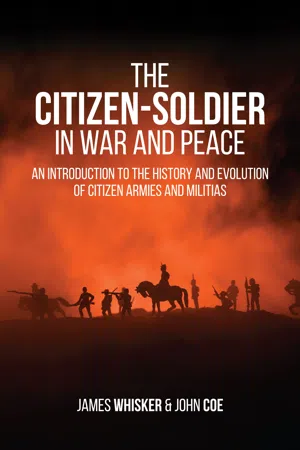
The Citizen-Soldier in War and Peace
An Introduction to the History and Evolution of Citizen Armies and Militias
- 246 pages
- English
- ePUB (mobile friendly)
- Available on iOS & Android
eBook - ePub
The Citizen-Soldier in War and Peace
An Introduction to the History and Evolution of Citizen Armies and Militias
About this book
Information
Part I
Introduction to Citizen-Armies
Introduction
The citizen soldier is a concept as old as, and certainly predating, recorded history. If we examine Plato’s thought we find that the first city of the Republic was occupied before the emergence of the warrior class. The second of Plato’s three hypothetical cities came emerged precisely because a warrior class had emerged from among the citizenry to dominate and control it. Good government was impossible as long as the warriors ruled.
Since Plato’s time many political theorists have concluded that the best way to insure that there will be open and honest government is to guarantee the right of the people to keep and bear arms as an unorganized militia. The idea that the people be armed weighed heavily in the minds of the English Puritans and radical Whigs who were writing substantial political philosophy in the seventeenth and eighteenth centuries. They returned to the major premise of antiquity: that only freemen may be armed and that the mark of a freeman was his right to keep and bear arms. While there were some assumptions that only an armed citizen could resist the proverbial “intruder in the night” and that a citizen might use arms for recreation and hunting, there was, constantly, the clear commitment that the state had made that the best and ultimate defense and protection of the state rested in the hands of the citizen-soldiers trained at arms.
In medieval law there was a three fold obligation shared by all freemen. They must repair and maintain public roads and bridges and the like; they must serve as an ancillary police force; and they must be prepared to bear arms in defense of the state as a militia. Both the posse and the militia requirements were based on the need for privately owned arms. Medieval law in these areas developed slowly, but was always based in common law and practice. Each man was required to keep in his home the arms of his socio-economic class and have these in order ready to use in case of emergency. Regular practice with one’s arms was a general requirement. At least one English king attempted to discourage participation in any form of recreation except practice with arms, primarily with the long bow.
There were three levels of military obligation generally accepted in medieval states. The standing army was populated with trained, professional soldiers. Some of the citizenry was trained to at least a minimal degree and comprised a select militia. The untrained masses of able-bodied freemen comprised a general militia. The principle of levee en masse, recognized under international law, grew out of the unenrolled, mass militia of the middle ages.
The first significant contribution to the literature of the militia was made by Niccolo Machiavelli who argued that freedom was incompatible with standing armies. Given to great mischief, the standing armies represented a great threat to the people and the state in Machiavelli’s writings. Although we frequently associate Machiavelli with authoritarian government as a matter of fact he looked forward to the establishment of a democratic regime as soon as possible following the establishment of a nation-state.
In democracies militias were established early as a part of the general western commitment to integral liberal values. The English militia is intimately associated with the transition from divine right kingship to liberal democracy. One of the grave errors of the Stuart monarchy was to seek control over the total armed forces of the nation. The trained bands, as the popular militias were then called, sought autonomy and identified their independence with freedom for the people. In the British colonies in North America the provincials demanded complete control their own military affairs.
Two democracies, Israel and Switzerland, have placed great emphasis on the citizen-soldier and the popular militia. Both nations require essentially universal military service and training of their subjects. Universal military service and training has resulted in wholly armed states in these two nations in which firearms are immediately available to the citizens. There is no indication that this has had any negative bearing on crime rates. Israel patterned its militia system after the Swiss program. Jews who emigrated to Israel after the near extermination of European Jewry during World War II knew that authoritarian political systems permitted no private ownership of firearms, at least among minority populations. They have vowed that they will never again be caught in the position of being effectively disarmed in the face of their enemies. The Swiss have come to believe that their long history of autonomy is inter-related with the armed nation.
Few Western democracies have followed Machiavelli’s advice or the Swiss or Israeli example. A few of the Nordic nations, such as Sweden and Finland, have militia systems and a very few other democratic nations have universal military training. Most democracies have accepted the perspective of those who believe that mature nations have advanced beyond the “Wild West” mentality. Anti-firearms rhetoric has created a climate of opinion that accepts conclusions such as that firearms breed violence and that civilized nations are disarmed nations. They see a military armed with advanced weapons systems that are electronic, computerized, specialized and complex. Such is the current state of military preparedness. The foot soldier with small arms training is obsolete. Without any need for the foot soldier there is no need for small arms and marksmanship training and thus there is no need for the militia or ancillary support for individual firearms training.
Totalitarian governments have heeded Machiavelli’s advice more than have Western democracies. They have armed their citizens and made certain that their citizens from early childhood through adulthood have become familiar with the arms regularly used by their military. They train their people in the use and assembly and disassembly of arms of all military types. The Soviet Union uses its D.O.S.A.A.F. [“Voluntary Society for the Assistance of the Army, Navy and Air Force”] as a pre-induction military support organization. Likewise, Communist China has an advanced and well funded people’s militia system. Fascist Italy, Imperial Japan and Nazi Germany all had para-military organizations which provided for training of military eligible citizens of all ages. Non-democratic governments have built regime support by showing their military hardware and building pride among the people in the sheer show of terror which only military hardware can bring. Knowing that either they were limited by international agreements not to exceed a certain size in the military, or knowing that their budgets cannot fully fund the military they would like, they arm and train the population. Totalitarian governments are well aware that they may fight total and unrestrained warfare and hence become totally armed camps. Pre-militia and militia training is a key ingredient in the concept of the armed nation.
Totalitarian governments realize that an armed and trained population is a threat to their authoritarian rule so they train the population under careful supervision and control the supply of arms. Some totalitarian nations like the Soviet Union and Communist China train their people in basements of factories and other public facilities. The government provides arms, training, instruction and ammunition. Most compel their citizens to participate.
Contemporary totalitarian governments have drawn their inferences and conclusions about weapons and citizen arms training from a very realistic view of the realities of war. The war in Korea, the Vietnam War, the war in Afghanistan and the recent joint western military action in the Middle East have all utilized advanced weapons systems, but have depended no less on the foot soldier armed with a rifle. The holy wars of communism, “wars of national liberation,” have not disappeared, and will not disappear, with the collapse of communism in the former Soviet Union. Communism is still much alive in China and in the nations of southeast Asia under its influence. And wars of national liberation have always depended upon the success of the individual citizen-soldier and his small arm. Many successful wars of national liberation have been fought with obsolete and obsolescent weapons. American soldiers found Russian World War I bolt action rifles on bodies of many Viet Cong soldiers. Wars of national liberation are necessarily fought by citizen-soldiers, that is, unorganized militia, consisting of men who are first and foremost agricultural peasants and secondarily soldiers in the revolution. Soldiers in wars of national liberation are engaged in guerrilla warfare and so must disguise their role in the armed camp.
In the twenty-first century, the select militia has become formalized and in most nations is entitled something like National Guard as is the case in the United States. Usually armed with weapons the same as, or similar to, the standing army, the trained militia has advanced far beyond what the Founding Fathers might have possibly conceived. Its role has greatly expanded to include two new tasks: counter-insurgency warfare and civic action, with emphasis on relief and assistance during and following natural and also man-made disasters.
James B. Whisker
Professor Emeritus
West Virginia University
The Citizen-Soldier
The citizen-soldier may have been either conscript or volunteer. He stands in marked contrast to the professional soldier whose vocation is war. The citizen-soldier does not enter war for pay or booty. He goes to war only reluctantly, spurred on by notions of patriotism and nationalism and of duty. The citizen-soldier was the backbone of every American army. He deplores war. It was he who called attention to the excesses of professional soldiers in such disgraceful events as My Lai, Vietnam. He fights only as last recourse, when his nation is threatened, and not in imperialistic adventures. A recent article concluded that the Second Amendment to the United States Constitution was adopted “as a declaration that Federal Government can never fully nationalize all the military forces of this nation” because the masses of men with their own guns constitute “an essentially civilian-manned and oriented set of military forces” who can “inveigh against federal professionalization of the state militia.”1 The Preamble to the Declaration of Independence listed as two grievances against King George III that “[h]e has kept among us, in times of peace, standing armies without the consent of our legislatures [and] [h]e has affected to render the military independent of and superior to the Civil power.”
The citizen-soldier is seen, again, in medieval times, as the peasant conscripted to fight as a foot soldier. After the wars were over the peasant, too, returned to the fields. He is seen in the Minuteman of Lexington and Concord who left his business to attend to the matter of the nation’s liberty. Of the wrongs done to the colonists, the Minute Men of Massachusetts, and the role of the citizen-soldiers, Chief Justice Earl Warren once wrote,
Among the grievous wrongs of which [the Americans] complained in the Declaration of Independence were that the King had subordinated the civil power to the military, that he had quartered troops among them in times of peace, and that through his mercenaries, he had committed other cruelties. Our War of the Revolution was, in good measure, fought as a protest against standing armies. Moreover, it was fought largely with a civilian army, the militia, and its great Commander-in-Chief was a civilian at heart…. [Fears of despotism] were uppermost in the minds of the Founding Fathers when they drafted the Constitution. Distrust of a standing army was expressed by many. Recognition of the danger from Indians and foreign nations caused them to authorize a national armed force begrudgingly.2
Definition of Militia
The citizen-soldier as a militiaman, is either a member of the unenrolled or the enrolled militia. Those enrolled formally today belong to the National Guard units of their state. A simple dictionary definition of militia is, “a body of soldiers for home use.” The term meant “miles” or “troops” and was derived from the Latin word for soldiers.3 In medieval Europe it was “the whole body of freemen” between the ages of 15 and 40 years, who were required by law to keep weapons in defense of their nation.4 In the later Middle Ages the militia was the whole body of “citizens, burgesses, free tenants, villeins [serfs] and others from 15 to 60 years of age” who were obliged by the law to be armed.5
The United State Code defines the militia in this way. The militia of the United States consists of all able-bodied males at least 17 years of age and, except as provided in section 313 of title 32, under 45 years of age who are, or who have made a declaration of intention to become, citizens of the United States and of female citizens of the United States who are members of the National Guard. The classes of the militia are:...
Table of contents
- Cover Page
- Half Title
- Full Title
- Copyright
- Dedication
- Contents
- About the Authors
- Part I: Introduction to Citizen-Armies
- Part II: Militia Organizations
- Part III: Philosophical Background
- Appendix 1
- Appendix 2
- Bibliography
Trusted by 375,005 students
Access to over 1.5 million titles for a fair monthly price.
Study more efficiently using our study tools.
Frequently asked questions
Yes, you can cancel anytime from the Subscription tab in your account settings on the Perlego website. Your subscription will stay active until the end of your current billing period. Learn how to cancel your subscription
No, books cannot be downloaded as external files, such as PDFs, for use outside of Perlego. However, you can download books within the Perlego app for offline reading on mobile or tablet. Learn how to download books offline
Perlego offers two plans: Essential and Complete
- Essential is ideal for learners and professionals who enjoy exploring a wide range of subjects. Access the Essential Library with 800,000+ trusted titles and best-sellers across business, personal growth, and the humanities. Includes unlimited reading time and Standard Read Aloud voice.
- Complete: Perfect for advanced learners and researchers needing full, unrestricted access. Unlock 1.5M+ books across hundreds of subjects, including academic and specialized titles. The Complete Plan also includes advanced features like Premium Read Aloud and Research Assistant.
We are an online textbook subscription service, where you can get access to an entire online library for less than the price of a single book per month. With over 1.5 million books across 990+ topics, we’ve got you covered! Learn about our mission
Look out for the read-aloud symbol on your next book to see if you can listen to it. The read-aloud tool reads text aloud for you, highlighting the text as it is being read. You can pause it, speed it up and slow it down. Learn more about Read Aloud
Yes! You can use the Perlego app on both iOS and Android devices to read anytime, anywhere — even offline. Perfect for commutes or when you’re on the go.
Please note we cannot support devices running on iOS 13 and Android 7 or earlier. Learn more about using the app
Please note we cannot support devices running on iOS 13 and Android 7 or earlier. Learn more about using the app
Yes, you can access The Citizen-Soldier in War and Peace by James Biser Whisker,John R. Coe in PDF and/or ePUB format, as well as other popular books in History & Military & Maritime History. We have over 1.5 million books available in our catalogue for you to explore.