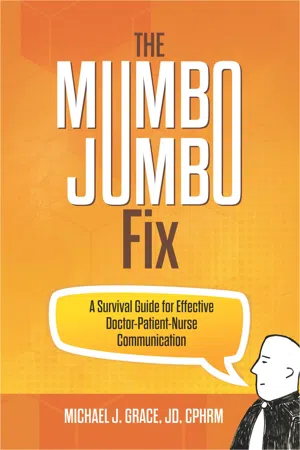
The Mumbo Jumbo Fix: A Survival Guide for Effective Doctor-Patient-Nurse Communication tackles the vital subject of healthcare miscommunication which is a leading cause of patient harm. It is the first book of its kind geared to all three essential
eBook - ePub
The Mumbo Jumbo Fix
A Survival Guide for Effective Doctor-Patient-Nurse Communication
- 230 pages
- English
- ePUB (mobile friendly)
- Available on iOS & Android
eBook - ePub
The Mumbo Jumbo Fix
A Survival Guide for Effective Doctor-Patient-Nurse Communication
About this book
Information
1
Where We Are
IN THIS CHAPTER
Patients learn miscommunication among healthcare participants—doctors, patients, and nurses—is the cause of most medical errors but they have usually been excluded as a target audience from books on the subject.
Nurses familiar with hospital education initiatives will recognize a continuing need for improved communication among all healthcare participants.
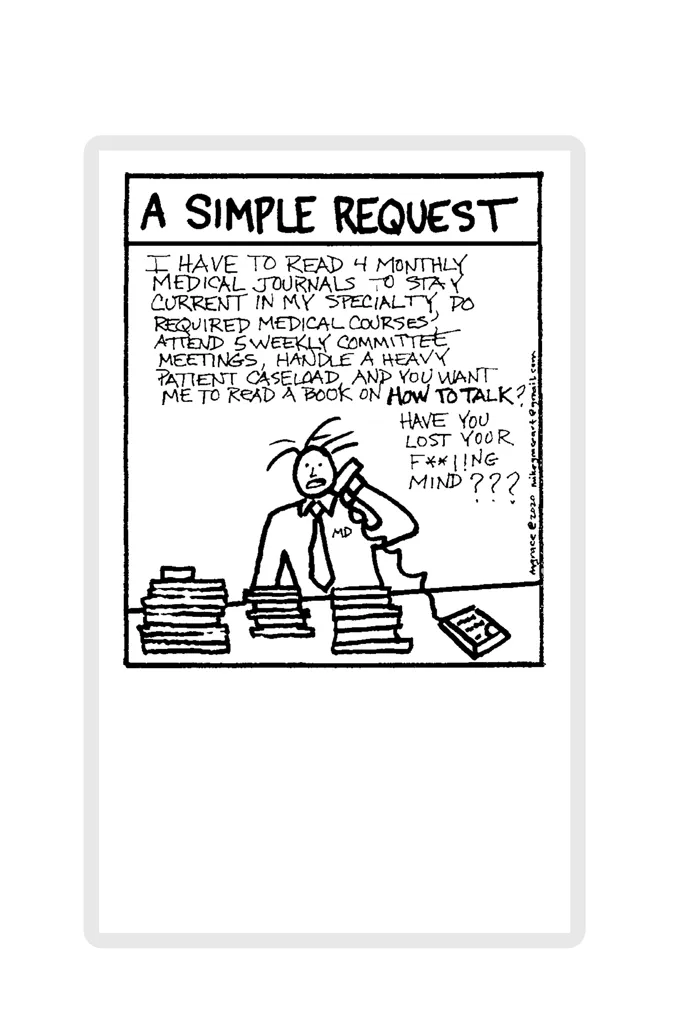
Doctors’ ability to communicate effectively remains elusive despite the best of intentions, formal training, and clinical experience.
“He doesn’t listen.” “She didn’t tell me.” “I thought I understood.”“How many times do I have to say it?”“Half the time I don’t know what he’s talking about.”“Why doesn’t she just get to the point?”
As a hospital Risk Manager and Patient Safety Officer, every day I encountered the effects of linguistic mumbo jumbo within the healthcare system—meaningless, confusing, and ineffective communication among doctors, patients, and nurses. As a trial attorney defending healthcare providers, I regularly saw firsthand the legal consequences and harm of poor communication among healthcare participants. And as a speech communication major in undergraduate and graduate school and as a healthcare educator, I discovered there are evidence-based best practices which add value and clarity to any professional interpersonal exchange.
How did we get here? We talk at, over, and past one another when there are easily adopted and effective strategies for these essential interactions.
The Joint Commission, the accrediting organization for most American hospitals and healthcare organizations, has long focused on the link between effective communication and patient safety. Its sentinel event data identified communication as a root cause for almost two-thirds of the reported serious harm events between 2004 and 2016.1 Ineffective communication continues to be among the top three root causes for serious adverse events along with leadership and human factors.2
It’s not that medical and nursing schools ignore communication. On the contrary, all clinical programs teach the centrality of the effective exchange of information. Both for optimal patient outcomes and provider job satisfaction. Yet despite mandatory coursework and the best of intentions, healthcare providers graduate with improved but only average communication competence. Apparently, communication skills are getting lost in the press of mastering the growing mountain of required clinical skills. Nor does clinical experience improve communication; bad habits become ingrained and excellent interpersonal skills remain elusive.3
Hospitals and other large healthcare delivery systems know communication is vitally important. An alphabet soup of “easily remembered” mnemonic tools are regularly rolled out in an effort to boost patient satisfaction scores. But posters plastered on institutional walls touting “patient centered” communication become wallpaper. Consciously or subconsciously harried healthcare workers muddle on as they’ve always done trying to gather and relate critical healthcare information as rapidly as possible in a time pressurized environment.
Nor has self interest improved effective doctor-patient-nurse communication. Medical malpractice claims data show the failure of a physician to communicate with the patient or other providers is one of the most common and costly reasons for the initiation of litigation. A major study released in 2016 representing one-third of the total insurance market estimated communication failures in U.S. hospitals and medical practices were responsible for 1,774 deaths and $1.7 billion in malpractice costs over the prior five years.4
Often the patient who sues is merely looking for understanding of an unexpected outcome. Unfortunately, many doctors shy away from addressing such problems out of ignorance, inertia or fear even when there may be a straight forward and medically sound explanation. So, patients pursue answers through the court system. Or as frequently happens, the physician did relate the proposed treatment’s risks and benefits in an appropriate and timely fashion, but the message was not fully understood in the moment. And often the physician fails adequately to document the conversation. Again, the result is a lawsuit.
There is already much written on this vital subject of healthcare communication, usually in the form of academic studies and scholarly treatises. Hardly an approachable format for time-strapped professionals and busy lay people already overwhelmed with other concerns. The Mumbo Jumbo Fix: A Survival Guide for Effective Doctor-Patient-Nurse Communication is based on the author’s extensive real-world experience as a medical malpractice trial lawyer, hospital administrative officer, and healthcare educator. It is intended as an accessible treatment of easily digestible bites of important information—practical strategies which can be read in any order as suits the reader’s appetite.
Most books in the field take a siloed approach to fixing miscommunication within the healthcare industry. They typically focus on either doctors or nurses and largely ignore patient education. Yet all three groups—doctors, nurses, and patients—are its essential participants. Emphasizing only one group to the exclusion of the others is similar to family counseling where the therapist never brings the individual family members together as a group. Is it any surprise that miscommunication remains a major cause of medical errors? The Mumbo Jumbo Fix is literally the first healthcare communication book to get everyone on the same page!
1The Joint Commission, “JC sentinel event data, root causes by event type 2004–2013,” 2014 Oct 1, https://www.jointcommission.org/assets
2Cooke, M., “TeamSTEPPS for health care risk managers: Improving teamwork and communication,” ASHRM Journal of Healthcare Risk Management, 2016; 36(3): 35,36
3Gilligan, C., Brubacher, S., Powell, M., “Assessing the training needs of medical students in patient information gathering,” BMC Medical Education, 2020; 20:61
4CRICO Strategies, “Malpractice risk in communication failures,” 2015 Annual Benchmarking Report, Boston, MA: The Risk Management Foundation of the Harvard Medical Institutions, Inc., 2015
2
We Once Knew It All
IN THIS CHAPTER
Patients discover the key to effective communication is a skill taught when they were young, the same early education received by healthcare professionals.
Nurses and other healthcare providers learn they can reshape their professional lives through enhanced communication skills.
Doctors recognize they can improve patient outcomes by adopting evidence-based best communication practices.
The essence of excellent and effective communication is not mysterious, and it’s easily attainable. You already know it. You learned it in the first grade.5
- Show respect
- Listen carefully
- Speak clearly
- Make eye contact
- Talk one at a time
- Avoid shouting
- Tell the truth
- Try to see the other side
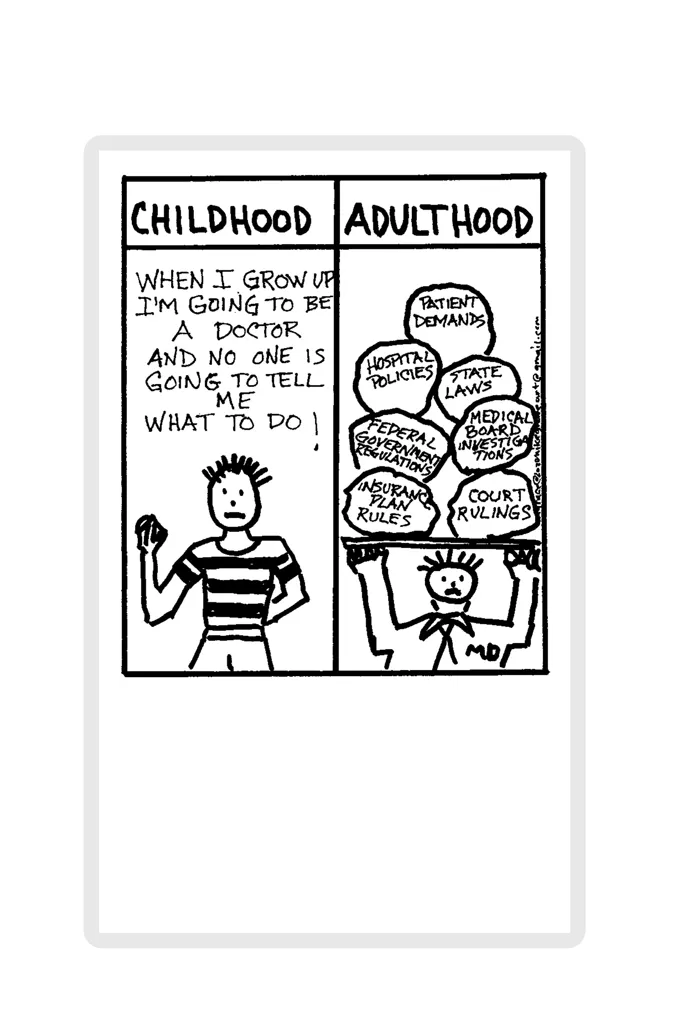
But what happened? We grew up. We became important. We got busy. We grew impatient. We got tired—of the demands, the expectations, the rules, the disrespect, and the stupidity. And we became fearful—and perhaps resentful—of change, the unknown and the loss of control. But as the rapper Tupac Shakur reminds us, “Things change. That’s the way it is.”
The good news is through effective communication we have the power to reshape our personal and professional lives. While there is some truth in the maxim “one cannot control anyone else,” there is also truth in the knowledge “one can choose to control oneself and how to respond to others.” And, frankly, there are even some evidence-based ways predictably and positively to affect others’ communication behaviors. Enhanced doctor-patient-nurse relationships will lead to improved patient outcomes, greater job satisfaction, less work-related stress, and better time management.6
As Aristotle, the Greek philosopher and rhetorician, observed 2400 years ago: “A good relationship starts with good communication.”
5Morin, A., “Important Social Skills for First Grade,” Very W...
Table of contents
- Cover Page
- Praise
- Half Title
- Full Title
- Copyright
- About the Author
- Dedication
- Table of Contents
- Chapter 1: Where We Are
- Chapter 2: We Once Knew It All
- Chapter 3: The Importance of a Name
- Chapter 4: Handshakes and Other Greetings
- Chapter 5: A Communication Model
- Chapter 6: Interruption
- Chapter 7: Technical Talk
- Chapter 8: Patient Barriers to Understanding
- Chapter 9: It’s More About Listening
- Chapter 10: Human Barriers to Active Listening
- Chapter 11: Physical Barriers to Active Listening
- Chapter 12: Nurse-Doctor Communication
- Chapter 13: Communication Within Teams
- Chapter 14: The Testimonial
- Chapter 15: Patient Preparation for the Office Visit
- Chapter 16: Patient Preparation for the Hospital Stay
- Chapter 17: The Angry Patient
- Chapter 18: The Quiet Patient
- Chapter 19: The Unfocused Patient
- Chapter 20: The Patient’s Family
- Chapter 21: Legal Healthcare Documents
- Chapter 22: The Patient Bill of Rights
- Chapter 23: The Disabled Patient
- Chapter 24: The Foreign Patient
- Chapter 25: Informed Consent
- Chapter 26: Conduct During Examinations
- Chapter 27: Communicating in the Medical Record
- Chapter 28: Confidentiality
- Chapter 29: Sex Talk
- Chapter 30: The Transgender and Non-Binary Patient
- Chapter 31: The Elderly Patient
- Chapter 32: The Seriously III Patient
- Chapter 33: Telemedicine
- Chapter 34: Doctor Disclosure and Apology
- Chapter 35: Terminating the Relationship
- References and Resources
- Acknowledgements
Trusted by 375,005 students
Access to over 1.5 million titles for a fair monthly price.
Study more efficiently using our study tools.
Frequently asked questions
Yes, you can cancel anytime from the Subscription tab in your account settings on the Perlego website. Your subscription will stay active until the end of your current billing period. Learn how to cancel your subscription
No, books cannot be downloaded as external files, such as PDFs, for use outside of Perlego. However, you can download books within the Perlego app for offline reading on mobile or tablet. Learn how to download books offline
Perlego offers two plans: Essential and Complete
- Essential is ideal for learners and professionals who enjoy exploring a wide range of subjects. Access the Essential Library with 800,000+ trusted titles and best-sellers across business, personal growth, and the humanities. Includes unlimited reading time and Standard Read Aloud voice.
- Complete: Perfect for advanced learners and researchers needing full, unrestricted access. Unlock 1.5M+ books across hundreds of subjects, including academic and specialized titles. The Complete Plan also includes advanced features like Premium Read Aloud and Research Assistant.
We are an online textbook subscription service, where you can get access to an entire online library for less than the price of a single book per month. With over 1.5 million books across 990+ topics, we’ve got you covered! Learn about our mission
Look out for the read-aloud symbol on your next book to see if you can listen to it. The read-aloud tool reads text aloud for you, highlighting the text as it is being read. You can pause it, speed it up and slow it down. Learn more about Read Aloud
Yes! You can use the Perlego app on both iOS and Android devices to read anytime, anywhere — even offline. Perfect for commutes or when you’re on the go.
Please note we cannot support devices running on iOS 13 and Android 7 or earlier. Learn more about using the app
Please note we cannot support devices running on iOS 13 and Android 7 or earlier. Learn more about using the app
Yes, you can access The Mumbo Jumbo Fix by Michael J. Grace, JD, CPHRM in PDF and/or ePUB format, as well as other popular books in Languages & Linguistics & Communication Studies. We have over 1.5 million books available in our catalogue for you to explore.