The impact of continuous coastal development, reclamation, destruction of corals, overfishing and increased maritime traffic places all of us on the front lines of preserving our oceans. Marine biologists, who share a common language that cuts across political, economic and social differences, recognize that the sea's remarkable coral reefs, which provide food, jobs and protection against storms and floods, have suffered unprecedented rates of destruction in recent decades.
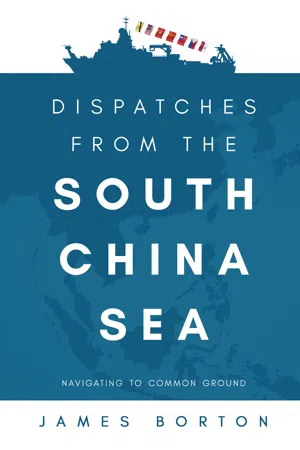
- 270 pages
- English
- ePUB (mobile friendly)
- Available on iOS & Android
eBook - ePub
About this book
Information

The Gathering Storm
Many stories for journalists often begin in bars in Southeast Asia and this one is no different. In 2014, I was seated in a Hanoi café, drinking the locally brewed beer, bia hoi, with celebrated Vietnamese writer La Thanh Tung. It was a scorching summer afternoon. Nearby, the Song Hong river swept by. It flows irregularly because of the large amount of silt it carries. Rising in China, its deep and narrow gorge broadens into the river that feeds the fertile, densely populated Vietnamese delta. On a map, the river ends in Vietnam, and the South China Sea begins.
Tung speaks passionately about that East Sea, and the Vietnamese fishermen who depend upon it to feed their families. Men have fished there since before recorded history. Pollution, overfishing, and a dozen violent wars have diminished it, but still the boats return lying heavy in the water, hulls filled with tuna, mackerel, croaker, and shrimp. 50 percent of the animal protein consumed in Southeast Asia comes from the huge ocean shelf off the Vietnamese coast. He slowly sips his beer and says, “I think the sea is large enough for fishermen to earn their livelihood, but there are more challenges for them.”
Two weeks earlier, a mammoth Chinese oil rig was parked in the middle of Vietnam’s traditional fishing grounds. The international media—of which I am a member—is everywhere, its lenses focused on the maritime drama unfolding for Vietnamese fishermen. I learned that the Chinese occupied Vietnam for over a thousand years. They called it Annam, which means “pacified south.” The protests and rioting on the coast, the Chinese warships protecting the rig, and my very presence here—confirm the irony in the long-forgotten meaning of that name.
I spoke with Tung about my recent interview with a fisherman in Da Nang (known as “China Beach” by the Americans during the Vietnam War), and one of Vietnam’s major port cities. While there, I met Dang Van Nhan, a third-generation local fishing boat captain, who has been casting his long-line nets into the turbulent South China Sea for two decades.
Nhan recalled that on May 26, 2014, dark political clouds suddenly came over his horizon, and his weathered blue painted plank-constructed 50-foot fishing trawler was rammed and sunk by a Chinese naval vessel. As I was recalling my interview with the captain, I could still see the fisherman’s plaintive eyes asking when do these attacks end since we are fishermen and the sea is open.
“The Chinese are plundering the sea with their huge trawlers and this hurts our ability to find the fish like we used to,” says Nhan.
China’s imposed annual seasonal fishing ban exacerbates the tensions for all fishermen in the contested waters. Beijing first announced this ban in 1999, broadly announcing that it would help sustain fishing resources in one of the world’s biggest fishing grounds. The ban historically runs from May 1 to August 16.
The competition for fishing rights is one of the main motivations for the dispute over the waters, and observers warn that the Covid-19 pandemic could prompt a food crisis that would heighten the risk of conflict in the region.
The South China Sea encompasses 1.4 million square miles. It is of critical economic, military, and environmental significance. Over $5.3 trillion in international trade plies its waters annually. The region is richer in biodiversity than nearly any other marine ecosystem on the planet, and the fish provide food and jobs for millions of people in the ten surrounding countries: Brunei, Cambodia, China, Indonesia, Malaysia, the Philippines, Singapore, Taiwan, Thailand, and Vietnam.
In the South China Sea there are approximately 180 features above water at high tide. These rocks, shoals, sandbanks, reefs and cays, plus unnamed shoals, and submerged features are distributed among four geographically different areas of the sea. In turn, these aspects are claimed in whole or in part by China, Taiwan, Vietnam, the Philippines, Malaysia, and Brunei.
My story was making me thirsty, and so I had another draft beer and described as many details as I remembered about Nhan’s boat since I viewed it after it was first pulled out of the roiling sea and brought into Da Nang’s boat yard, where I stood with the forlorn captain examining the wreckage.
The damage was evident when I first climbed an improvised wooden ladder to closely inspect Captain Nhan’s boat. It had been salvaged following its sinking and was now on display for foreign media in one of Da Nang’s boat yards. The deep gouge inflicted by the steel-hulled Chinese boat on the Vietnamese fishing boat’s starboard side revealed the mortal wound that had sunk the once buoyant and colorful traditional fishing vessel.
The hull shape is long and slender, with a high overhanging sharp bow directly derived from the country’s traditional sailing vessels, but the stern is not pointed and runs to form a flat transom. The engine is placed directly under the wheelhouse. The fishing appendages are fitted on the foredeck, where sometimes the remnants of a mast serve to hang up lights for squid fishing or a protective tarpaulin. The bow is always festooned with a traditional eye or “oculi” and with a nga (cathead). These eyes are long and painted on both sides, distant from the stem or median plank.
Unfortunately, for this fisherman and crew on this fateful morning, their traditional and ceremonial decorative eye failed to protect them from a Chinese vessel that deliberately smashed their livelihoods.
According to Charlotte Pham, an Australian scholar on Vietnamese boats, “Some hulls in a northern tradition have plank edge-joined by nails, on a keel plank that rises fore and aft, and ends with a flat transom. Hull planks in the center and south of Vietnam are edge-joined with dowels and have high sterns and prows overhanging the water. Other hull planks were stitched, and some bamboo rafts were fitted with sails and daggerboards.”1
Nhan’s boat was certainly no match for the mega-ton steel-hulled Chinese boat. Over the last decade, Xi Jinping has promoted the maritime industry and urged mariners to “build bigger ships and venture even farther and catch bigger fish.” Some experts claim that China’s distant water fishing fleet numbers around 2,500 ships, but one study claimed it could have as many as 17,000 boats trawling and plundering the oceans.2
The United Nations confirms that China is a fisheries superpower since it consumes around 36 percent of total fish production, and hauls in more than 15.2 million tons of marine life a year, or 20 percent of the world’s entire fish catch.
Tung ordered me another beer since he wanted to hear more of the fisherman’s story.
The 56-year-old boat captain and other fishermen, like Bui Ngoc Thanh, have always been aware of the perils of a seaman’s life. Squalls capable of upending a trawler spring up quickly and a fast-moving typhoon can easily outrun a ship. Their lives have always been at risk, but this monolithic rig and its heavily armed Chinese escorts posed a new and unfamiliar threat to their livelihood.
For sure, the new China has made steady advances over the past two decades to reclaim its role as the pre-eminent power in the Pacific. Because of their investments into the maritime industry, what has emerged is the rising level of competition and even conflict in the South and East China Seas, driven by fear of losing control of key supply lines, competing maritime claims, differing interpretations of maritime agreements, and competition for resources, especially fish.
China Dialogue, an independent, non-profit organization dedicated to promoting a common understanding of China’s environmental challenges, states that China is now among the world’s largest ocean powers. It has the largest fishing fleet, emits the greatest volume of greenhouse gases, produces one third of the world’s ocean plastic pollution, maintains the world’s biggest aquaculture industry, and harvests and consumes more of the world’s seafood than any other nation.3
With their thousands of steel-hulled mega trawlers operating far outside their exclusive economic zone (EEZ) spanning from the South China Sea, the Pacific, the Federated States of Micronesia, Papua New Guinea and to the African coasts, it’s no wonder that China is recognized as the major driver of illegal, unreported, and undocumented (IUU) fishing globally.
As the afternoon peacefully slipped away at the café with the nearby Tamarind trees offering little respite from the heat and humidity, I decided to digress, like the Southerner that I am, to ask Tung some sensitive questions. Since he is a writer, I knew that he was expecting them. After all, he has seen much in Vietnam’s fast-moving renovations post the American War. But my intention was not to speak about a war that cost 58,200 American lives and more than 1.1 million North Vietnamese and Viet Cong fighters. I wanted to better understand Chinese and Vietnamese relations that span two thousand years.
“My country has lived with Chinese threats for more than my lifetime. We clashed with them in a brief war in 1979 in the mountainous northern border in Lao Cai and in a naval battle in 1988, in the Spratlys, where 64 Vietnamese soldiers died,” sighed Tung.
I knew these were sensitive subjects for the two countries are ideological brothers who share a belief in communism, an ideology largely abandoned by much of the world. That helps explain why the 1979 border war is something not too many Vietnamese want to speak about. The other equally delicate topic are the territorial claims on The Paracel Islands, called Xisha Islands in Chinese and Hoang Sa Islands in Vietnamese. They lie in the South China Sea approximately equidistant from the coastlines of the PRC and of Vietnam at nearly 200 nautical miles. With no native population, the archipelago’s ownership has been in dispute since the early 10th century.
“Of course, our relationship with China is complex. We honor the Chinese philosopher Confucius at our Temple of Literature right here in Hanoi. But how can we forget the 1979 border war when Chinese troops advanced on our citizens in the province of Lang Son,” interjected Tung.
I joked that that the South China Sea documents the transition from wide continental rifts to narrow rifts in geological time dating back to the Eocene. Since I am a non-scientist, Tung laughed when I added that maybe that the tectonic shifts help explain the China and Vietnam history.
This brief war between Hanoi and Beijing on the northern border was attributed to several factors, including to punish Vietnam for its invasion of Cambodia in the early winter of 1979 to oust the Chinese-backed Khmer Rouge. Beijing sent more than 80,000 Chinese troops across the border.
As Tung chain-smoked his cheap Vietnamese cigarettes, he was quick to interject, as if he were already anticipating my question about the 1988 Sino-Vietnamese clash at Johnson Reef or Gac Ma. This event memorialized in Vietnam, occurred when a Chinese naval frigate sank two Vietnamese ships, leaving 64 sailors dead, some shot while standing on a reef, and to this day it remains a serious inflection point between the two nations.
The aftermath of that skirmish is felt today by fishermen in the contested South China Sea. China secured its first Spratly Islands foothold where the early fortifications remain critical markers in the geopolitical tensions between Beijing and Hanoi.
Tung quietly shared details of that battle. He looked around the bar to see if any eyes were on us or rather on him as he narrated his understanding of the very political sensitive historic battle that took place on March 14, 1988, when 64 Vietnamese fishers and soldiers lost their lives protecting a reef in the Spratly Islands.
The scene ensued in the early hours of a red sky morning, when Chinese warships first approached the South Johnson Reef, nearly submerged and encircled by white coral reefs and located in the middle of the Spratlys. It was reported that the Vietnamese sent several small boats with crew to take possession of the reef. About a half dozen Vietnamese soldiers bravely waded into the waters to attempt to plant their nation’s flag on the rock. The Chinese wasted no time and fired on the men. It was no match. The Chinese warship fired its canons at the remaining Vietnamese aboard their boat, and it sank.4
32 years later, the tragedy remains memorialized. Gac Ma is now claimed by China, Taiwan, the Philippines, and Vietnam. In the intervening years, China’s power has dramatically increased as the second largest economy in the world, and even in the midst of the present pandemic, it is expected to surpass the US to become the biggest economy in 2030.
Although the state-controlled media sometimes publishes articles on the topic, with headlines like, “Officials award the Vietnam flag for fishermen to encourage fishing.” The political sensitivity surrounding the Gac Ma attack has not gone away.
In email communication with the book publisher First News based in Saigon (Ho Chi Minh City) that was tasked with publishing the book Gac Ma The Immortal Circle, I was informed that upon publication (Vietnamese language edition) that the book was recalled because of one specific passage cited by a survivor of the battle.
“I intended to pick up the Chinese captain’s gun and shoot him dead, but since there was an order of not to shoot so I didn’t. If allowed, I would kill him! In the end, I was both stabbed and shot.”
I want to protect the Vietnamese source at First News, since he revealed to me, that the publication of the words, “not to shoot,” defamed the Vietnamese Army, as cowards towards the enemy. Although before the book was published, there were many blogs and commentaries about thi...
Table of contents
- Cover Page
- Praise for Dispatches from the China Sea
- Half Title
- Author info
- Full Title
- Copyright
- Dedication
- Map
- Contents
- Preface
- Part I - Field Notes
- Part II - Ecological Politics
- Part III - Science Cooperation and Diplomacy
- Appendices
- Abbreviations and Acronyms
- Acknowledgements
- Endnotes
- References
- Index
Trusted by 375,005 students
Access to over 1.5 million titles for a fair monthly price.
Study more efficiently using our study tools.
Frequently asked questions
Yes, you can cancel anytime from the Subscription tab in your account settings on the Perlego website. Your subscription will stay active until the end of your current billing period. Learn how to cancel your subscription
No, books cannot be downloaded as external files, such as PDFs, for use outside of Perlego. However, you can download books within the Perlego app for offline reading on mobile or tablet. Learn how to download books offline
Perlego offers two plans: Essential and Complete
- Essential is ideal for learners and professionals who enjoy exploring a wide range of subjects. Access the Essential Library with 800,000+ trusted titles and best-sellers across business, personal growth, and the humanities. Includes unlimited reading time and Standard Read Aloud voice.
- Complete: Perfect for advanced learners and researchers needing full, unrestricted access. Unlock 1.5M+ books across hundreds of subjects, including academic and specialized titles. The Complete Plan also includes advanced features like Premium Read Aloud and Research Assistant.
We are an online textbook subscription service, where you can get access to an entire online library for less than the price of a single book per month. With over 1.5 million books across 990+ topics, we’ve got you covered! Learn about our mission
Look out for the read-aloud symbol on your next book to see if you can listen to it. The read-aloud tool reads text aloud for you, highlighting the text as it is being read. You can pause it, speed it up and slow it down. Learn more about Read Aloud
Yes! You can use the Perlego app on both iOS and Android devices to read anytime, anywhere — even offline. Perfect for commutes or when you’re on the go.
Please note we cannot support devices running on iOS 13 and Android 7 or earlier. Learn more about using the app
Please note we cannot support devices running on iOS 13 and Android 7 or earlier. Learn more about using the app
Yes, you can access Dispatches from the South China Sea by James Borton in PDF and/or ePUB format, as well as other popular books in Politik & Internationale Beziehungen & Asiatische Politik. We have over 1.5 million books available in our catalogue for you to explore.