This research monograph presents an inter-disciplinary study of the impact, and current status, of applications of complexity-related concepts in the early stages of development of Agile Project Management (APM). The results serve as an introduction for exploring more profound relations between complexity-related ideas and APM in the future.
The increasing complexity of software projects and their environment in the 1990s constituted the main determinants of the development of the family of methodological frameworks called Agile Project Management. Development of APM has been shaped by a broadly defined area of research called complexity science or complexity theory based on complex adaptive systems (CAS) and on their characteristics: Complexity, chaos, the edge of chaos, emerging properties, non-linearity, self-organization, etc. In the 21st century, due to the expansion of Agile beyond software development, the challenges deriving from the complexity of projects and the environment are even more urgent or compelling. Such phenomena demand more profound inter- and multi-disciplinary studies. This book examines the impact of applications of complexity-related ideas deriving from intuitive complexity and from complexity science in the early stages of development of the Agile methodological frameworks in project management and considers the current status of those applications. It questions the usefulness of those applications for the practice and theory of APM, and then proposes a conceptual framework for further theoretical studies and several ways of improvement and refinement of the Agile Project Management necessary to deal with broadly defined complexity in project management.
Requiring a medium-level knowledge of complexity studies and knowledge of project management, this book is written for the research community studying the links between the various methodological frameworks included in APM and complexity-related ideas. It will also be interesting for studies of the impact of complexity on modern management, and for master's students on IT and management courses.
Detailed descriptions of assumptions, explanations, and definitions may sometimes seem excessive and unneeded. In this book it is not incidental. There are two reasons for such an approach. First, because the majority of applications of complexity-related ideas are metaphors and other linguistic constructs (similes, metonymies), therefore we purposively conduct a kind of “archaeology of knowledge” trying to show the journey of some notions from the source domain of analogies and metaphors to their target domains. In consequence, it gives the reader a chance to better learn the meanings of the terms applied in the theory and practice of project management and of Agile in particular. Second, since it is commonly agreed that more complex projects will be developed with APM, therefore the level of knowledge about complexity among theoreticians and practitioners in Agile should be ameliorated. Too often, the consequences of complexity for Agile are presented with superficial descriptions.
Complexity and management, project management, and Agile Project Management
When studying the role of complexity in Agile Project Management we have to remember that it should always be seen in the context of a three-level hierarchy of containment of complexity-related ideas. The first-level ideas were developed in such domains as cybernetics, systems thinking, system dynamics, systems engineering, and complexity science. This level includes the fundamental initial concepts – abstract mathematical models and their applications in modelling collective phenomena in physics, chemistry, biology, engineering, and variously defined socioeconomic systems. The second level embodies the applications of complexity-related ideas in management. Project management broadly defined, including Agile Project Management, which, in turn, includes software projects and other types of projects, can be treated as the third level.
A question arises: What are the relations between levels two and three? Evidently the third level is included in the second one. It will have to be recalled sometimes since not always all applications of complexity-related concepts used in management are relevant to project management. Distinctive features of management and project management include the temporary character of projects, the specificity of risk management, and the specificity of stakeholders relation.
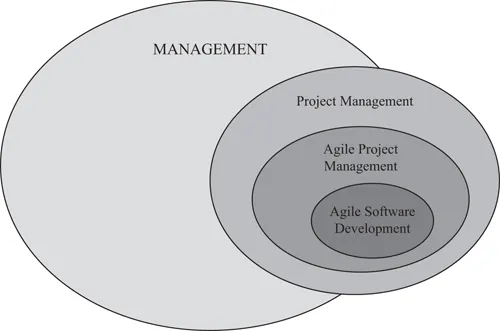
The Agile Project Management frameworks constitute the most specific field where complexity and associated ideas have become equally important as in management. According to the propositions in the fundamental works, it embodies applications of non-software Agile Project Management frameworks and Agile software development – see Figure 1.1.
Figure 1.1 Relations between management, project management, and Agile Project Management. Source: Own research.
The distinction between project management and management is necessary since they are not identical and the former is a part of the latter. Usually in the literature on applications of complexity-related ideas in project management this distinction is omitted. In our study we keep in mind this phenomenon, and whenever necessary we expose the specificity of complexity in project management broadly defined in relation to complexity in management.
The difference between project management and management understood in a broader sense must be taken into account. It is of special importance in our study. Of course, a project is a special, temporarily limited type of organization. In the theory of project management, the following approaches can be found. First, no distinctions are made as to expose specificity of both areas, and the fundamental characteristics such as, for example, strategy and relations with stakeholders are treated as similar. Second, it is assumed that project management constitutes a specific, well-defined part of management understood in a broader sense. In our study the main area of applications of complexity-related concepts is project management. Whenever necessary, we expose the distinctive facets of management and of project management.
Terminology
Terminological precision constitutes one of most important challenges in inter- and multi-disciplinary studies. Our approach towards the terminology is as follows. We realize how many different definitions and interpretations of various terms can be found in the research area encapsulating complexity-related ideas and Agile Project Management. At the same time it is also well-known that precise definition is neither possible nor necessary. However a certain compromise must always be found especially for the facilitation of communication in academic discourse and between theory and practice. Additionally, the care for reasonable precision of interpretations is necessary in the era of constructivism and interpretative approaches in management theory. The meaning can be created in the discourse, but some initial interpretations always have to be presented. It is of special importance when the idea of Agile in project management defined in multiple ways is confronted with also not too-precisely defined ideas associated with complexity.
The first terminological problem derives from the meaning of the term agile. Etymology and definitions of this term are explained later. Here it is only necessary to explain when the term is used as an adjective and noun and when it is used as a proper name. In all situations when a new approach in project management is associated with the methodological frameworks declared by their authors as agile in the Agile Manifesto (2001) then the uppercase first letter is used. Uppercase characters are also used in Agile Project Management. Elsewhere lowercase characters begin the term agile. The same rule concerns the term agility.
Further explanation is needed for the terms organizational theory (theory of organization), management theory, and organization and management theory (as the name of a Division of the Academy of Management). In the majority of texts in management they are either used interchangeably or without any deepened reflection. So as to avoid any doubts and long discussions we use the terms theory of organization and management theory interchangeably with full awareness of terminological doubts and discussions.
Agile and project management: Method, practice, methodology, or approach
Other definitional doubts are associated with the variety of interpretations of the term Agile in relation to project management. This problem will be discussed in detail in the remainder of the book. In this introductory part it is only necessary to explain the meaning of Agile as a methodological concept and/or a methodological framework. For the sake of brevity, wherever in the text the term Agile is standing alone it can be interpretated as Agile Project Management defined in the first chapter and relating to software development and project management. It is always properly indicated when the term Agile is used in reference to various areas of corporate management.
One of the consequences of complexity narratives for complexity is the multitude of more or less precise and formally logically correct definitions, or rather interpretations, of complexity, chaos, and akin terms in science and in practice. So as to avoid extensive definitional considerations, we propose using the term interpretations in reference to all attempts to define more or less precisely that notion. This approach is not a novelty since in multiple works dealing with complexity, broadly defined, and its characteristics, the authors often do not formulate definitions fulfilling the demands of classical logical correctness and leave the readers with more or less confusing interpretations.
We propose to use the following terminology. In addition to using the terms complex and complexity we apply the notions of complexity-related ideas, concepts, terms, etc. These notions embody not only the words complex and complexity but also the characteristics usually associated with various interpretations of complexity. As an example, chaos theory can be used. As it will be shown later, in some sources, the terms chaos theory and complexity theory are applied separately, while in other cases, they are put under the umbrella of complexity science and/or complexity theory.
The literature on complexity is teeming with ideas, definitions, and interpretations. As a natural consequence, we quote only a fraction of the sources, although we tried to collect the most representative ones. It can be easily spotted that reference to the fundamental works on complexity-related ideas is not incidental. Without mentioning specific sources, it can be observed that a large number of works applying the ideas relating to complexity are superficial and not always useful for theoreticians and practitioners.
Agile Project Management: Origins and status quo. Beginnings of the Agile approach in software development
A survey of literature in management, software development, and project management allows for the conclusion that the idea of Agile has passed through a specific, in some sense, a cyclical evolution. From production management and management, through software development and project management to multiple areas of industry, the economy, and society – manufacturing, trade, health service, education, etc. The term Agile is even viewed as a new paradigm in project management and in management. In some cases, claims are made that all areas of human activity should be “Agile”. Such an expansion may lead to justifiable criticisms. If something has too broad a scope of meaning it could be useless from a logical and cognitive point of view.
In dealing with Agile and complexity, two concepts which both have multiple and fuzzy interpretations, it is necessary to clarify their meaning to the degree which would allow a sufficient level of communication. Explanations of the interpretations of complexity will come later; now we focus on the notion agile. Etymology and dictionaries help as an introduction to more advanced studies. Etymologically the term agile, meaning having quickness of motion, nimble, active (of body or mind) derives from the French agile and directly from the Latin agilis, “nimble, quick” (Online Etymology Dictionary). Merriam-Webster Dictionary defines agile as: 1: Marked by ready ability to move with quick easy grace an agile dancer; 2: having a quick resourceful and adaptable character and agile mind.
Studying the impact of complexity-related concepts on the origins and development of Agile Project Management requires giving at least preliminary answers to the following questions:
What were the origins of assigning the term agile to various methodological concepts in management, software development, and project management?
What concepts are assigned to the group of Agile methodological frameworks in software development and in project management?
What were the directions of evolution of Agile methodological frameworks in software development and in project management?
References
Principles behind the Agile Manifesto (2001) http://agilemanifesto.org/principles.html
Complexity-related models, analogies, and metaphors in Agile Project Management
The definitions and interpretations of complexity as well as the definitions and interpretations of Agile stir fundamental ontological, epistemological, and methodological questions. In the ontological discussions about complexity, the main challenge is whether there is something like objectively existing “complexity” (parentheses are not incidental) or whether complexity is a social construct deriving from the relations between observer and observed object. This problem would require additional reflection; therefore it is only assumed that in studying the influence of complexity-related ideas on Agile Project Management an interpretative approach and cognitive approaches are applied – complexity is a feature of the relations between observer and observed objects. In the most fundamental sense, it was stressed by Gell-Mann that even the complexity of physical, chemical, and biological systems has its roots in relations between observer and observed object (Gell-Mann 1994, p. 33). It will be given more attention when the role of the observer in studying complexity is analysed in the remainder of the book.
In management, and subsequently in Agile Project Management, the key questions are the characteristics of the system (organization). Is the organization like a natural or engineering system which can be more or less precisely studied as an objective, independent from the observer, or is it just a social construct created in an intersubjective process? It can be concluded that both options are legitimate. If an organization is more or less precisely depicted with measurable parameters and then studied with mathematical models/simulation models then we may apply approaches taken from physics, biology, and engineering (“hard” systems thinking and “hard” complexity). However, when such an approach is not achievable, then the situation becomes more intricate. We deal with “soft” complexity depicted with qualitative narratives or mixed, qualitative/quantitative narratives. It has to be remembered that i...
Table of contents
Cover
Half-Title
Title
Copyright
Contents
Introduction
1 Conceptual framework
2 Theoretical background and methods of research
3 Typology of interpretations of complexity-related concepts in Agile Project Management
4 Agile project management and complexity science
5 Project management and indigenous complexity-related concepts
6 Scrum and complexity-related ideas
7 Adaptive Software Development and complexity-related ideas
8 Complexity in the Agile Manifesto and in the Declaration of Interdependence
Index
Trusted by 375,005 students
Access to over 1.5 million titles for a fair monthly price.
Study more efficiently using our study tools.
Frequently asked questions
Yes, you can cancel anytime from the Subscription tab in your account settings on the Perlego website. Your subscription will stay active until the end of your current billing period. Learn how to cancel your subscription
No, books cannot be downloaded as external files, such as PDFs, for use outside of Perlego. However, you can download books within the Perlego app for offline reading on mobile or tablet. Learn how to download books offline
Perlego offers two plans: Essential and Complete
Essential is ideal for learners and professionals who enjoy exploring a wide range of subjects. Access the Essential Library with 800,000+ trusted titles and best-sellers across business, personal growth, and the humanities. Includes unlimited reading time and Standard Read Aloud voice.
Complete: Perfect for advanced learners and researchers needing full, unrestricted access. Unlock 1.5M+ books across hundreds of subjects, including academic and specialized titles. The Complete Plan also includes advanced features like Premium Read Aloud and Research Assistant.
Both plans are available with monthly, semester, or annual billing cycles.
We are an online textbook subscription service, where you can get access to an entire online library for less than the price of a single book per month. With over 1.5 million books across 990+ topics, we’ve got you covered! Learn about our mission
Look out for the read-aloud symbol on your next book to see if you can listen to it. The read-aloud tool reads text aloud for you, highlighting the text as it is being read. You can pause it, speed it up and slow it down. Learn more about Read Aloud
Yes! You can use the Perlego app on both iOS and Android devices to read anytime, anywhere — even offline. Perfect for commutes or when you’re on the go. Please note we cannot support devices running on iOS 13 and Android 7 or earlier. Learn more about using the app
Yes, you can access Agile Project Management and Complexity by Katarzyna Bartusik,Czesław Mesjasz,Tomasz Małkus,Mariusz Sołtysik in PDF and/or ePUB format, as well as other popular books in Business & Business General. We have over 1.5 million books available in our catalogue for you to explore.