How can I fairly reward and recognize employees and align this with team and organizational performance? Reward Management is a practical guide for understanding how to develop successful reward strategies.
It covers key areas including pay and grade structures, job evaluation, non-cash reward, pay reviews, bonus plans and tax issues. Featuring guidance, practical tools and case studies throughout, this book provides the knowledge and skills needed to plan, implement and assess an effective reward strategy in any type of organization.
This third edition of Reward Management includes the latest research and developments, such as how to incorporate wellbeing and new technologies in reward strategy and how new ways of working may affect a benefits package. Case studies include insight from McDonald's UK, Marks and Spencer and Which? to show how this can be applied in practice. Online resources include downloadable templates and further tools to be used in practice.
HR Fundamentals is a series of succinct, practical guides featuring exercises, examples and case studies. They are ideal for students and those in the early stages of their HR careers.
- English
- ePUB (mobile friendly)
- Available on iOS & Android
eBook - ePub
About this book
Information
Part One
The fundamentals of reward management
01
Reward and reward strategy
The first part of this book is about reward strategy. I try to demystify it and give examples of what reward strategy is, and perhaps more important, explain what I mean by taking a strategic position on reward. It is all about maximizing value from reward through ensuring it aligns with the business (or organizational) strategy. This is real, practical and firmly organizationally focused.
In this first chapter I define what I mean by reward and reward strategy along with some associated terms and ideas. To start us off I need to deal with a few terms so you can see how I am using them in the rest of the book.
Reward
Definitions
- Reward – which is what this book is about. I will use the word to mean the total of all of the financially valuable related elements received by employees in an organization.
- Remuneration – means the same as ‘reward’. It is commonly used in the context of the ‘Remuneration Committee’, which oversees the remuneration of senior executives and sometimes remuneration policy.
- Compensation – this is commonly used in the US and refers to pay and bonus. In larger US organizations, the two functions of compensation and benefits (referring to pension and healthcare in the US) are often separated.
- Benefits – are the non-cash parts of reward that are provided by the employer either to all employees or differentiated by level.
‘Remuneration’ and ‘Reward’ are interchangeable whilst ‘Compensation’ and ‘Benefits’ are a part of reward or remuneration. I have seen job titles such as Reward and Remuneration Manager, which makes no sense as it is a tautology, neither does Rewards and Benefits.
- Total reward – has started to be used to mean both reward plus a range of other non-reward items such as training and development. I do not think that this is helpful. My preference is to use ‘reward’ or ‘total reward’ interchangeably and use a quite different phrase to capture the other things that in total make up the employee experience, such as the ‘employee deal’.
- Recognition – is also sometimes used as in ‘Reward and Recognition’. As I show in Chapter 9, recognition is very different from reward.
If you do want to take a broader definition of total reward then this may be helpful. Vartiainen et al (2008) suggest that rewards are all of the monetary, non-monetary and psychological payments that an organization provides for its employees in exchange for the work they perform. They go on to define reward as an outcome one receives from others for doing one’s job, and they see three types of reward:
- Financial rewards – are all the monetary payments an employee receives. Financial rewards derive their motivating potential from their exchange function: money can be exchanged for desirable outcomes, eg goods and services.
- Material rewards – have an indirect identifiable monetary value, implying a cost for the organization, although the employee cannot exchange the reward for its monetary value, eg training opportunities and presents.
- Psychological rewards – are the supportive and positively evaluated outcomes of the professional interpersonal relationships an employee develops with their supervisor, colleagues and/or clients, eg compliments and recognition.
Elements of reward
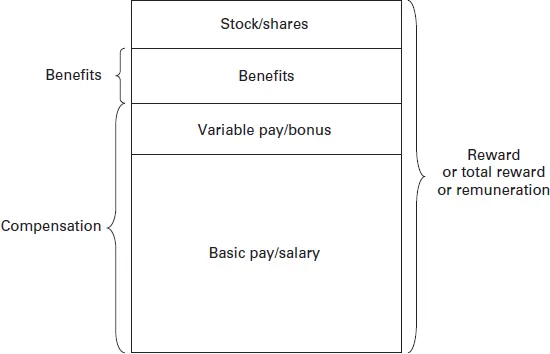
Reward can be broken into the four parts illustrated in Figure 1.1, which should also help explain the relationships between the terms discussed above.
Figure 1.1 implies the relative size of the four components, but of course this will vary considerably by corporate structure, sector, employee group and reward strategy.
Figure 1.1 The four components of reward
BASIC PAY/SALARY
Basic pay (also referred to as base pay) is the contractual salary and may include allowances that are paid regularly and are, in effect, salary. Basic pay is dealt with in Chapters 8 and 9. For the vast majority of people, basic pay will always be the largest part of their reward. The two main exceptions are:
- senior executives whose reward may incorporate a large potential annual bonus and very significant share plans; and
- sales people or traders whose bonus and commission potential may be much greater than their salary.
VARIABLE PAY/BONUS
Variable pay can come in many shapes and sizes, but mostly means some form of bonus. Unlike salary which is a fixed cost, variable pay is just that, variable – its payment will be contingent on something and so it may or may not be paid. If it is fixed, like a guaranteed bonus, I would consider this is the same as salary just dressed up as something else by using a different name. Bonus is discussed in Chapter 10.
BENEFITS
Benefits are not cash and will include tangible things like company cars, insured benefits like life assurance or medical insurance, pensions and some terms and conditions such as holidays. Whilst I have classified shares as a separate element of reward, primarily because for executives their value can be very large, they may be considered part of the benefit package. The range of benefits (covered in Chapter 13) will vary between sectors and, often, by seniority. Interestingly, the proportion of cost devoted to benefits can be highest in the UK public sector due to the pension arrangements. In the public sector defined benefit (DB) pension plans still dominate whilst they are now extremely rare in the private sector where some form of defined contribution (DC) plan is more common. The cost of a DB pension plan is normally very considerably higher than a DC plan.
STOCK/SHARES
Share plans, by definition, will only be available within private sector companies with shares. Shares are mostly available for the more senior employees, but some companies have ‘all employee share’ plans that allow everyone in the business to become a shareholder, usually by buying shares within a tax approved plan. The types of share plan will vary considerably and are heavily dependent on the relevant tax legislation. Shares are dealt with in Chapter 12.
The whole should be greater than the sum of the parts
Effective reward management is about both the individual elements of reward and the total cost and value. The different parts of reward may be for different purposes but they all cost money to provide, so the organization needs to look at the total as well as the separate elements. There will be some choices about where to spend the organization’s money to best effect in the balance between the different parts of reward. For example, fixed basic pay could be lower but with a high potential bonus or profit share. Or more could be spent on tax-efficient benefits that deliver good value to employees than fully taxable salary.
What is important is that the options and the impact of these choices are considered carefully taking a strategic approach and the rationale is clearly explained to employees. It was common in the past, and persists in many organizations today, that the different elements of reward were managed separately and sometimes in a piecemeal fashion. For example, cars were managed by fleet management, pensions by the pensions department and so on. Whilst this might have been administratively efficient, overlooking the total value proposition to employees would lose the value to the organization of their total spend on reward. I discuss how this can be helped by effective communications in Chapter 6.
Cost of reward
It is a surprise to some organizations quite how much they spend on the total cost of reward and in particular the proportional cost of the various elements. For example, I have worked with an organization where the cost of the DB pension for just 15 per cent of their employees cost half of the total amount spent on all benefits for the whole company. As you might expect, they did something about this inequitable spend.
A valuable way of considering the total cost of reward is as a proportion of all of the costs of an organization (property, technology, power, insu-rance, interest etc). Reward can be anything from 5 per cent to 75 per cent of total costs. At one end there is the service sector which has little capital employed and where reward is likely to be more than 70 per cent of total costs. At the other extreme, in a sector such as oil and gas, which uses a huge amount of capital, the total cost of reward can be less than 5 per cent of all costs. Whilst employment costs will be of interest to all finance directors and leaders of organizations, where they are by far the most significant cost, they should be given ...
Table of contents
- Acknowledgements
- About the author
- Introduction
- PART ONE The fundamentals of reward management
- 01 Reward and reward strategy
- 02 Why reward is important and how it can make an impact
- 03 Relationship between motivation and reward
- 04 How reward fits together
- 05 How to get started with a reward strategy
- 06 Communications
- 07 Tax and National Insurance
- PART TWO Reward in practice
- 08 Grades and pay structures
- 09 Managing pay data and pay reviews
- 10 Bonus plans
- 11 Recognition and non-cash reward
- 12 Long-term plans
- 13 Benefits
- 14 Conclusions
- Appendix
- References
- Index
- HR Fundamentals series
Trusted by 375,005 students
Access to over 1.5 million titles for a fair monthly price.
Study more efficiently using our study tools.
Frequently asked questions
Yes, you can cancel anytime from the Subscription tab in your account settings on the Perlego website. Your subscription will stay active until the end of your current billing period. Learn how to cancel your subscription
No, books cannot be downloaded as external files, such as PDFs, for use outside of Perlego. However, you can download books within the Perlego app for offline reading on mobile or tablet. Learn how to download books offline
Perlego offers two plans: Essential and Complete
- Essential is ideal for learners and professionals who enjoy exploring a wide range of subjects. Access the Essential Library with 800,000+ trusted titles and best-sellers across business, personal growth, and the humanities. Includes unlimited reading time and Standard Read Aloud voice.
- Complete: Perfect for advanced learners and researchers needing full, unrestricted access. Unlock 1.5M+ books across hundreds of subjects, including academic and specialized titles. The Complete Plan also includes advanced features like Premium Read Aloud and Research Assistant.
We are an online textbook subscription service, where you can get access to an entire online library for less than the price of a single book per month. With over 1.5 million books across 990+ topics, we’ve got you covered! Learn about our mission
Look out for the read-aloud symbol on your next book to see if you can listen to it. The read-aloud tool reads text aloud for you, highlighting the text as it is being read. You can pause it, speed it up and slow it down. Learn more about Read Aloud
Yes! You can use the Perlego app on both iOS and Android devices to read anytime, anywhere — even offline. Perfect for commutes or when you’re on the go.
Please note we cannot support devices running on iOS 13 and Android 7 or earlier. Learn more about using the app
Please note we cannot support devices running on iOS 13 and Android 7 or earlier. Learn more about using the app
Yes, you can access Reward Management by Michael Rose in PDF and/or ePUB format, as well as other popular books in Business & Human Resource Management. We have over 1.5 million books available in our catalogue for you to explore.