Many information professionals working in small units today fail to find the published tools for subject-based organization that are appropriate to their local needs, whether they are archivists, special librarians, information officers, or knowledge or content managers. Large established standards for document description and organization are too unwieldy, unnecessarily detailed, or too expensive to install and maintain. In other cases the available systems are insufficient for a specialist environment, or don't bring things together in a helpful way. A purpose built, in-house system would seem to be the answer, but too often the skills necessary to create one are lacking. This practical text examines the criteria relevant to the selection of a subject-management system, describes the characteristics of some common types of subject tool, and takes the novice step by step through the process of creating a system for a specialist environment. The methodology employed is a standard technique for the building of a thesaurus that incidentally creates a compatible classification or taxonomy, both of which may be used in a variety of ways for document or information management. Key areas covered are: What is a thesaurus? Tools for subject access and retrieval; what a thesaurus is used for? Why use a thesaurus? Examples of thesauri; the structure of a thesaurus; thesaural relationships; practical thesaurus construction; the vocabulary of the thesaurus; building the systematic structure; conversion to alphabetic format; forms of entry in the thesaurus; maintaining the thesaurus; thesaurus software; and; the wider environment. Essential for the practising information professional, this guide is also valuable for students of library and information science.
- 303 pages
- English
- PDF
- Available on iOS & Android
eBook - PDF
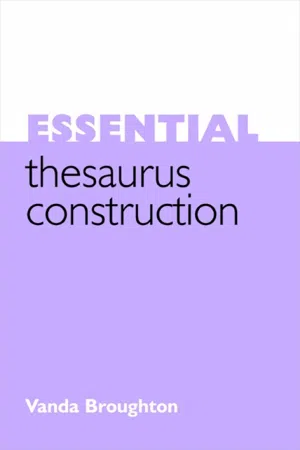
Essential Thesaurus Construction
About this book
Information
Table of contents
- Title page
- Contents
- 1 Introduction
- 2 What is a thesaurus?
- 3 Tools for subject access and retrieval
- 4 What a thesaurus is used for
- 5 Why use a thesaurus?
- 6 Types of thesaurus
- 7 The format of a thesaurus
- 8 Building a thesaurus 1: vocabulary collection
- 9 Vocabulary control 1: selection of terms
- 10 Vocabulary control 2 :form of entry
- 11 Building a thesaurus 2: term extraction from document titles
- 12 Building a thesaurus 3: vocabulary analysis
- 13 The thesaural relationships
- 14 Building a thesaurus 4: introducing internal structure
- 15 Building a thesaurus 5: imposing hierarchy
- 16 Building a thesaurus 6: compound subjects and citation order
- 17 Building a thesaurus 7: conversion of the taxonomy to alphabetical format
- 18 Building a thesaurus 8: creating the thesaurus records
- 19 Managing and maintaining the thesaurus: thesaurus software
- 20 Conclusion
- Glossary
- Bibliography
- Appendix 1 Sample titles for thesaurus vocabulary
- Appendix 2 Sample terms for the thesaurus
- Appendix 3 Facets at stage 1 of analysis
- Appendix 4 Facets at stage 2 of analysis
- Appendix 5 Completed systematic display
- Appendix 6 Thesaurus entries for sample page
- Index
Trusted by 375,005 students
Access to over 1.5 million titles for a fair monthly price.
Study more efficiently using our study tools.
Frequently asked questions
Yes, you can cancel anytime from the Subscription tab in your account settings on the Perlego website. Your subscription will stay active until the end of your current billing period. Learn how to cancel your subscription
No, books cannot be downloaded as external files, such as PDFs, for use outside of Perlego. However, you can download books within the Perlego app for offline reading on mobile or tablet. Learn how to download books offline
We are an online textbook subscription service, where you can get access to an entire online library for less than the price of a single book per month. With over 1.5 million books across 990+ topics, we’ve got you covered! Learn about our mission
Look out for the read-aloud symbol on your next book to see if you can listen to it. The read-aloud tool reads text aloud for you, highlighting the text as it is being read. You can pause it, speed it up and slow it down. Learn more about Read Aloud
Yes! You can use the Perlego app on both iOS and Android devices to read anytime, anywhere — even offline. Perfect for commutes or when you’re on the go.
Please note we cannot support devices running on iOS 13 and Android 7 or earlier. Learn more about using the app
Please note we cannot support devices running on iOS 13 and Android 7 or earlier. Learn more about using the app
Yes, you can access Essential Thesaurus Construction by Vanda Broughton in PDF and/or ePUB format, as well as other popular books in Languages & Linguistics & Library & Information Science. We have over 1.5 million books available in our catalogue for you to explore.