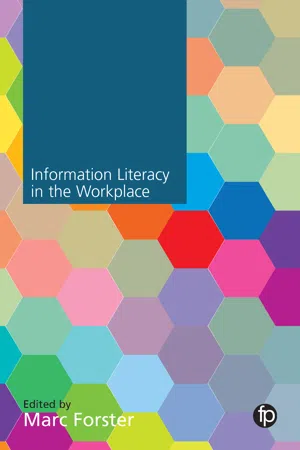
This book explains how information literacy (IL) is essential to the contemporary workplace and is fundamental to competent, ethical and evidence-based practice. In today's information-driven workplace, information professionals must know when research evidence or relevant legal, business, personal or other information is required, how to find it, how to critique it and how to integrate it into one's knowledge base. To fail to do so may result in defective and unethical practice which could have devastating consequences for clients or employers. There is an ethical requirement for information professionals to meet best practice standards to achieve the best outcome possible for the client. This demands highly focused and complex information searching, assessment and critiquing skills. Using a range of new perspectives, Information Literacy in the Workplace demonstrates several aspects of IL's presence and role in the contemporary workplace, including IL's role in assuring competent practice, its value to employers as a return on investment, and its function as an ethical safeguard in the duty and responsibilities professionals have to clients, students and employers. Chapters are contributed by a range of international experts, including Christine Bruce, Bonnie Cheuk, Annemaree Lloyd with a foreword from Jane Secker. Content covered includes: - examination of the value and impact of IL in the workplace - how IL is experienced remotely, beyond workplace boundaries - IL's role in professional development - organizational learning and knowledge creation - developing information professional competencies - how to unlock and create value using IL in the workplace. This book will be useful for librarians and LIS students in understanding how information literacy is experienced by professions they support; academics teaching professional courses; professionals (e.g. medical, social care, legal and business based) and their employers in showing that IL is essential to best practice and key to ethical practice.
- 208 pages
- English
- PDF
- Available on iOS & Android
eBook - PDF
Information Literacy in the Workplace
About this book
Information
Table of contents
- Title page
- Contents
- Chapter 1. Information Literacy and the workplace: new concepts, new perspectives?
- Chapter 2. How is Information Literacy experienced in the workplace?
- Chapter 3. Information Literacy and the personal dimension: team players, empowered clients and career development
- Chapter 4. From transaction to transformation: organizational learning and knowledge creation experience within Informed Systems
- Chapter 5. Virtuality at work: an enabler of professional Information Literacy
- Chapter 6. Determining the value of Information Literacy foremployers
- Chapter 7. Information Literacy’s role in workplace competence, ‘best practice’ and the ethics of professional obligation
- Chapter 8. Learning within for beyond: exploring a workplace Information Literacy design
- Chapter 9. Developing information professional competences in disciplinary domains: a challenge for higher education
- Chapter 10. The ‘hidden’ value of Information Literacy in the workplace context: how to unlock and create value
- Chapter 11. The ‘Workplace Experience Framework’ and evidence-based Information Literacy education
- References
- Index
Trusted by 375,005 students
Access to over 1.5 million titles for a fair monthly price.
Study more efficiently using our study tools.
Frequently asked questions
Yes, you can cancel anytime from the Subscription tab in your account settings on the Perlego website. Your subscription will stay active until the end of your current billing period. Learn how to cancel your subscription
No, books cannot be downloaded as external files, such as PDFs, for use outside of Perlego. However, you can download books within the Perlego app for offline reading on mobile or tablet. Learn how to download books offline
Perlego offers two plans: Essential and Complete
- Essential is ideal for learners and professionals who enjoy exploring a wide range of subjects. Access the Essential Library with 800,000+ trusted titles and best-sellers across business, personal growth, and the humanities. Includes unlimited reading time and Standard Read Aloud voice.
- Complete: Perfect for advanced learners and researchers needing full, unrestricted access. Unlock 1.5M+ books across hundreds of subjects, including academic and specialized titles. The Complete Plan also includes advanced features like Premium Read Aloud and Research Assistant.
We are an online textbook subscription service, where you can get access to an entire online library for less than the price of a single book per month. With over 1.5 million books across 990+ topics, we’ve got you covered! Learn about our mission
Look out for the read-aloud symbol on your next book to see if you can listen to it. The read-aloud tool reads text aloud for you, highlighting the text as it is being read. You can pause it, speed it up and slow it down. Learn more about Read Aloud
Yes! You can use the Perlego app on both iOS and Android devices to read anytime, anywhere — even offline. Perfect for commutes or when you’re on the go.
Please note we cannot support devices running on iOS 13 and Android 7 or earlier. Learn more about using the app
Please note we cannot support devices running on iOS 13 and Android 7 or earlier. Learn more about using the app
Yes, you can access Information Literacy in the Workplace by Marc Forster in PDF and/or ePUB format, as well as other popular books in Business & Information Management. We have over 1.5 million books available in our catalogue for you to explore.