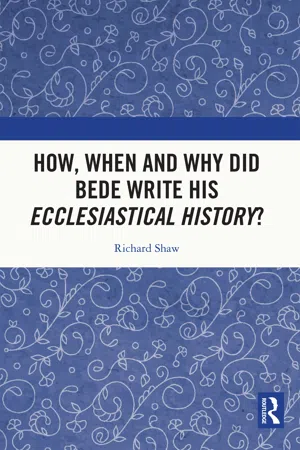
Bede's Ecclesiastical History is our main source for early Christian Anglo-Saxon England, but how was it written? When? And why? Scholars have spent much of the last half century investigating the latter question – the 'why'. This new study is the first to systematically consider the 'how' and the 'when'. Richard Shaw shows that rather than producing the History at a single point in 731, Bede was working on it for as much as twenty years, from c. 715 to just before his death in 735. Unpacking and extending the period of composition of Bede's best-known book makes sense of the complicated and contradictory evidence for its purposes. The work did not have one context, but several, each with its own distinct constructed audiences. Thus, the History was not written for a single purpose to the exclusion of all others. Nor was it simply written for a variety of reasons. It was written over time – quite a lot of time – and as the world changed during that time, so too did Bede's reasons for writing, the intentions he sought to pursue – and the patrons he hoped to please or to placate.
- 332 pages
- English
- ePUB (mobile friendly)
- Available on iOS & Android
eBook - ePub
How, When and Why did Bede Write his Ecclesiastical History?
1 Introduction The Ecclesiastical History in context
DOI: 10.4324/9780429022425-1
Bede’s Historia ecclesiastica [HE] is our main source for early Christian Anglo-Saxon England, but how was it written? When? And why? Historians have spent much of the last half century investigating the last question – the ‘why?’. In contrast, much of the content of the present book is focused on when and how Bede wrote his most famous work. The central thesis of this study is that it is not possible to fully appreciate the nuances of Bede’s purposes in the HE without trying to reconstruct how and when he wrote it.
Recent historiography has suggested and debated a variety of possible agendas behind the HE, casting invaluable light on Bede and the History and amounting effectively to a new wave of Bedan studies. Each hypothesis can be supported by evidence from the HE; equally, other material in the History undermines each proposed theory’s claim to having found the reason that Bede wrote the work. Without special pleading, no single proposal devised so far comprehensively accounts for all the evidence in the HE. Thus, the search for one that does continues. The present book argues that such an all-encompassing explanation will never be discovered and that the pursuit of one is fundamentally flawed, because it is based on a misunderstanding of the way that Bede wrote the History.
All the main motivations recently proposed for Bede’s writing of the HE have been grounded in views of the contemporary ecclesio-political context. But what was that context? The attempt to find a single dominant agenda behind the HE assumes that Bede produced the History at an essentially single point or in effectively unchanging circumstances. As the present investigation will show, he did not. Bede composed the HE over a period of as much as twenty years. Different parts reflect different layers of composition at different times. The shifting contexts over this period explain the contradictory evidence for motivations in the HE. As the context changed, so, too, did Bede’s purposes, at least partly because ‘Bede’s purposes’ were not always ‘his’; they were those of his patrons – and who his patrons were also altered with the shifting ecclesio-political context. Bede adapted the HE as he wrote it to differing conditions and for differing audiences, resulting in a book which reflects multiple purposes. Bede, of course, attempted to smooth out the tensions to produce a coherent piece of literature; in this, he was remarkably successful, as the enduring reputation of the HE testifies, but evidence for the layers nonetheless remains.
This study, therefore, is intended first as a history of the writing of Bede’s History, and then, and on that basis, as an attempt to resolve the current impasse on the problem of the agendas behind the HE. From the start, however, it must be acknowledged that this volume can represent only a beginning to a much wider enterprise beyond the capacity of a single scholar or the confines of a single book.
1.1 Why did Bede write the HE? Modern theories and their evidence
Until relatively recently, the HE tended to be viewed as a generally objective account of the early Christian Anglo-Saxon past. What was seen as a credulous approach to the miraculous was criticised (Levison, 1935: 146; Jones, 1946: 31; Gransden, 1974: 20), but it seemed easy to distil the positivist reality from the History by simply removing such elements in retelling Bede’s stories, especially as, contrasted to other authors of the time, the HE’s miracle stories appeared less fabulous (Jones, 1947: 90; Gransden, 1974: 21; Ward, 1976: 71–72; 75). The other potentially discrediting factor was the History’s apparent obsession with the Easter question (Plummer: 2.201; Levison, 1935: 146). This was understandable as an idiosyncratic tic in a Christian scholar who had spent as much of his life as Bede had on computus – that is, the study of ecclesiastical calculation, especially relating to the dating of Easter. The Easter emphasis was a perspective that, again, could easily be discounted in recapitulating the narrative of the conversion of the English. Otherwise, Bede was often almost seen as ‘one of us’ by early and mid-twentieth-century historians – an objective historian interested in giving an account of the past that was based on an analysis of the sources and written for its own sake (Laistner, 1966a: 98–99; Hunter Blair, 1970a: 77; Stenton, 1971: 187; Gransden, 1974: 16; 24–25).
This is not to dismiss some of the excellent studies of the HE by nineteenth- and twentieth-century scholars – many of which remain essential reading today (Plummer; Levison, 1935; Jones, 1946; Jones, 1947).1 Nonetheless, in the last quarter of the twentieth century, scholars increasingly emphasised that Bede, like everyone else, had biases and could not be treated as a basically independent arbiter of events. Two essays by James Campbell were vital in this shift (Campbell, 1986a, 1986b). Bede wrote in context. Bede’s perspectives and assumptions are a matter worthy of study; consciously and unconsciously, they affected his portrayal of events. As a result, Bedan scholarship as a whole began to look more closely at his literary corpus beyond the HE, on the basis that ‘biblical commentary, not history, was the privileged focus of Bede’s scholarship’ (Goffart, 2005a: 238) and with the understanding that the HE was produced only after a life dedicated to exegesis (DeGregorio, 2006b: 2). The primary focus of Bedan studies today is more his exegesis than his History, with crucial lessons for our understanding of Bede, of early medieval intellectual life and, indirectly, of the HE itself: the essays in some of the recent scholarly collections are good examples of this trend (Lebecq, Perrin and Szerwiniack, 2005; DeGregorio, 2006a; DeGregorio 2010a; Darby and Wallis, 2014a; Darby and MacCarron, forthcoming). Such investigations have emphasised Bede as an original thinker and writer rather than, as he presented himself, a narrow follower ‘in the footsteps of the Fathers’ (Ray, 2006; Thacker, 2006).
Bede’s intentionality in the HE went beyond the mere impact of his assumptions. Scholars began to ask why Bede produced the History at all. Most scholarly attention paid to the HE over the last half century has directly or indirectly considered Bede’s purposes in producing the History. These agendas, it is argued, lay behind the writing of the HE; only in their light, can the book be fully understood. The new emphasis on Bede’s intentions in the HE has been accompanied by a clearer sense of Bede’s personal interest in the concerns of his own time. His composition of the Letter to Ecgberht [EEE] in 734 demonstrates that Bede was engaged in the issues of the day. The HE was dedicated to King Ceolwulf; Bede’s Preface is up front about his desire to influence the king through the History. The ‘ecclesiastical’ part of the title should not disguise the reality – an unavoidable reality – that a history of the Church would be partly political. Bede was writing about politics and inevitably responded to politics – of the past and present, and presumably with an eye to his hopes for the future. As a result, most examinations of Bede’s reasons for writing the History have concluded that the answers lie in an understanding of the contemporary ecclesio-political situation. The following tour seeks to summarise, while no doubt oversimplifying, the main modern theories for Bede’s agenda in the HE and to consider some of the evidence for and against each individual theory.
1.1.1 Bede and the ‘Ghost of Bishop Wilfrid’
Probably the most influential account of Bede’s purposes has been that of Walter Goffart. The impact of Goffart’s arguments means that they merit more extensive treatment than others will be given. Goffart made his initial case in 1988 in The Narrators of Barbarian History and developed it, responding to certain lines of criticism in later book chapters and articles (Goffart, 2005a: 1–19; 235–328; ix–xv, and xxvi–xxx; Goffart, 1990; Goffart, 2005b; Goffart, 2005c; and Goffart, 2006). Goffart’s arguments are complex and simplification can risk dismissing them. In essence, there are four interconnected contentions.
His first point was a general one with an import well beyond Bede and his History: early medieval authors were not mere compilers of facts or rumour – they had agency (Goffart, 2005a: xxxv, from original preface). The second point was that Bede’s corpus as whole, but especially the HE, must be viewed within his contemporary ecclesio-political circumstances (Goffart, 2005c: 158). Bede did not write for the future but for the present (Goffart, 2005a: 16) – and specifically for Northumbria, which Goffart saw as the subject of the HE, not the English. Bede intended to reflect on and affect ongoing disputes by framing the narrative of Christian Northumbria in the seventh century based on his perspective on political trends in the eighth. Goffart’s third, and most important, point was that the primary political context for the HE was the enduring controversy over the role of Wilfrid – a controversy which continued after Wilfrid’s death (in 710: Kirby, 1983: 113; Stancliffe, 2013 – although Bede may have thought it was 709), thanks to the perseverance, so it is claimed, of a Wilfridian party centred on Acca, Wilfrid’s successor as bishop of Hexham. Acca was Bede’s diocesan for most of his literary career and the dedicatee of many of Bede’s commentaries. Even so, Goffart argued that Bede was opposed to the Wilfridians. In this picture, Bede favoured a view of early Christian Northumbria that emphasised the role of St Cuthbert, and other Irish, or Irish-influenced, clerics, to the detriment of Wilfrid and the model of episcopacy that Stephen of Ripon’s Life of Wilfrid [VW], written 712x714 (Thacker, 2010: 186; Stancliffe, 2013), suggests that Wilfrid represented. This attitude on Bede’s part linked him to Lindisfarne, for whom he wrote a prose Life of Cuthbert [VCP]. In that work, Bede subtly contested the perspective presented in the VW and attempted to win back momentum for those seeking to present Cuthbert as a model of Northumbrian clerical, and especially episcopal and monastic, life. Goffart then claimed that Bede took this to the next level in the HE, subtly recasting the whole history of the Church in Northumbria to minimise, criticise and sanitise Wilfrid’s role, though it could never be entirely erased. Finally, in his fourth point, Goffart saw signs in the HE of attempts by Bede to build the case for turning York into a metropolitan archbishopric, something which did happen, in 735, Bede’s year of death.
Goffart’s suggestions sparked energetic controversy among Bedan scholars. In general, however, they have, to a great extent, been absorbed into accounts of Bede and the HE. The idea of agency in the HE is now widely accepted; the proposal that this derived from the ecclesio-political context now tends to be assumed. Even the specifics of that context – the Wilfrid question – have largely been adopted. Goffart was breaking new ground, so his binary presentation of the controversy was understandable. In critiquing Goffart’s conclusions, other scholars have added more nuance to the picture. Alan Thacker has suggested that there may have been mo...
Table of contents
- Cover Page
- Half Title Page
- Title Page
- Copyright Page
- Dedication
- Contents
- List of Tables
- Acknowledgements
- Abbreviations
- 1 Introduction: The Ecclesiastical History in context
- 2 The process and logistics of collecting and analysing material for the HE
- 3 Bede, Canterbury and the origins of the HE
- 4 The original context for the HE: Easter and ecclesiastical authority
- 5 The HE after 731
- 6 Post-731 Northumbria and the HE
- 7 Conclusion: The HE’s shifting purposes in context
- Appendix 1: Sourcing the HE
- Appendix 2: Bede’s Calculation Table
- Select Bibliography
- Index
Trusted by 375,005 students
Access to over 1.5 million titles for a fair monthly price.
Study more efficiently using our study tools.
Frequently asked questions
Yes, you can cancel anytime from the Subscription tab in your account settings on the Perlego website. Your subscription will stay active until the end of your current billing period. Learn how to cancel your subscription
No, books cannot be downloaded as external files, such as PDFs, for use outside of Perlego. However, you can download books within the Perlego app for offline reading on mobile or tablet. Learn how to download books offline
Perlego offers two plans: Essential and Complete
- Essential is ideal for learners and professionals who enjoy exploring a wide range of subjects. Access the Essential Library with 800,000+ trusted titles and best-sellers across business, personal growth, and the humanities. Includes unlimited reading time and Standard Read Aloud voice.
- Complete: Perfect for advanced learners and researchers needing full, unrestricted access. Unlock 1.5M+ books across hundreds of subjects, including academic and specialized titles. The Complete Plan also includes advanced features like Premium Read Aloud and Research Assistant.
We are an online textbook subscription service, where you can get access to an entire online library for less than the price of a single book per month. With over 1.5 million books across 990+ topics, we’ve got you covered! Learn about our mission
Look out for the read-aloud symbol on your next book to see if you can listen to it. The read-aloud tool reads text aloud for you, highlighting the text as it is being read. You can pause it, speed it up and slow it down. Learn more about Read Aloud
Yes! You can use the Perlego app on both iOS and Android devices to read anytime, anywhere — even offline. Perfect for commutes or when you’re on the go.
Please note we cannot support devices running on iOS 13 and Android 7 or earlier. Learn more about using the app
Please note we cannot support devices running on iOS 13 and Android 7 or earlier. Learn more about using the app
Yes, you can access How, When and Why did Bede Write his Ecclesiastical History? by Richard Shaw in PDF and/or ePUB format, as well as other popular books in History & World History. We have over 1.5 million books available in our catalogue for you to explore.