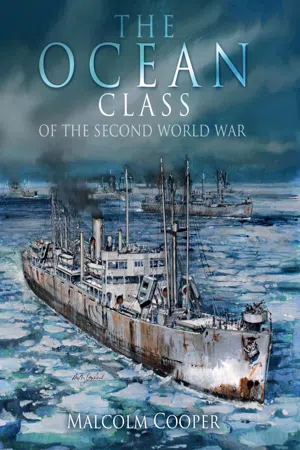
This new book tells the story of the Ocean class of standard cargo ships, their design, building, and careers, and the author places them firmly in the context of the battle of the Atlantic which was raging at the time of the first launchings. They entered the vanguard of the Allied shipping effort at a time when the German U-boat threat was at its most dangerous, and British shipping resources were stretched to the limit. They were deployed in the North Atlantic, on the long supply routes around Africa to the Middle East, in the Russian convoys, in operations in support of the invasions of North Africa and Italy and the land campaigns which followed, in the D-Day landings, and later amphibious operations on the south coast of France. Finally, some of the class joined an invasion force making its way towards Malaya when Japan surrendered in August 1945. The Oceans paid a heavy price for these accomplishments, one third of the class being lost to torpedoes, bombs, or mines in places as far apart as the Florida coast, the Norwegian Sea, the Bay of Algiers, and the Gulf of Oman. While these achievements alone would merit an important place in histories of the war at sea, the impact of the Oceans stretched far beyond the direct contribution of the ships themselves. The yards where they were built also served as models for a series of new American shipyards, designed to mass produce cargo vessels with such speed and in such volume as to completely reverse the mathematics of attrition, which had run so badly against the Allies into 1942. Even more important, the Oceans' blueprints were used as the basis for the American Liberty ship, the 2,700-strong fleet which finally tilted the balance of the war at sea decisively in the Allies' favor and went on to underpin the post-war renewal of the world merchant fleet. This comprehensive new history, based on extensive archival research and lavishly illustrated with contemporary photographs, restores the Oceans to their rightful place in history. The ships' design antecedents are explained, and their ordering, financing, and construction analyzed in full. Wartime operations are covered in depth, by theater, and with full details of war losses and other casualties. The book concludes with an assessment of their subsequent peacetime careers and a comparison to other war-built designs. This is a model history of a highly significant class of ship.
Torpedoed on 17 October 1940, the Whitby tramp steamer Scoresby (3,843g/1923) was just one of seven ships sunk by U 48 on a single patrol at a time when British shipping losses were threatening to outstrip the country’s capacity to replace them.
(R M Scott/Roy Fenton collection)
The Origins of the Shipbuilding Crisis
The British government’s decision to order new merchant ship tonnage in the United States was born of a series of developments in the summer of 1940 which, together, made it clear that domestic new-building and the acquisition of existing tonnage from other sources would fall well short of meeting the expanding requirements of the war. The picture here was complex. Overall, the shrinkage of the domestic shipbuilding industry in the inter-war period had left it poorly placed to face the challenge of hostilities. The two basic components of this challenge were the industry’s increasingly obvious inability to produce enough new tonnage to replace growing losses; and the geo-political and logistic developments associated with the war which had greatly increased the amount of tonnage required to supply the home islands and support the war effort.
The shortage of shipbuilding capacity was the product of both long-term and war-related factors. In the first of these cases, the inter-war period had witnessed a significant reduction in the number of large British shipyards. One group of long-established concerns went under after the implosion of the post-Great War shipping boom in the early 1920s. Another failed to survive the near-complete cessation of orders during the Great Depression. Finally, one last group of yards were purchased and closed in the 1930s by the National Shipbuilders Security Ltd (NSS), a government-sponsored and industry-financed scheme created to eliminate what was then perceived as over-capacity to improve the competitiveness and profitability of the remaining yards. To give an idea of the extent of the shrinkage, the hitherto well-established cluster of shipyards in the Tees–West Hartlepool area (which had been particularly strong in the construction of deep sea tramp tonnage) saw the disappearance of five long-established firms: Craig, Taylor & Co; Richardson, Duck & Co; Ropner & Sons; Sir Raylton Dixon & Co; and Irvine’s Shipbuilding. Significant casualties elsewhere included Workman, Clark & Co in Belfast; D & W Henderson on the Clyde; Palmers’ Shipbuilding & Iron on the Tyne; and Earle’s Shipbuilding & Engineering in Hull.
Merchant shipbuilding also suffered from a progressive switch of surviving berths to warship construction. Naval rearmament had seen an ongoing increase in warship orders from the mid-1930s. In the short term, this had not impacted significantly on mercantile output as many commercial owners were reluctant to undertake significant fleet renewal or expansion in the uncertain market conditions then prevalent. Naval demand, however, accelerated as war approached, and continued to grow after hostilities began, the calls on yard capacity rising further as war damage and increased service wear and tear produced ever-expanding repair and refit requirements. It rapidly became clear that conflicting demands on berths could only be managed effectively if responsibility were placed in the hands of a single government ministry. Of the two possible candidates, the Admiralty, and the newly created Ministry of Shipping, it is perhaps not surprising that it was the former, always likely to emerge as the senior partner, which was given controlling powers when the decision was taken to unify procurement decision making at the end of January 1940.
Turning from shipbuilding capacity to the wartime demand for merchant shipping, this expanded in two clear stages during the first year of the war. The first of these was triggered by the outbreak of hostilities. The UK was heavily dependent on sea-borne imports of both foodstuffs and many industrial commodities. These demands increased rapidly as the British Government searched overseas for war-related materials, and as merchant shipping was deployed to supply the British Expeditionary Force in France. The immediate introduction of convoys decreased the productivity of shipping itself as it increased not only voyage durations, but also time spent in port, both assembling the convoys at one end, and dealing with increased port congestion at the other. Finally, Admiralty requisition for naval service removed a growing number of vessels from commercial service, including a disproportionate percentage of fast modern tonnage.
If the developments of the early months of the war were burdensome, those of the spring and summer of 1940 were exponentially more severe. They largely stemmed from the German invasion and conquest of Denmark, Norway, the Netherlands, Belgium, and France, and from the entry of Italy into the war as a German ally. The major consequences of this series of disasters can be summarised as follows:
-The closure of the Baltic and the consequent loss of imports, particularly wood products and iron ore (the latter loss compounded by the loss of the Norwegian outlet for Swedish iron ore exports at Narvik)
-The loss of manufacturing capacity (particularly for the heavy forgings essential for marine engineering) in the industrial areas of north Europe in France and the Low Countries, and across the region of shipbuilding berths (foreign yards being particularly prominent in the production of tankers and motor ships)
-The closure of the Mediterranean as a result of the Italian declaration of war with another regional loss of imports, and, more seriously, the forced diversion of Allied shipping around South Africa, producing much longer voyage times both for imports from India and the Far East, and the carriage of supplies to support the increasingly important military campaign in North Africa’s Western Desert
-The displacement of sources of imported goods to more distant ports, for example wood products and iron ore to eastern Canada, and the increasing requirement to supplement home production of strategic resources such as steel with heavy imports, primarily from the United States
-The general squeeze on the import of foodstuffs from distant markets in North and South America, and Australasia as a result of competing requirements from other trades, and the need for convoying in the final stage of the inward voyage
-The partial closure of the English Channel and ports in the south of the country, and consequent increases in the length and number of coasting voyages, and of levels of congestion in northern ports.
A victim of the widening U-Boat offensive, Reardon Smith’s Jersey City (6,332g/1920), seen here at Vancouver, succumbed to a torpedo from U 99 northwest of Ireland on 31 July 1940.
(Walter E Frost/City of Vancouver Archives CVA 447-2339)
Thus, the demand for tonnage was increasing as the output of tonnage was decreasing, which in turn was further increasing demand. This was taking place at a time when merchant shipping losses appeared to be spiralling upwards, and domestic shipbuilding output seemed increasingly likely to fall short of expectations. As early as the beginning of June 1940, the Admiralty was telling the War Cabinet that the target for annual production of mercantile tonnage to be achieved by the first half of 1941, which had been established as 1.5 million tons as recently as 1 February 1940, would need to be reduced to 1.1 million tons. In making the case for the lower target, Sir James Lithgow, the Controller of Merchant Shipbuilding and Repairs at the Admiralty, cited the main causes as bottlenecks in the supply of heavy forgings and castings required for propelling machinery, and of rolled steel for boilers and hulls, as well as shortages of trained manpower in engineering and shipbuilding establishments. Responding on 7 June 1940 to the Admiralty’s suggestion that the output target be reduced, the Minister of Shipping rehearsed the problems the British were facing, highlighting ‘the losses incurred in recent operations, the additional demands on merchant shipping for direct naval and military purposes, the reduction in importing capacity due to diversion from the Mediterranean, the possible further reduction arising from the accentuated risks of interruption to the working of our ports, the necessity of resorting to more distant sources of supply for iron ore, timber and other commodities and the greatly increased demands of the French due to the effect on their production of the German invasion.’
The situation would get much worse over the next few weeks. By the end of June, the Allies had lost the campaign in Norway, and France had surrendered, leaving Britain alone in Europe to face not only Germany but its new Axis ally Italy. The entire western coastline of the continent, from North Cape to the Pyrenees, was now in enemy hands, while the Mediterranean had been closed to any merchant shipping not supported by a heavy naval escort. This gloomy picture was made darker still by a sharp increase in mercantile losses from enemy action. Reviewing the situation in mid-July, the Minister of Shipping noted that the average weekly loss rate due to enemy submarines of British-flagged vessels was 40,000 tons over the five-week period ending 14 July, and that the figure rose to 70,000 tons per week when allied and neutral losses were added. When losses due to all other causes (of which those from air attack were particularly severe) were added, the total weekly loss rate over the five weeks in question reached 116,000 tons, a level which, if sustained, would result in annual losses of roughly six million tons. A follow-up War Cabinet memorandum by the First Lord of the Admiralty and the Minister without Portfolio dated 16 August suggested that a continuation of current casualty rates would result in annual losses (exclusive of marine causes) of between 4.5 and 6 million tons, adding: ‘whether or not our losses reach these dimensions, there can be no doubt that our shipping position is likely to be one of considerable difficulty by the winter of 1941–42.’
The Emergence of the American Solution
The British government responded to the progressive deterioration of the strategic situation through the spring and early summer of 1940 with a series of different measures to improve its shipping capacity. As the Netherlands and Belgium fell to the German invaders in May, so their surviving merchant fleets were chartered to operate under British control, with responsibility for manning and day-to-day management being retained by shipping missions established in London by their respective governments-in-exile. A similar arrangement brought part of the large Norwegian merchant fleet into the fold in June, although in this instance roughly one-third of the ships controlled by the Norwegian Shipping and Trade Mission (Nortraship) were managed by a second office in New York and would not come under British charter and control until early 1942. The governments of the other two countries to fall in 1940, Denmark and France, remained in place at home under varying degrees of German influence, and in both cases Britain responded by seizing all ships found in port or intercepted at sea and operating them under the British flag.
Even while these measures were still underway, the Ministry of Shipping began to restock Britain’s own shipping inventory by direct purchases from the neutral world’s largest pool of surplus tonnage, the United States merchant marine. When America entered the First World War in April 1917, the newly established US Shipping Board and its associated Emergency Fleet Corporation requisitioned all ships building in American yards, including 150 vessels of 869,000dwt on order for the British Shipping Controller, and launched a massive building programme which by October 1919 would complete just under 1,500 vessels aggregating another 8.1 million dwt. This armada far exceeded the peacetime needs of the US economy, and much of it went straight into long-term layup. This surplus fleet was further swelled in the winter of 1939–40 as commercial operators withdrew vessels from transatlantic services suspended under the provisions of the Neutrality Acts.
The first British purchases, all from commercial operators of ships built in 1919–20, were completed in February 1940, the biggest single transaction eventually including five ships from the American–Hawaiian Steamship Company. The first two acquisitions, the ex-American–Hawaiian Delawarean, and Oakwood, a purchase from Lykes Brothers, sailed from Halifax in HX 24 on 2 March 1940. Oakwood’s machinery proved unequal to the challenge of maintaining convoy speed in the North Atlantic and she was forced to turn back for repairs, leaving Delawarean to be the first to arrive in Europe, unloading a consignment of trucks for the French government at Le Havre before delivering her remaining cargo of wheat and steel to the London docks on 25 March. Oakwood finally succeeded in completing her delivery crossing in HX 27, sailing in company with the second ex-American–Hawaiian acquisition, Louisianan. As with other vessels purchased outright or built for government account, the US-built veterans were given names beginning Empire after their arrival in Britain, Oakwood becoming Empire Moose, while Delawarean and Louisianan were renamed Empire Hawksbill and Empire Gannet, respectively. Britain would eventually acquire just over one hundred such ships, and casualties among them would be heavy. Of the first trio, only Empire Gannet would survive the war, Empire Moose being sunk by U 100 in August 1940 after straggling from her second westbound convoy, and Empire Hawksbill going down with her entire crew north of the Azores after being torpedoed by U 564 in July 1942.
Empire Haw...
Table of contents
Cover
Title
Copyright
Contents
Acknowledgements
Introduction
CHAPTER 1 – Genesis
CHAPTER 2 – Mission to America
CHAPTER 3 – Building the Oceans
CHAPTER 4 – The Oceans at War
CHAPTER 5 – Wartime Casualties
CHAPTER 6 – The Oceans at Peace
CHAPTER 7 – Evaluation and Conclusions
APPENDIX 1 – Ocean Class Vessel Specifications
APPENDIX 2 – Ocean Class Vessel Histories
APPENDIX 3 – Valour and Strength in the Firing Line: Two Oceans at War
APPENDIX 4 – Manning the Oceans
APPENDIX 5 – The Cost of War
Bibliography
Trusted by 375,005 students
Access to over 1.5 million titles for a fair monthly price.
Study more efficiently using our study tools.
Frequently asked questions
Yes, you can cancel anytime from the Subscription tab in your account settings on the Perlego website. Your subscription will stay active until the end of your current billing period. Learn how to cancel your subscription
No, books cannot be downloaded as external files, such as PDFs, for use outside of Perlego. However, you can download books within the Perlego app for offline reading on mobile or tablet. Learn how to download books offline
Perlego offers two plans: Essential and Complete
Essential is ideal for learners and professionals who enjoy exploring a wide range of subjects. Access the Essential Library with 800,000+ trusted titles and best-sellers across business, personal growth, and the humanities. Includes unlimited reading time and Standard Read Aloud voice.
Complete: Perfect for advanced learners and researchers needing full, unrestricted access. Unlock 1.5M+ books across hundreds of subjects, including academic and specialized titles. The Complete Plan also includes advanced features like Premium Read Aloud and Research Assistant.
Both plans are available with monthly, semester, or annual billing cycles.
We are an online textbook subscription service, where you can get access to an entire online library for less than the price of a single book per month. With over 1.5 million books across 990+ topics, we’ve got you covered! Learn about our mission
Look out for the read-aloud symbol on your next book to see if you can listen to it. The read-aloud tool reads text aloud for you, highlighting the text as it is being read. You can pause it, speed it up and slow it down. Learn more about Read Aloud
Yes! You can use the Perlego app on both iOS and Android devices to read anytime, anywhere — even offline. Perfect for commutes or when you’re on the go. Please note we cannot support devices running on iOS 13 and Android 7 or earlier. Learn more about using the app
Yes, you can access The Ocean Class of the Second World War by Malcolm Cooper in PDF and/or ePUB format, as well as other popular books in History & Military & Maritime History. We have over 1.5 million books available in our catalogue for you to explore.