Reclaiming Lives from Sexual Violence
eBook - ePub

Reclaiming Lives from Sexual Violence

Understanding Shame through Innovative Narrative Therapy

  1. 120 pages
  2. English
  3. ePUB (mobile friendly)
  4. Available on iOS & Android
eBook - ePub

Reclaiming Lives from Sexual Violence

Understanding Shame through Innovative Narrative Therapy

About this book

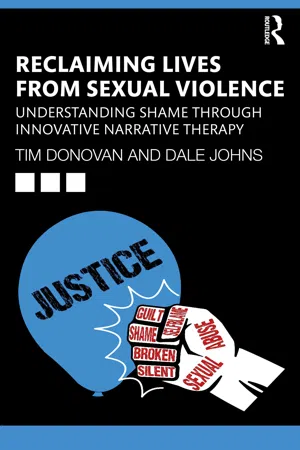
This book takes an innovative approach to using narrative therapy in counselling people who have been subject to childhood sexual abuse.

Reclaiming Lives from Sexual Violence presents an illustrative case study of the authors, Tim the therapist in consultation with Dale the client, who was sexually abused as a child by a clergy member. The book is unique in documenting their therapeutic work using transcripts taken directly from their sessions together. This narrative approach invites the reader to consider different ways of engaging in therapy in order to challenge the dominant social discourses around masculinity and shame.

Looking at shame from a position of value awareness rather than a deficit perspective, this book extends counselling to consider the individual experience as political and one that must be shared outside the one-to-one therapy environment. This will be an essential resource for beginning or established therapists and practitioners working with clients who have been victims of sexual violence.

Frequently asked questions

Yes, you can cancel anytime from the Subscription tab in your account settings on the Perlego website. Your subscription will stay active until the end of your current billing period. Learn how to cancel your subscription.
No, books cannot be downloaded as external files, such as PDFs, for use outside of Perlego. However, you can download books within the Perlego app for offline reading on mobile or tablet. Learn more here.
Perlego offers two plans: Essential and Complete
  • Essential is ideal for learners and professionals who enjoy exploring a wide range of subjects. Access the Essential Library with 800,000+ trusted titles and best-sellers across business, personal growth, and the humanities. Includes unlimited reading time and Standard Read Aloud voice.
  • Complete: Perfect for advanced learners and researchers needing full, unrestricted access. Unlock 1.4M+ books across hundreds of subjects, including academic and specialized titles. The Complete Plan also includes advanced features like Premium Read Aloud and Research Assistant.
Both plans are available with monthly, semester, or annual billing cycles.
We are an online textbook subscription service, where you can get access to an entire online library for less than the price of a single book per month. With over 1 million books across 1000+ topics, we’ve got you covered! Learn more here.
Look out for the read-aloud symbol on your next book to see if you can listen to it. The read-aloud tool reads text aloud for you, highlighting the text as it is being read. You can pause it, speed it up and slow it down. Learn more here.
Yes! You can use the Perlego app on both iOS or Android devices to read anytime, anywhere — even offline. Perfect for commutes or when you’re on the go.
Please note we cannot support devices running on iOS 13 and Android 7 or earlier. Learn more about using the app.
Yes, you can access Reclaiming Lives from Sexual Violence by Tim Donovan,Dale Johns in PDF and/or ePUB format, as well as other popular books in Psychology & Mental Health in Psychology. We have over one million books available in our catalogue for you to explore.

Information

1 Paying reverence to the stories we hear

DOI: 10.4324/9781003256816-2

Key points to consider

  • Double listening: Listening for accounts of how people have responded to their trauma.
    • Listening for the stories of self that lay beyond the problem story.
  • Self-awareness in your practice: Knowing when you are pushing your own agenda.
    • Seeing the client as the expert in their own lived experiences.
A narrative worldview supports the belief that no matter how compelling any given story might be, no matter how powerfully it is entrenched, there are always other stories. Michael White (2003) names the ability to hear both stories as ‘double listening’. Therefore, initially when the practitioner is listening to a person presenting problem stories of their suffering, their fears, their experience of sexual violence, at the same time, they can be listening for openings into stories that speak of other possibilities, alternative accounts of how people have responded to the trauma. Paying attention and drawing out the actions they may have taken during their experience of oppression requires continual reassurance and sensitivity from the practitioner. It depends on many factors as to when these conversations can be had – for instance, the person needs to be ready to move beyond the problem story. This can take time and requires patience from the practitioner. Exploring these reclaimed ideas of self can occur when the conversation moves towards the often-neglected stories of a person’s response to their experience of sexual violence, and it can enable the excavation of what the person stands for and how they wish to live their life. Through conversations where the knowledge and experience of a person become more richly described, the person can identify with their own experiences. Furthermore, White (2003) used the term ‘absent but implicit’ to convey the understanding that in the expression of any experience of life, there is a discernment we make between the expressed experience and other experiences that have already been given meaning and provide a contrasting backdrop, thus shaping the expression being given attention to. In therapeutic conversations, we can use the concept of the ‘absent but implicit’ to enquire into the stories of self that lay beyond the problem story. For instance, a person’s ability to discern their own despair implies that they also have hopes, dreams or visions that have been lost or weakened. Making visible the client’s own positive identity conclusions has an intention for the client to reclaim what was already theirs.
Early on with Dale, it was particularly important not to focus only on the negative impacts of the sexual abuse and the actions of the person that carried out the sexual abuse, though these conversations did occur, and at times in great detail over a number of sessions, as it was crucial to acknowledge the problem stories experienced by Dale. These stories were also important to acknowledge as they enabled Dale to feel heard and be clear on where he stood, indicating the actions of the person who carried out the sexual violence were morally wrong and physically abusive. Yet, our conversations also explored actions Dale took to place himself in a situation of safety during his experiences of sexual violence. These conversations drew upon an assumption that Dale’s ability to withstand, get away from, disassociate from the pain and suffering experienced during the sexual violence placed him in a position of power, even if subtly, enabling Dale to take a position on his preferred identity. To illustrate this point, I have included an excerpt from a conversation I had with Mathew, a child I previously ‘walked alongside’. Mathew was enabled to speak with conviction and freedom through his sharing of how he took action in resisting the sexual abuse. Finding openings where the practitioner can be curious, exploring exceptions to, or a time where, the person was not under the influence of the problem and was able to take a stand, however small, against the problem is a key tenet of narrative therapy. Angel Yuen (2007) named this as exploring the person’s ‘acts of resistance’ to the oppressive influence of the problem. Acts of resistance are not only physical acts but can include thoughts that may contradict the way the problem would be causing the person to think. In particular, narrative therapy is about asking questions that enable the person to identify the alternative stories to the problem story (of abuse). For instance:
Tim:
What did you do to get yourself through what happened, to get yourself out of the situation [… of being sexually abused]?
Mathew:
[Using the whiteboard, Mathew wrote a list of actions he took that enabled him to get himself out of the situation of being sexually abused.] I used to say to the ‘bad fruit’ that I am tired and that I needed to go home, or sometimes I would say that I needed to call my brother.
Tim:
What would you name this as… the ability to be able to say this to the ‘bad apple’?
Mathew:
I would call it ‘courage’.
In future sessions, Mathew and I built upon these actions of ‘courage’ and examined how he had used this ability in past and present situations within other life contexts, and not only within his experiences of the abuse. The process of people re-authoring their lives involves noticing the ‘quiet’, unnoticed stories that are able to support them in ‘reclaiming self’ as they separate themselves from their problems. As Michael White wrote, these ‘quiet’ stories are often referred to in narrative practice as ‘unique outcomes’ or ‘exceptions’. Effective therapy is about engaging people in the re-authoring of the compelling plights of their lives in ways that arouse curiosity about human possibility and in ways that invoke the play of imaginations (White 2007). Following on from my conversations with Mathew, their experiences were documented in the form of a therapeutic letter named as ‘Mathew’s actions of Life/Bravery’ (refer to Appendix A). As a result, Mathew wasn’t experiencing the distancing effects of therapy, where the expert analysis of the problem stems from the therapist and can potentially further silence the client from speaking out about their experiences for fear of self-doubt, shame and judgement.
Having the answers to the client’s problems is not always possible. When I was initially consulting with Dale, my desire to grow his understanding of his experiences of shame was provoked. I would do this via particular questions, such as, how can someone who has experienced sexual violence take on the acts of the perpetrator when it wasn’t their choice? At the time I was new to working in sexual assault, and I felt personally vulnerable due to the uncertainty I had around not being able to fix Dale’s pain. Instead, I listened to Dale’s expertise, relying upon his lived experiences. By exposing my vulnerability and asking Dale questions with curiosity and wonder, I was not relying on evidence-based theories. This was a reflection of my own questioning around dominant therapeutic models.
We all have knowledge, skills and experience we bring into our work setting that gives us certain competencies, enabling us to contribute to people’s lives in significant ways. Therefore, how can we as professionals challenge dominant ideas of expert-driven service and become aware when we are pushing our own agenda in the therapeutic setting? Maybe you are already doing this? How were Dale and I able to challenge society’s view of shame, particularly as to how sexual violence informs the client’s view of themselves? I hope that this book honours the stories of the people I have ‘walked alongside’ – it is particularly important to distance myself from being the primary author of what has been written.
2 Ethics of care and understanding practices of self

DOI: 10.4324/9781003256816-3

Key points to consider

  • Consulting respectfully with the client: Being aware of your position of power and establishing safety in how you consult.
  • Establishing safety in your consultation: Providing an environment for sensitive and vigilant conversations.
Acknowledging a client’s response to their experience of trauma, while listening with reverence to the often-intimate details of their lives, requires care and meticulous attention as they share their story. How do we do what we do respectfully when consulting with people? Working collaboratively and being transparent, while being aware of our position of power, requires continual self-analysis. Michael White (2000, p. 129) writes about the ‘the belief that we need to be reclaiming these sorts of terms in the interpretation of what we are doing’ in the therapeutic space. Without underestimating or under-acknowledging the influence of professional development, other work colleagues and professionals on one’s practice, techniques of self-awareness and developing conscious knowledge of one’s own character, feelings, motives, and desires can also profoundly impact the therapeutic interactions we have with a client. Furthermore, means of building relationships enhance conversations and our therapeutic alliance, which render possible the acknowledgement of the client in different ways that are not centred purely on the abuse. Michael White (2000, p. 150) writes about honouring these principles:
  • Accountability: that is available in partnership with other people, opening up possibilities for us to become other than who we are on account of the conversations we have. For example, being genuine and open with other agencies, work colleagues and the people we see. And approaching conversations with a willingness to learn from others.
  • Transparency: committing to the deconstruction of our own actions and the taken-for-granted ways of being in this work and thinking about life. For example, sharing case notes with the client, using the whiteboard in sessions and sharing this with the person as a record for them to keep hold of.
  • Working collaboratively: taking steps to prepare for new foundations for possibilities in the time it takes, and not being goal orientated. For example, involving the client in whiteboard conversations during the sessions, checking in with the client, and actively seeking feedback from the client.
  • Developing an attitude of reverence: for the client’s sharing of stories of their daily existence. For example, listening to the client’s history of experiences and the meaning making they give to these hard-won knowledges. Writing down the client’s words using their language when describing these experiences.
  • Challenging the dominant beliefs and assumptions of our culture: for example, bringing into the sessions conversations that deconstruct society’s beliefs and assumptions and how these inform the client’s view of themselves and the view of yourself as the therapist.
Therefore, setting the scene when commencing a session for the first time is crucial if your intention is to promote an ongoing, open relationship of trust. Here are a couple of ways that I have chosen to commence a conversation with a client.
Tim:
Are you okay if I take notes and share them with you throughout the session, so that I am getting your words down correctly? And please let me know if I have misheard or written down something incorrectly. These are your notes and your experiences, which you can have at the end of our sessions. [I then place an open paper book on a table, in the middle of the room, and/or use the whiteboard to document our conversation.]
Tim:
I will write down your words as I am interested and curious to hear about your experiences, as you are the expert in your own lived experiences. I am here to walk alongside you and the sessions could go in any direction – depending on the conversations that present. Are you okay with that, please let me know?
It is generally held that having a framework for a session is important, because then there is structure and a consistency in how the sessions are conducted. However, arguably an open relationship and the process of asking questions, making discoveries, and testing those discoveries in the search for new understanding are equally important, if not more so, than the content of the counselling sessions (Erskine 1997 p. 22). Alan Jenkins (2009) stressed the importance of the practitioner’s opening remarks, observations and responses in the initial conversations, in establishing this safe environment and thereby setting the tone for the whole session. Without this relationship it is difficult to create the safe, trusting environment that is necessary for effective therapeutic interventions.
Most of the people that mental health practitioners consult with in their work have experienced disadvantage or injustice in their lives, and the way we proceed initially can set the scene for a safe, therapeutic environment. By creating an environment for sensitive and vigilant conversations, we can promote agency and integrity for the client (Jenkins 2009). In being ready to listen and to challenge a client’s feelings of shame, we may better understand the client’s concerns. This type of inquiry requires genuine interest in the client’s personal experiences – how they construct meaning for themselves and the perception of how they are viewed by others (Erskine 1997). By staying curious in your initial enquiries and responses, you remain accountable to your own practice as well as promoting a level of transparency and encouraging the client to speak more openly (Jenkins 2009). Not paying sufficient attention at this early stage could close down all...

Table of contents

  1. Cover Page
  2. Half Title Page
  3. Title Page
  4. Copyright Page
  5. Dedication
  6. Contents
  7. Lists of illustrations
  8. Foreword
  9. A personal testimony to Dale’s story
  10. Preface
  11. Acknowledgments
  12. Introduction
  13. 1 Paying reverence to the stories we hear
  14. 2 Ethics of care and understanding practices of self
  15. 3 Revealing and grasping the coat of shame
  16. 4 The politics of men’s pain: Informing our ‘walking alongside’ each other
  17. 5 Deconstructing negative identity conclusions
  18. 6 Exposing the coat of shame and fighting to claim what is already yours
  19. 7 Positioning yourself in ways that acknowledge strength in what you stand for
  20. 8 Wrestling through shame and sharing stories of resistance
  21. 9 Discerning shame and speaking the truth with integrity: Dale’s Tree of Life
  22. 10 Dale’s re-claiming of integrity: “sharing a glimpse of my story with explicit detail”
  23. 11 The joining of stories as a political act
  24. 12 Making visible the signs of social and psychological resistance
  25. 13 Dale moving out into the world with confidence in knowing the truth and having a deeper understanding of shame
  26. 14 Connecting it all together – linking neurobiology, the body and narrative practice with Dale’s emotions, through story telling
  27. References
  28. Appendix A Therapeutic letter: Responding to trauma
  29. Appendix B Narrative Maps
  30. Appendix C Interview with ‘Shame’ practice questions
  31. Appendix D Interview with ‘Integrity’ practice questions
  32. Appendix E Re-membering Conversations practice map questions
  33. Appendix F Tree of life project
  34. Appendix G Dale’s Tree of Life
  35. Appendix H Signs of social and psychological resistance
  36. Index