The book 'Information Technology – A Finance Professional's Perspective' written by Srinivasan M K is to help the finance professionals to equip themselves with concepts and application of Information Technology in one's profession.Over the years, finance and auditing professionals' work is deeply intertwined with information technology as more and more computer applications are deployed in business. Therefore, besides knowledge of finance and auditing, finance professionals are expected to acquire knowledge and develop understanding of information and emerging technologies and its impact on business.The book has been written to address the needs of wide variety of readers ranging from students pursuing public accounting, cost accounting, management accounting, internal auditing courses through experienced professionals such as controllers & CFOs.International Federation of Accountants (www.ifac.org) stipulates the need for professional accountants to possess knowledge of Information Technology by certified and accredited finance professionals at a specified level based on one's role.This book has been written to provide knowledge on fundamentals of Business Processes, Information Technology concepts and on overview of advanced & emerging technologies. The contents of the book have been organized into nine different sections from Finance perspective of IT through Business process & automation, BPR, Computer system & auditing in IT environment, Network-Internet-Telecommunication, Business systems, Deploying business application software, Access & Identity Management, Advanced & Emerging Technologies. Contents have been developed to explain the subject to a non-technical reader, in a simple language. The concepts have been explained with appropriate examples and applications along with diagrams to detail the principles for better visual understanding.
- English
- ePUB (mobile friendly)
- Available on iOS & Android
eBook - ePub
About this book
Information
Subtopic
PoliticsSection 1
IT: Finance Perspective
1.1 | Background |
Given the fact that Information Technology has invaded all aspects of life at all ages and generations, perspectives differ from individual to individual.
This book attempts to bring together the various aspects of Information Technology from the perspective of a Finance Professional.
The term ‘Finance Profession’ includes the roles of financial analysts, controllers, CFOs, auditors, financial accountants, cost accountants, management accountants, finance consultants, capital market advisors, investment managers in banks, mutual funds, insurance funds and so on. In addition, irrespective of the level of experience, all finance professionals are included—right from the generation of ‘Elders’ to the generation ‘Millennial’.
I belong to a generation that is at the cusp of the ‘Baby Boomers’ and ‘Generation X’ and from a professional point of view, I call my generation as a sandwiched generation—meaning, the generation that has been sandwiched between the traditional way of doing business and the modern business models.
Also, my generation has been lucky to experience the ‘Book & Ledger’ model of accounting to the ‘Click & Close’ model of book keeping.
Considering the need for knowledge and skills on Information Technology for accountants, the International Federation for Accountants (www.ifac.org) clearly spelt the need for an exposure on Information Technology for the professional accountants,
“To help professional accountants worldwide meet ongoing and changing information and rely on information technology challenges, the International Accounting Education Standards Board (IAESB), an independent standard-setting board within the International Federation of Accountants (IFAC), is proposing new guidance outlining the knowledge and skills necessary to prepare professional accountants to perform competently in one or more information technology roles.The proposed new International Education Practice Statement, an exposure draft entitled Information Technology for Professional Accountants, provides details of the knowledge and skills required from the professional accountants in the IT environment and to prepare them to use information technology, work in the information technology environment, and rely on information technology....”
This book attempts to provide an exposure to the various technologies relating to Information Management, Internet, Telecommunication and their application in business to significant extent; if not to the full extent as recommended by the IFAC.
1.2 | Accounting Processes History: ‘Book & Ledger’ to ‘Click & Close’ |
The golden rule of accounting and principles behind debits and credits have not changed since the ancient days, but the way we maintain books of accounts have dramatically changed. Though the current generation is using sophisticated computers to perform accounting functions, there is no certainty whether the current-generation finance professionals are aware regarding how the financial books were maintained in the olden days through subsidiary books for each function such as Purchase, Purchase Return, Bills Payable, Sales, Sales Return, Bills Receivable, Cash, Bank, Journal Entry Book (for passing financial period end adjustments). All the books were manually updated, manually totalled (with the help of mechanical calculators/electronic calculators in the later times), literally tallied and reported. The General Ledger would have the periodic summary of all these subsidiary books posted and accounts finalised.
The principles of subsidiary books are still applied in the current-day ERP (such as SAP) through a design called ‘Sub-ledger’.
In the1950s and 1960s, Mainframe computers were deployed by major corporations in the banking and insurance sectors. This involved data entry through offline data entry machines. The medium of data were punched cards and 8” floppy diskettes.

Diagram 1.1 Punched Card
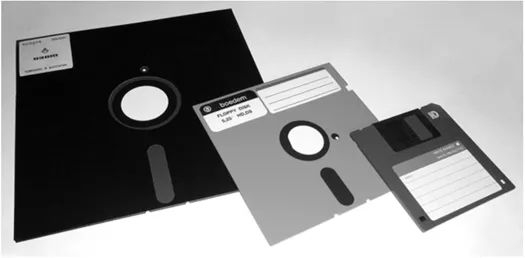
Diagram 1.2 Floppy diskettes of Various Sizes
Mainframe computers were very expensive to maintain and were affordable only by very few large corporations. Medium-size and small-sized enterprises continued to have manual book-keeping.
The 1970s were the era of ‘Personal Computers’ (PC); A computer system that was made affordable for the medium and small businesses. Almost every enterprise realised the value of having a computer. The businesses were run in the same old fashion with most of the enterprises having a functional departmental structure. Either the small EDP (Electronic Data Processing) Department was having a bunch of PCs and performing computing operations for different functions as a shared service or each department had its own personal computers applied to its business operations. During this era, most of the manual functions were automated. Depending upon the investment levels in IT, each enterprise had its own automated system. Custom-built financial accounting, payroll, MRP I, MRP II and inventory management were popular systems in those days.
Functional automation was very popular and financial accounting books were automated by various software enterprises. The most popular one in those days was the Oracle Financial.
In India, Tally was one of the first financial accounting softwares.
In the 1980s and early 1990s, networking technologies were invented and commercialised. The enterprises embraced client-server architecture. Novell Netware was the most popular one which was compatible for the MS-DOS PCs. Prior to Novell Netware, various variants of UNIX were existing. More networking technologies such as Windows NT, Linux, etc. came later.
Then came the Enterprise Resource Planning (ERP) and around the same time Michael Hammer propounded the Business Process Reengineering (BPR). At one point in time there were hundreds of ERPs worldwide, though the popular ones were SAP and Oracle.
Technology further enabled Data Warehousing, which in turned enabled Business Intelligence. Internet further accelerated and facilitated the possession of a uniform system and processes with a single instance of an ERP for an enterprise globally.
The convergence of Information Technology, Communication and Entertainment enabled the accessing of enterprise applications through mobile devices. Alongside the technological advancement, new business models were developed such as e-Commerce, Social Networking, Customer Self-Service models in Banking, Insurance, Airline services, Travel & Transportation, Hospitality sectors, etc.
As against the conventional way of recording the accounting entries on a receipt of documentary evidence for the transaction, in the current era the accounting entries are posted in books as and when transactions were triggered. For example, during the olden days, if you wanted to withdraw cash from a bank, you would visit the bank and submit a written requisition in the form of a withdrawal slip or a cheque and upon submission, the cash would be disbursed after verifying the signature to identify the account holder and the payee. The cheque or withdrawal slip therefore becomes the documentary evidence for transaction and the individual account balance is debited and cash is credited and in the General Ledger the deposit account is debited and the cash account is credited.
Nowadays, we use an ATM card to withdraw cash; identity is managed with the help of a physical card along with a Personal Identification Number (PIN). As the ATM machine disburses the cash, the accounting entries are automatically posted in the bank’s books of accounts. In the same way, accounting entries are automatically posted in the company’s books based on the transactions triggered by the various business personnel.
It is a paradox that the CFO is responsible for the financial accounting records, but except period-ending accounts’ close-related transactions and certain financial entry transactions such as depreciation posting, remaining transactions—primarily revenue and expenses—are automatically posted in the books of accounts based on transactions triggered by someone outside the Finance and Accounts department. Strange—but true.
Added to these complexities, the Internet contributed towards an accelerated technological advancement. Global corporations nowadays transmit their commercial documents, payments to their business partners through internet protocol and those transaction records are captured by the business partner’s information system which in turn triggers accounting entries. In a nutshell, entities outside one’s own organisation trigger transactions and consequential accounting entries in the books of accounts.
1.3 | Volatility, Uncertainty, Complexity and Ambiguity (VUCA) |
The VUCA explains the current ways of modern business. Every business in every industry is confronted with VUCA.
VUCA is caused by
- Technological advancement: The example of Nokia—once a leader—now no longer in the mobile-phone business.
- New business model: The e...
Table of contents
- Cover
- Half
- Title
- Copyright
- Contents
- Dedication
- Front
- Acknowledgments
- Preface
- Section 1: IT: Finance Perspective
- Section 2: Business Process and Automation
- Section 3: Business Process Reengineering and Approaches
- Section 4: Computer Systems & the Auditing IT Environment
- Section 5: Network, Internet and Telecommunication
- Section 6: Business System
- Section 7: Deploying Business Applications Software
- Section 8: Access and Identity Management
- Section 9: Advanced and Emerging Technologies
Trusted by 375,005 students
Access to over 1.5 million titles for a fair monthly price.
Study more efficiently using our study tools.
Frequently asked questions
Yes, you can cancel anytime from the Subscription tab in your account settings on the Perlego website. Your subscription will stay active until the end of your current billing period. Learn how to cancel your subscription
No, books cannot be downloaded as external files, such as PDFs, for use outside of Perlego. However, you can download books within the Perlego app for offline reading on mobile or tablet. Learn how to download books offline
Perlego offers two plans: Essential and Complete
- Essential is ideal for learners and professionals who enjoy exploring a wide range of subjects. Access the Essential Library with 800,000+ trusted titles and best-sellers across business, personal growth, and the humanities. Includes unlimited reading time and Standard Read Aloud voice.
- Complete: Perfect for advanced learners and researchers needing full, unrestricted access. Unlock 1.5M+ books across hundreds of subjects, including academic and specialized titles. The Complete Plan also includes advanced features like Premium Read Aloud and Research Assistant.
We are an online textbook subscription service, where you can get access to an entire online library for less than the price of a single book per month. With over 1.5 million books across 990+ topics, we’ve got you covered! Learn about our mission
Look out for the read-aloud symbol on your next book to see if you can listen to it. The read-aloud tool reads text aloud for you, highlighting the text as it is being read. You can pause it, speed it up and slow it down. Learn more about Read Aloud
Yes! You can use the Perlego app on both iOS and Android devices to read anytime, anywhere — even offline. Perfect for commutes or when you’re on the go.
Please note we cannot support devices running on iOS 13 and Android 7 or earlier. Learn more about using the app
Please note we cannot support devices running on iOS 13 and Android 7 or earlier. Learn more about using the app
Yes, you can access Information Technology by Srinivasan M K in PDF and/or ePUB format, as well as other popular books in Politics & International Relations & Politics. We have over 1.5 million books available in our catalogue for you to explore.