eBook - ePub
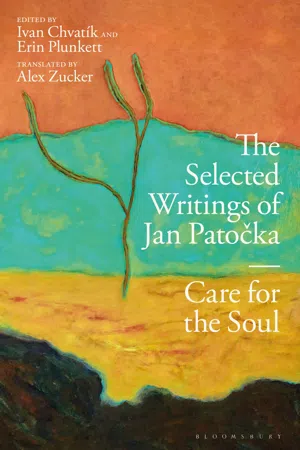
The Selected Writings of Jan Patocka
Care for the Soul
- 392 pages
- English
- ePUB (mobile friendly)
- Available on iOS & Android
eBook - ePub
The Selected Writings of Jan Patocka
Care for the Soul
About this book
Jan Patocka's contribution to phenomenology and the philosophy of history mean that he is considered one of the most important philosophers of the 20th century. Yet, his writing is not widely available in English and the Anglophone world remains rather unfamiliar with his work. In this new book of essential Patocka texts, of which the majority have been translated from the original Czech for the first time, readers will experience a general introduction to the key tenets of his philosophy. This includes his thoughts on the relationship between philosophy and political engagement which strike at the heart of contemporary debates about freedom, political participation and responsibility and a truly pressing issue for modern Europe, what exactly constitutes a European identity? In this important collection, Patocka provides an original vision of the relationship between self, world, and history that will benefit students, philosophers and those who are interested in the ideals that underpin our democracies.
Information
PART ONE
Early Texts
These two early texts introduce some of the main themes of Patočka’s work: a critique of the prevailing notion of objectivity, a concern for the role of history in our understanding of human being and world, and a commitment to cultivating the spiritual dimension of human being in the face of grave historical and political obstacles. Here, spiritual does not denote anything religious but instead marks out that element of human being which is capable of more than mere survival, which would be the subject and the agent of both “history” and “education” as Patočka presents them.
“The Idea of Education” was written in 1938, just after the signing of the Munich Agreement, which authorized Hitler to seize key border areas of Czechoslovakia and spelled the beginning of the end of the nation’s sovereignty. In response to this political disaster, Patočka launches a challenge to his fellow citizens, especially to intellectuals, asking what they stand for, whether they still possess the power to ask what kind of country and society they want to be. He centers this challenge on the idea of education and what a meaningful education entails. Education, he argues, cannot mean simply cramming the head with facts, nor should it be an intellectual exercise; it must train learners to develop a new relationship to themselves and to relate to the world differently, responsibly. Sympathetic to but also critical of the classical German ideal of education—Bildung—Patočka presents a portrait of education that emphasizes the struggle it involves, the break with previously accepted forms of meaning and value. “There is no harmonious, blissful development here, as in the growth of a tree from a seed, but a piece of concentrated life, an indispensable moment in the life struggle, that moment in which one fights for standards and models not only for oneself but for everyone.”
CHAPTER ONE
A Few Remarks on the Concept of “World History”(1935)
Translated from the Czech by Alex Zucker
1. On another occasion, the author of these lines sought to show that pure intellectualism in the theory of history is impracticable, or better put, that it leads to a false, decadent understanding of history. We can best realize this if we seek to carry through to its consequences the fiction of pure intellect regarding history. The ideal of pure intellect is “objectivity.” This “objectivity” has an important prerequisite: a sharp dividing line between “subject” and “object.” Only under this assumption can an “object” be perfectly captured, described, analyzed. If not for this strict distinction, the “subject” coming to know the “object” would at the same time have to come to know itself, which is “impossible for the same reason that I cannot walk down the street and look at myself out the window at the same time”; this would steer the process of cognition down the path of infinite self-perception, which lacks the requisite perfect perceptibility.1 In other words: pure intelligence gains knowledge by way of pure self-forgetting, in fact explicitly severing any ties that might bind it to the object, so that the object appears completely separate and independent. Only then does the process of apprehending the essential aspects and structures of the field toward which it is turning, and the attempt to exhaust the entire field by way of deduction, or at least systematic description, commence.
The result of that in looking at history would be a reduction of it to what can be objectified, to what insight can be gained from history through recollection. Though an “object” may be inexhaustible, which is to say infinite, still it must be complete in its being. Every physical object, for example, is de facto inexhaustible in its possibilities; but all of its aspects are equally real at the same time. The possibilities of an object such as this exist in the form of forces. What happens to it is a regular process, codetermined by these forces. Applied to history, this perspective gives a particular picture of it: history is the human past conceived as a series of processes played out with human objects. History then is a simple description of these processes, and philosophy of history is the interpretation within this description of processes perceived on the basis of the lawful operation of the great forces that determine what happens to objects. In short, we would arrive at the familiar view of history as practiced by naive historical positivism; all “processes” in principle unfold on the same level, history constitutes a set of interrelated causal series, which need only be mentally reconstructed for the goal of historical knowledge to be achieved.
It has been observed (by Rickert) that this widespread view of history is not employed by historical science nor would it be feasible for it to do so. To begin with, the principle of choosing which parts of the human past are suitable as historical material is absent. And yet when we contemplate history today, it is a view that readily comes to hand, a view we quickly relapse into whenever we start to reflect on history, a view we find it difficult to disengage ourselves from. One of the main reasons it comes to us so naturally is the ahistorical understanding of humanity that has been at home in all of Western philosophy, with several exceptions, up until the modern day. In antiquity and later, in analogous fashion, in the medieval view, human beings were conceived of as a level of the cosmos, a segment in the eternal order of ideas. In modern times the situation is reversed; if, before, the concept of physis, “nature,” was subordinate to the concept of cosmos, “the order of the whole,” now all order is dependent on nature, its rules and forces. But the static, ahistorical view of humanity has not changed; what was cosmic has merely become naturalistic. Modern anthropology, plotted out by the names Descartes, Hobbes, Spinoza, Locke, is characterized by the process of naturalization of the traditional conception of humanity. The outcome of this process is modern psychology, the doctrine of the objectively natural foundation of human experience, which ultimately understands experience itself as a factual, objective process. The popular, most readily accessible thinking of today sees humans as a part of nature. History as a process that plays out on the stage of humanity therefore becomes a process of nature.
Naturalistic anthropology found itself in crisis when the consequences it had in human life became apparent. The decadent phenomena of our modern life are in large part related to it. Examples of these phenomena are skeptical relativism, the indifferentism of pure intellectualism, and noncommittal aestheticism. The phenomenon of self-alienation emerges and spreads, the subjugation of spontaneous humanity to an alien norm. One partial phenomenon here is the feeling of “cultural discontent,” which can be seen in European civilization from the sentimentalism of the eighteenth century to this day. The introduction of notions of the whole, of form, of structure, of “teleological” factors into at least some areas of the concept of nature is of no help to the more recent era in seeking to replace the purely mechanistic concept of nature that dates to the beginnings of modernity. All because, in spite of all the reforms in the form of being, it remains stuck in the same fundamental type of being, the same ontological sphere. One of the consequences of this is, as noted, a misunderstanding of history, which can also be counted among the reasons for the nonsensicality of naturalistic anthropology.
What we would like to attempt here is to reverse the position: seeking to penetrate in original form to what makes history history, we will seek to deduce from that the consequences for philosophical anthropology and for an epistemic ideal that can stand in opposition to the ideal of pure intellectualism sketched above.
2. Assuming we accept the fiction of pure intellect, we may note first and foremost that it engages its material too broadly, mixing the non-essential with the essential, reducing both to the same level (a variation on Rickert’s objection). Even more important, however, is how much this view is missing. It lacks not merely a connecting link and a guide, but the creative energy of history itself.
What do we mean by this creative energy? The best way to arrive at this is to start from the approximation that it is that which causes individual efforts to follow on one another within the historical process. The codetermination of human activity by the past is a basic feature of historicity, assuming of course that codetermination is conscious. There is no historicity where something utterly new is being created, yet it is everywhere connection occurs, a spilling of one will into another so to speak, however obscure and complex the paths of that connection may be. Historicity can be anonymous, but it cannot be unconscious. Thus there is historicity when, feeling a communion of interest with something in the past, we co-create a work whose meaning lies deeper than on the individual level. Even when acting on the basis of individual motives, historical figures see themselves as supporting a deeper cause.2 The process of history is the transmission of the creative impulse. This transmission is a conscious, voluntary effort: that is the reason why humans instinctively understand history. The world of history is our practical world, the world of our (conscious) interests.3 To comprehend history historically, then, does not mean to interpret (e.g., psychologically, economically, etc.) these interests, but to conceive of them as supporting the typical forces governing humanity, human life and the world. If we ask why something happened in history, the question does not mean the same as it does in natural science. Because in this case we are not simply asking after the natural constellations that lead to certain processes, but rather we wish to understand them on the basis of those original forces that govern our existence and which we too may “experience,” “feel,” “consider,” “overcome.”
The forces that govern our lives cannot be simply calculated or deduced from principles. Later we will say why. But they are all fundamental determinatives of individual and social life, which we feel as impulses within ourselves and thanks to which we are able to see life not merely filled, but in fact fulfilled. In history, people seek to give their lives objective meaning through active creation. This meaning is not some mystical notion, but the creation and realization of one’s own will. The “search for the meaning of life” is nothing other than the effort to discover and clarify one’s will. On the other hand, one must bear in mind that the lack of impulse, energy, will is equally a life-governing force, even a very important one. Nonsense, however, gets its definition from sense, lack of force from force.
As an example of these original forces, let us consider the ambition of a government with great variation in capacity to govern, leading to imperialist expansion as well as to a lawful consolidation of civil society within the state. Another such force is what is often referred to as “spirit,” that is, the conscious connection of a person to the world through the forms of philosophy (and science), the arts, life wisdom, and religion. Every such force occupies a position within the polarity of individual vs. social tension, being both an individual and a community matter, but in varying degrees and proportions. And none of these forces is given prior to history, which would make them, so to speak, extrahistorical explicans of history, but they themselves are also still subject to the historical process. The process of history is essentially the process of creating these forces, which govern and effectuate life. We may also express this paradoxical phenomenon by saying that there are goals created in the course of history, and it is only in proceeding from them that we are able to comprehend life (in its historical form).
When we talk about the “forces” that govern life, we are actually speaking in the abstract, which could lead us to make the error of compromising the historicity of these concepts. In fact these forces are real only in concrete historical periods, in concrete philosophies, in concrete impulses of political power and state formations. Yet there is something in common that holds throughout this diversity of historical formations that allows us to speak of a unitary historical force; this is not a general concept in the natural sense, but in the specific historical sense that presupposes a continuity of the fundamental impulse, of the fundamental “creative energy,” as we explained it above.
This “creative energy,” introduced to history by certain personalities within the historical process, is neither a spatially nor, in the last instance, a temporally individuated fact. Let us take for example “Plato’s philosophy.” This philosophy is not simply what Plato thought in a particular place at a particular period in time, but all that Plato introduced to intellectual history: it lives on within that history independent of his individual existence. Nor is it rigid in its ideal content, like the content of a theorem in geometry, but in fact it lives on in history. In the same way, as long as they affect us, the impulses of power and politics live independent of their creators; in the same way, ideas, styles, artistic devices live in history. Whoever in...
Table of contents
- Cover
- Half-Title Page
- Dedication
- Series Page
- Title Page
- Contents
- Foreword
- Acknowledgments
- Translator’s Note
- Timeline
- Introduction
- PART ONE Early Texts
- 1 A Few Remarks on the Concept of “World History” (1935)
- 2 The Idea of Education and its Relevance Today (1938)
- PART TWO Care for the Soul
- 3 Limping Pilgrim Josef Čapek (1950–1964)
- 4 On the Soul in Plato (1972)
- 5 Comenius and the Open Soul (1970)
- PART THREE Phenomenology
- 6 The Natural World and Phenomenology (1967)
- 7 What is Phenomenology? (1975)
- PART FOUR Arts and Culture
- 8 Time, Myth, Faith (1952)
- 9 Art and Time (1966)
- 10 Time, Eternity, and Temporality in the Work of Karel Hynek Mácha (1967)
- 11 On the Principle of Scientific Conscience (1968)
- 12 The Writer’s Concern (Toward a Philosophy of Literature) (1969)
- 13 Ivanov (1970)
- 14 The Truth of Myth in Sophocles’ Theban Plays (1971)
- 15 On Faust: The Myth of the Pact with the Devil—Observation on the Variants of the Faust Legend (1973)
- PART FIVE Philosophy of History
- 16 The Spiritual Foundations of Life in Our Time (1970)
- 17 The Dangers of Technicization in Science according to E. Husserl, and the Essence of Technology as Danger according to M. Heidegger (Varna Lecture, 1973)
- 18 The Spiritual Person and the Intellectual (1975)
- 19 An Outline of History (1976)
- Postscript: Philosophy, Fate, and Sacrifice
- List of Contributors
- Bibliography
- Index
- Copyright
Trusted by 375,005 students
Access to over 1.5 million titles for a fair monthly price.
Study more efficiently using our study tools.
Frequently asked questions
Yes, you can cancel anytime from the Subscription tab in your account settings on the Perlego website. Your subscription will stay active until the end of your current billing period. Learn how to cancel your subscription
No, books cannot be downloaded as external files, such as PDFs, for use outside of Perlego. However, you can download books within the Perlego app for offline reading on mobile or tablet. Learn how to download books offline
Perlego offers two plans: Essential and Complete
- Essential is ideal for learners and professionals who enjoy exploring a wide range of subjects. Access the Essential Library with 800,000+ trusted titles and best-sellers across business, personal growth, and the humanities. Includes unlimited reading time and Standard Read Aloud voice.
- Complete: Perfect for advanced learners and researchers needing full, unrestricted access. Unlock 1.5M+ books across hundreds of subjects, including academic and specialized titles. The Complete Plan also includes advanced features like Premium Read Aloud and Research Assistant.
We are an online textbook subscription service, where you can get access to an entire online library for less than the price of a single book per month. With over 1.5 million books across 990+ topics, we’ve got you covered! Learn about our mission
Look out for the read-aloud symbol on your next book to see if you can listen to it. The read-aloud tool reads text aloud for you, highlighting the text as it is being read. You can pause it, speed it up and slow it down. Learn more about Read Aloud
Yes! You can use the Perlego app on both iOS and Android devices to read anytime, anywhere — even offline. Perfect for commutes or when you’re on the go.
Please note we cannot support devices running on iOS 13 and Android 7 or earlier. Learn more about using the app
Please note we cannot support devices running on iOS 13 and Android 7 or earlier. Learn more about using the app
Yes, you can access The Selected Writings of Jan Patocka by Jan Patocka, Erin Plunkett,Ivan Chvatík, Alex Zucker in PDF and/or ePUB format, as well as other popular books in Philosophy & 20th Century History. We have over 1.5 million books available in our catalogue for you to explore.