The first full-length biography in English of Aspar, the eastern Roman general and statesman, this book explores his central role in the history and politics of the fragmenting Roman Empire in the fifth century. It also considers what his life and career may suggest as to the differing fates of the eastern and western parts of the empire.
Taking a chronological approach, Bleeker guides us through what is known of Aspar's life and his changing influence in the eastern Roman army and court. Born and raised in Constantinople, Aspar primarily viewed and presented himself as a Roman general, consul, and senator. Yet he also stood outside the Roman mainstream in two important ways–as a member of the empire's "barbarian" military leadership and as a devout Arian Christian. Early chapters treat his formative military experiences with the Persians, a Roman usurper in Italy, the Vandals in Africa, and the Huns of Attila, while later chapters focus on Aspar's political role in resolving the two imperial succession crises that struck the eastern Roman empire in the mid-fifth century and his extended struggle to control the succession to Leo I.
Bleeker builds on earlier studies in three ways. First, previous work has largely concentrated on the role of "barbarian" generals in the western Roman empire, while much less attention has been paid to similar figures (such as Aspar) in the east. Secondly, while important recent work has explored the prevalence of "child-emperors" in the late-fourth and early-fifth centuries, this book suggests a further evolution of the imperial role in the mid-fifth century. Finally, while previous studies of this period have focused on Aspar's late career role in the succession struggles, a full study allows us to see how and why his relations with other key figures within and outside the eastern Roman government changed over the course of his lengthy career.
- 248 pages
- English
- ePUB (mobile friendly)
- Available on iOS & Android
eBook - ePub
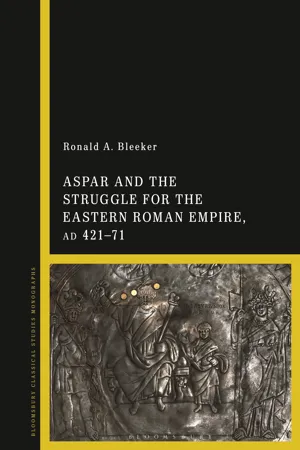
Aspar and the Struggle for the Eastern Roman Empire, AD 421–71
About this book
Information
1
Why Does Aspar Matter?
Theodosius I, a strong military leader, was the last person to rule all of a Roman empire with essentially the same borders as the empire established by Caesar Augustus some four hundred years earlier. When Theodosius died at Milan in January 395, the management of this empire was divided territorially between his two young and very underwhelming sons.1 The older son, Arcadius, age eighteen, was given responsibility for the eastern provinces. The younger son, Honorius, age ten, was given responsibility for the western provinces (i.e., everything west of the Balkans and of Egypt). It was not the first time that administration of the empire had been divided in this way, but it would be the last.2
Despite this division of management, the concept of a unified empire remained intact. On occasion, the two parts cooperated in military efforts (e.g., in 431, 440, and 468 against the Vandals). Other forms of cooperation included coinage, acceptance of laws (e.g., the Theodosian Code), and (usually) the reciprocal recognition of emperors and consuls.3 However, separate courts in separate capitals inevitably led to the development of as much rivalry as cooperation. Since the task of running each part of the empire rested with the emperor’s advisers (initially Rufinus in the east and Stilicho in the west), each of the young emperors depended on men who jealously guarded their own power and often competed with the other camp for prestige and military resources.4 Given these diverging interests, historians of the early fifth century refer to “eastern Roman” and “western Roman” states, even though in theory they both remained part of one Roman empire.
Yet, by the last quarter of the fifth century, this picture had dramatically changed. The western Roman empire had essentially ceased to exist, and its territory was now ruled by several “barbarian” kingdoms.5 In contrast, the eastern Roman empire had been battered but remained vibrant and Roman—and it would survive as a Roman state for another thousand years.6
Historians of late antiquity tend to fall into two camps—those who see these changes as a “catastrophe” as a result of invasions by hostile “barbarians,” and those who see a more gradual “transformation” in which the empire’s internal factors played a larger role and where the influx of “barbarians” was part of an ongoing and often less violent process.7
But why did the outcomes differ in the two parts of the empire? While there has been considerable study of the fall of the west, this book will focus on the survival of the east, and particularly on the role of military officers of “barbarian” descent in the politics of imperial succession during the fifth century. In that arena, no one of “barbarian” descent played a more important role for as long a time as the general, senator, consul, and patrician, Flavius Ardaburius Aspar.
Aspar’s story stands at the intersection of two major issues in the Roman world in late antiquity. One was the evolving concept of imperial succession; the other was the role of “barbarians” in the Roman state. This is not to suggest that these were the only issues that have been advanced.8 However, the question we will consider is how did the incorporation of “barbarians” into the Roman state (and particularly the Roman military) affect imperial succession in the mid-fifth century? On several occasions, this question became central to the differing fates of the empire’s two parts. Our focus will be on how Aspar’s life illuminates matters. However, it also leads to further questions—e.g., who was a “barbarian”? who was “orthodox”? how did these concepts affect who could be emperor?9
Looking at the first issue, there had always been a surprising lack of clarity about the Roman imperial succession.10 While there was a continuing preference for dynastic succession, legitimacy could also be based on acceptance by the senate and/or the army. Without this, the result was often civil war. Nonetheless, in the fourth century, relatively stable dynasties were established by Constantius I, followed by Valentinian I and then Theodosius I. Moreover, Theodosius’ dynasty was connected by marriage to the previous dynasty, since his second wife was Galla, the widow of Valentinian I.11
However, the glaring weakness of a dynastic approach to succession was that a successful transfer of power depended on having a suitable male heir. In addition, a Roman emperor had come to be viewed as a “soldier-emperor” who confirmed his legitimacy through military victories.12 This could be a problem if the available dynastic candidate was unable or unwilling to fill this role.
The problem became real in the late fourth and early fifth centuries when on several occasions the dynastic heir was a young child who had received the imperial title of “Augustus.” Nonetheless, these “child-emperors” were accepted as legitimate rulers. This often involved having a guardian (usually a military officer) run matters until the child came of age.13 In some cases, this “partnership” continued after the child became an adult.14 McEvoy persuasively suggests that this arrangement would not have been successful without a “transformation of the imperial office” in which the role of the emperor no longer required actual military leadership but instead became primarily ceremonial (and distinctly Christian) in nature. However, while McEvoy refers to this as an “infantilization,” she recognizes that an adult might simply lack the interest or ability to take a more active role. Nor did it preclude the possibility of partnership between a military leader (e.g., Ricimer) and a soldier-emperor (e.g., Majorian).15 This development occurred roughly simultaneously in both halves of the empire, with ceremonial practices at Constantinople influencing its evolution in the west.16
However, the use of “child-emperors” broke down in the mid-fifth century, when both the eastern and western branches of the Theodosian dynasty faced succession crises due to the complete absence of a male dynastic heir.17 The western Roman empire never recovered from its crisis. However, the eastern Roman empire saw peaceful transitions in 450, 457 and 491. As we will see, it was Aspar, a second-generation general of “barbarian” descent, who played a key role in the first two transitions.
A main thesis of this book is that Aspar essentially expanded the concept of a “ceremonial ruler” by recognizing that the emperor could be a non-dynastic adult so long as he was agreeable to a “partnership” with his military leader and could perform his ceremonial duties. Although not limited to religious matters, “ceremonial” also meant someone who was sufficiently orthodox and could be acclaimed as “pious.” Although this had previously (and un...
Table of contents
- Cover
- Half-Title Page
- Series Page
- Title Page
- Contents
- List of Illustrations
- Preface
- Genealogies
- 1 Why Does Aspar Matter?
- 2 “Barbarians” and “Heretics”
- 3 Aspar’s Antecedents
- 4 Ardaburius the Elder and Aspar: Persia and Italy (421–5)
- 5 Aspar in Africa: The War with the Vandals (431–5)
- 6 Aspar and Attila: The Wars with the Huns (440–50)
- 7 Aspar and the Choice of Marcian (450–7)
- 8 Aspar and the Choice of Leo (457)
- 9 Beginnings of the Struggle with Leo (457–65)
- 10 The Rise of Zeno (465–7)
- 11 Leo’s African Gamble (467–8)
- 12 Aspar’s Apogee and Defeat (469–71)
- 13 Aftermath (471–91)
- 14 Conclusions
- Bibliography
- Index
- Copyright
Trusted by 375,005 students
Access to over 1.5 million titles for a fair monthly price.
Study more efficiently using our study tools.
Frequently asked questions
Yes, you can cancel anytime from the Subscription tab in your account settings on the Perlego website. Your subscription will stay active until the end of your current billing period. Learn how to cancel your subscription
No, books cannot be downloaded as external files, such as PDFs, for use outside of Perlego. However, you can download books within the Perlego app for offline reading on mobile or tablet. Learn how to download books offline
Perlego offers two plans: Essential and Complete
- Essential is ideal for learners and professionals who enjoy exploring a wide range of subjects. Access the Essential Library with 800,000+ trusted titles and best-sellers across business, personal growth, and the humanities. Includes unlimited reading time and Standard Read Aloud voice.
- Complete: Perfect for advanced learners and researchers needing full, unrestricted access. Unlock 1.5M+ books across hundreds of subjects, including academic and specialized titles. The Complete Plan also includes advanced features like Premium Read Aloud and Research Assistant.
We are an online textbook subscription service, where you can get access to an entire online library for less than the price of a single book per month. With over 1.5 million books across 990+ topics, we’ve got you covered! Learn about our mission
Look out for the read-aloud symbol on your next book to see if you can listen to it. The read-aloud tool reads text aloud for you, highlighting the text as it is being read. You can pause it, speed it up and slow it down. Learn more about Read Aloud
Yes! You can use the Perlego app on both iOS and Android devices to read anytime, anywhere — even offline. Perfect for commutes or when you’re on the go.
Please note we cannot support devices running on iOS 13 and Android 7 or earlier. Learn more about using the app
Please note we cannot support devices running on iOS 13 and Android 7 or earlier. Learn more about using the app
Yes, you can access Aspar and the Struggle for the Eastern Roman Empire, AD 421–71 by Ronald A. Bleeker in PDF and/or ePUB format, as well as other popular books in History & Military Biographies. We have over 1.5 million books available in our catalogue for you to explore.