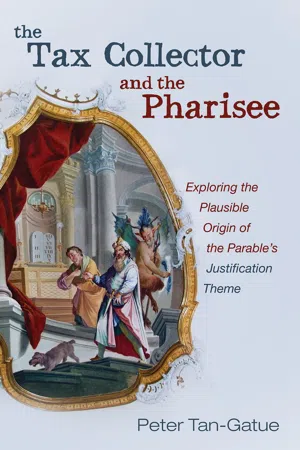
eBook - ePub
The Tax Collector and the Pharisee
Exploring the Plausible Origin of the Parable’s Justification Theme
- 216 pages
- English
- ePUB (mobile friendly)
- Available on iOS & Android
eBook - ePub
The Tax Collector and the Pharisee
Exploring the Plausible Origin of the Parable’s Justification Theme
About this book
The idea of "justification by faith" is noticeably illustrated in narrative form in the parable of the tax collector and the Pharisee (Luke 18:9-14). Did Luke the evangelist copy or import this idea from the apostle Paul? Or is there a better likelihood that Luke derived the theme from the teachings of Jesus himself? The answers to these questions have implications on the likely origin of this central Christian theme, and the connection between Jesus and Paul. In The Tax Collector and the Pharisee, Peter Tan-Gatue builds a plausible case that this notion of "justification by faith" comes from material sources that already exist in the Jesus tradition. Through biblical exegesis, critical use of authenticity criteria, and contributions in ancient and current historical-cultural studies, this work challenges the idea that justification is a Pauline innovation and also affirms the intrinsic authenticity of the Lukan parable.
Information
Topic
Theology & ReligionSubtopic
Biblical CommentaryChapter 1
Introduction
Luke 18:9–14, the parable of the Pharisee and the Tax Collector is one of the singly attested Lukan parables in the Jesus tradition.1 One notable feature of this parable, especially when read together with Luke 18:1–8, is the concentrated use of the δικαιόω word group (i.e., ἐκδικήσω, ἀδικίας, ἐκδίκησιν, δίκαιοι, δεδικαιωμένος—18:3, 5–8, 9, 14). Interestingly, various commentators have noticed that the parable presents a theme or notion of justification/righteousness, and they often try to relate it to the Pauline idea of righteousness. For example, I. H. Marshall suggests that the picture of justification in Luke 18 (and in Acts 13:13–41) is not different from the notion depicted in Paul’s writings.2 He further asserts that both Paul and Luke drew from the Jesus tradition and that the variety in the way these are expressed stems from the different language used by the authors.3 On the other hand, John Nolland states that Luke 18:9–14 does not provide a picture of justification but instead addresses the Pharisees’ concern about their appearance before others. Therefore, he believes that this parable should not be seen through Paul’s doctrine of justification.4 Overall, for those who find it notable to mention the theme of justification/righteousness in this parable, they compare it to Paul’s version and then argue that they say and mean the same thing, signify something totally different, or are related in some particular way.5 In addition, some would conjure up different theories or assumptions about the Gospel author’s relationship to Paul, which in their view perhaps influenced the notion of justification/righteousness in the parable. For example, W. C. Van Unnik proposes that Luke’s author, as a second-generation theologian, really had no understanding of the concerns of Paul’s day and ultimately did not really comprehend the doctrine of justification by faith. He was supposedly an admirer of Paul, and he shared his view of a gospel that had done away with Jewish law. Unfortunately, he did not truly get what Paul was saying in his letters.6 Likewise, Joseph Fitzmyer believes that the evangelist considered Paul a hero and prominent example of the earlier generation of Christian missionaries, which was why the evangelist highlighted Paul for most of the second half of Acts. However, the Gospel of Luke presents Paul’s notion of justification as “forgiveness of sins” because the Lukan evangelist was not well informed about Pauline theology.7 More recently, John Meier, in his fifth volume of his series on the historical Jesus, proposes that the unique Lukan parables are creative works of the early church or by the evangelists themselves, and that the theology of justification in Luke 18:9–14 was unmistakably imported from Paul.8
Did Luke the evangelist co-opt or recast this theme of justification from Paul? Is there a better likelihood that Luke derived the theme from the teachings of Jesus himself? This study is an attempt to find an answer for the second question.
Literature Review
A scarcity of scholarly works deal with the theme of justification or righteousness in Luke. Some early modern sources deal with the topic of justification in various non-Pauline biblical writings of which justification in the Gospel of Luke is but one subtopic. That is the case for F. F. Bruce’s “Justification by Faith in the Non-Pauline Writings of the New Testament” and also the work of J. H. P. Reumann, Joseph A. Fitzmyer, and Jerome D. Quinn’s Righteousness in the New Testament: Justification in the United States Lutheran-Roman Catholic Dialogue.9 Various other works deal with the presentation of justification by the Lukan author, specifically in the book of Acts.10 A monograph by Richard Gaffin about the theme of justification in the whole Bible includes a chapter on justification in Luke-Acts.11 Gaffin comments that “monographs and articles on the theme of justification in Luke-Acts are few indeed” and also notes that there are “numerous relevant materials in various commentaries, New Testament theologies, and monographs and articles on Lucan theology but they are not substantial.”12 The most recent work concerning the topic of justification in Luke is Kyle Barrett’s dissertation on justification in Lukan theology. In his work he asserts that Luke has “a conscious and detectable theology of justification which is explicit in the parable of the Pharisee and the Tax Collector, yet subtly permeates the entirety of Luke’s work.” He also claims that Luke’s understanding of justification has its foundation in the Old Testament view of God’s vindication of the righteous.13
While Barrett and some of the other authors do suggest origins or sources of this theme of justification in Luke, they do not necessarily fully develop their line of thinking to support their claims in a more comprehensive manner. In addition to those who claim that Luke simply copied, reworked, or misunderstood Paul’s notion of justification, there are also those who believe that the ultimate source of the theme of justification in Luke is the Jesus tradition. An example is Joseph Fitzmyer who claims that pre-Lukan tradition was used in the parable o...
Table of contents
- Title Page
- Preface
- Abbreviations
- Chapter 1: Introduction
- Chapter 2: Luke 18:9–14
- Chapter 3: Coherence of Justification with the Lukan Tradition (L)
- Chapter 4: Coherence of Justification with Mark and Q
- Chapter 5: Jewish Palestinian Background of Luke 18:9–14
- Chapter 6: The “Inauthenticity” of Luke 18:9–14, Other Unique Lukan Parables
- Conclusion
- Bibliography
Trusted by 375,005 students
Access to over 1.5 million titles for a fair monthly price.
Study more efficiently using our study tools.
Frequently asked questions
Yes, you can cancel anytime from the Subscription tab in your account settings on the Perlego website. Your subscription will stay active until the end of your current billing period. Learn how to cancel your subscription
No, books cannot be downloaded as external files, such as PDFs, for use outside of Perlego. However, you can download books within the Perlego app for offline reading on mobile or tablet. Learn how to download books offline
Perlego offers two plans: Essential and Complete
- Essential is ideal for learners and professionals who enjoy exploring a wide range of subjects. Access the Essential Library with 800,000+ trusted titles and best-sellers across business, personal growth, and the humanities. Includes unlimited reading time and Standard Read Aloud voice.
- Complete: Perfect for advanced learners and researchers needing full, unrestricted access. Unlock 1.5M+ books across hundreds of subjects, including academic and specialized titles. The Complete Plan also includes advanced features like Premium Read Aloud and Research Assistant.
We are an online textbook subscription service, where you can get access to an entire online library for less than the price of a single book per month. With over 1.5 million books across 990+ topics, we’ve got you covered! Learn about our mission
Look out for the read-aloud symbol on your next book to see if you can listen to it. The read-aloud tool reads text aloud for you, highlighting the text as it is being read. You can pause it, speed it up and slow it down. Learn more about Read Aloud
Yes! You can use the Perlego app on both iOS and Android devices to read anytime, anywhere — even offline. Perfect for commutes or when you’re on the go.
Please note we cannot support devices running on iOS 13 and Android 7 or earlier. Learn more about using the app
Please note we cannot support devices running on iOS 13 and Android 7 or earlier. Learn more about using the app
Yes, you can access The Tax Collector and the Pharisee by Peter Tan-Gatue in PDF and/or ePUB format, as well as other popular books in Theology & Religion & Biblical Commentary. We have over 1.5 million books available in our catalogue for you to explore.