- 146 pages
- English
- ePUB (mobile friendly)
- Available on iOS & Android
eBook - ePub
About this book
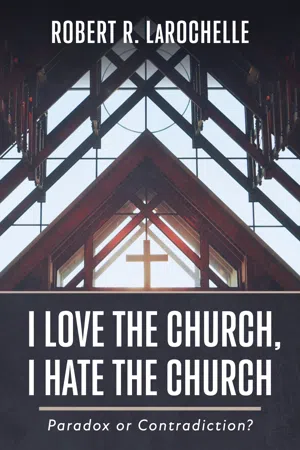
Is it possible to both love and hate the church at one and the same time?
Bob LaRochelle has had a lot of experience with different churches. Raised a Roman Catholic, he was ordained a Permanent Deacon in that church. After a period of intense soul-searching, he left the Catholic Church and embarked on a career in ordained Protestant ministry, serving congregations in both the United Church of Christ and the Evangelical Lutheran Church in America. Through most of the same time, he also worked in the field of education, first as a teacher, and, for most of his career, as a counselor.
Balancing personal experience with historical and theological background and reflection, I Love the Church, I Hate the Church combines factual information, theological analysis, and deep-seated personal feelings, all inviting the reader to take a look at the church, perhaps in ways that she or he never has before!
Information
Topic
Theology & ReligionSubtopic
Christian Ministry1
Hating What I Love
I always found it fascinating how people develop the interests that we do. I was fortunate to have a lot of personal exposure to the variables in this process as for forty-three years of my life, I worked as either a teacher or counselor in schools, primarily on the high school level, with one eleven-year foray into the world of counseling young people in a middle school. This bivocational experience of having a full-time job in addition to my work as a church pastor turned out to be a wonderful resource for my ministry as a pastor, something about which I have written quite extensively over the years14.
What always intrigued me about working with young people, especially in the thirty years I spent time as a school counselor, was finding out the how and the why behind their career interests and decisions. For some, quite honestly, it was the sense that they should live up to their parents’ expectations. For others, it was the parents’ insistence upon careers that drove them in the direction of something different. In reflecting on this, I could not help but do some self-examination, including considerable reflection upon the aspect of my life that was so connected to the institutional church and that, going many years back, had led me to consider ordained ministerial leadership within it.
In fact, the data gives evidence that for a growing number of people within our society, participation in the organized religious activities found in houses of worship has been on the decline for several years. My experience with religion in both my formative years and in early adulthood has been quite different from what is reflected in those current trends. I had planned many years ago to be involved in religion on the institutional level, even to the point of flirting with and then eventually deciding to serve as a church leader in the role of a pastor, something I have done over the last twenty years. Even prior to that, I held positions within the organized institutional church as a teacher of religion, a director of religious education on the local church level and the broader institutional level of a Catholic diocese including my work as a youth ministry coordinator and eventually as an ordained permanent deacon within the church in which I was raised and eventually left at the age of 46.
So, what I am saying is that much of my life has been spent working in the field of institutional religion. I have been connected to church institutional structures such as dioceses and religious schools, youth ministry programs, synods, and conferences for most of my adult life. I have offered educational programs for both adolescents and adults in many different settings, both Catholic and Protestant. Heck, as a kid growing up, from the age of 8, much of my early morning time was spent serving Mass for nuns in a convent! In a time when many people of my age and a plethora of those who are younger have repudiated the practice of organized religion and have difficulty seeing its relevance, it has remained an integral part of my own life. Except for a few restless months in my late 30’s when, technically, I was not affiliated with any particular religious denomination as well as a short period in the 1970’s when I was sporadic with my church attendance, I have been connected to official organized religion for most of my life! Rare have been the periods of time when Sunday worship and church involvement were not an integral part of my regular routine! 15
As I see it, it is interesting to enter into some self-reflection and wonder how I got to the place that I am, a place where I can say with certainty that my life and the life of organized Christianity have been bound together quite closely. However, and I think this is really important, while I cannot deny the importance of institutional religion in my life considering the fact that I have been ordained in two different church bodies, one Protestant, the other Roman Catholic, and have served as a pastor in two different Protestant denominations and have worked in many Catholic parishes, as well as other institutions within the church, at the same time that I would have to state that there is much about this institution called church that I love, I also have to admit that there is much about it that bothers and annoys me as well, even to the point of stirring up within me some rather strong feelings of hate.
Now, before I go any further, I need to spend some time here defining and explaining the term hate as used within the context of that of which I am writing:
Here are some dictionary definitions of the word hate16 :
1.To feel extreme enmity toward
2.To have a strong aversion to . . .
Of course, in this usage, it is important to spell out what the word enmity might mean as defined in that same dictionary:
The feeling of being actively opposed or hostile to someone or something.17
I have always tried to distinguish between having passionate feelings about issues, political positions or, in this case, policies and procedures found in churches and my attitude toward the people who hold them. In my view, any person who might happen to hold an opinion on a religious or political topic with which I strongly disagree, despise or, yes, hate, is a human being and daughter or son of God, someone who, simply put, should not be hated and who must be treated with the respect due a child of God. This distinction is extremely important and is clearly part of the message of Jesus, the driving force, I believe, beneath the Biblical injunction to love your enemies18.Given the political climate in the United States at the time I am writing this, it is very easy to misunderstand this interpretation, an interpretation to which many have very little exposure as a result of the vitriolic language inherent in much of the language found primarily on the political right, as well as in certain religious circles!
Now, as I considered how I wanted to write this book, I found myself looking back at the experiences of my life with an eye toward the question of how I got so involved in institutional religion in the first place. That question, of course, quite naturally leads to an even deeper question: What, for me, was and is the appeal of religion, more specifically faith, in the way that I seek to organize, structure and live my life?
I want to make something clear: There are an awful lot of people whom I know, people with whom I have worked and students whom I have taught, who might say they are not really into religion yet are individuals whom I would see as living examples of that which is good and true. These people are genuinely kind and giving to others, are repulsed at discriminatory behavior and are open to the goodness expressed by people of varied backgrounds and perspectives. For several reasons, they see what we might call organized religion as, at best, irrelevant and, at worse, quite harmful. Though my perspective is different from theirs, I often find myself quite sympathetic to their position. There are many times when I have cringed at the declarations of public figures and of preachers who, in my view, are distorting the message of Jesus. Unfortunately, I have known a good number of people who, while perceived by others to be religious, possess attitudes and tendencies that are exclusivist and, sad to say, even racist!
Yet, despite the reality of its flaws, I cannot deny that the church, as in organized Christianity, has been a significant and important part of my life. And with the understanding that my experience of it really has been what I would call a love- hate relationship, I think it is important that I explain a bit of how I got to a place wherein I could honestly reach that conclusion.
So . . . Let’s begin . . .
Through no choice of my own, when I was six years old, my parents enrolled me in the local, now nonexistent Catholic school in the small mill town in which I grew up19. It was the school my mother had attended several decades before. It was also a place in which the teaching was done by an order of religious sisters, popularly known, of course, as nuns, women with whom my mother was most familiar. My mom had a very close relationship with this order of sisters, the Daughters of the Holy Spirit, including having two cousins who were members of this order, and my sense as I look back at this t...
Table of contents
- Title Page
- Introduction: Why This Book?
- Chapter 1: Hating What I Love
- Chapter 2: Where There Is Hatred, Love
- Chapter 3: The Local Church
- Chapter 4: Church: Social Club or Community of Disciples?
- Chapter 5: The Crisis of Church Documents
- Chapter 6: We Have Always Done It that Way
- Chapter 7: The Church as Countercultural
- Chapter 8: Do We Need the Church?
- Chapter 9: Before We Conclude . . .
- Chapter 10: In Conclusion
- Bibliography
Trusted by 375,005 students
Access to over 1.5 million titles for a fair monthly price.
Study more efficiently using our study tools.
Frequently asked questions
Yes, you can cancel anytime from the Subscription tab in your account settings on the Perlego website. Your subscription will stay active until the end of your current billing period. Learn how to cancel your subscription
No, books cannot be downloaded as external files, such as PDFs, for use outside of Perlego. However, you can download books within the Perlego app for offline reading on mobile or tablet. Learn how to download books offline
Perlego offers two plans: Essential and Complete
- Essential is ideal for learners and professionals who enjoy exploring a wide range of subjects. Access the Essential Library with 800,000+ trusted titles and best-sellers across business, personal growth, and the humanities. Includes unlimited reading time and Standard Read Aloud voice.
- Complete: Perfect for advanced learners and researchers needing full, unrestricted access. Unlock 1.5M+ books across hundreds of subjects, including academic and specialized titles. The Complete Plan also includes advanced features like Premium Read Aloud and Research Assistant.
We are an online textbook subscription service, where you can get access to an entire online library for less than the price of a single book per month. With over 1.5 million books across 990+ topics, we’ve got you covered! Learn about our mission
Look out for the read-aloud symbol on your next book to see if you can listen to it. The read-aloud tool reads text aloud for you, highlighting the text as it is being read. You can pause it, speed it up and slow it down. Learn more about Read Aloud
Yes! You can use the Perlego app on both iOS and Android devices to read anytime, anywhere — even offline. Perfect for commutes or when you’re on the go.
Please note we cannot support devices running on iOS 13 and Android 7 or earlier. Learn more about using the app
Please note we cannot support devices running on iOS 13 and Android 7 or earlier. Learn more about using the app
Yes, you can access I Love the Church, I Hate the Church by Robert R. LaRochelle in PDF and/or ePUB format, as well as other popular books in Theology & Religion & Christian Ministry. We have over 1.5 million books available in our catalogue for you to explore.