- 262 pages
- English
- ePUB (mobile friendly)
- Available on iOS & Android
eBook - ePub
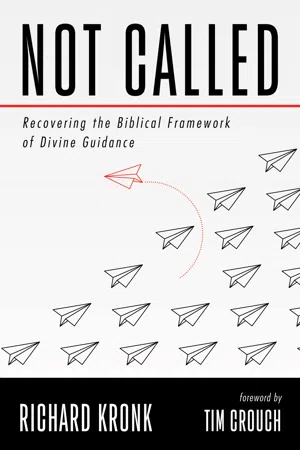
About this book
So how do I know what I am supposed to do with my life? I hear from my pastor and the things I read that God calls people to be pastors and missionaries. Some people even talk about being called to be a doctor or a teacher. I think I remember my mom saying she felt called to be a mom. But what am I supposed to do with my life? Has God actually called me to be a high school science teacher? Should I be looking for something else? How will I know if and when he does call me or is that just for people going into ministry, after all?
Not Called draws on church history, the evolution of Western societal norms, and biblical revelation to answer these and other related questions in an effort to determine if calling, as it is understood today, retains the meaning it was intended to carry from the beginning. In addition to a biblical and historical assessment of the evolution of the concept, Not Called raises both cultural and practical challenges to the contemporary meaning and use of the concept which all but excludes Christians from a non-Western, first-world cultural context.
Information
Subtopic
Ministère chrétienSection 1
Where We Are and How We Got Here
A Contemporary Understanding of the Call of God
1
Collin’s Story
Collin is a recent graduate of a Christian college that is located in the American South. While a student, Collin pursued a degree in outdoor leadership and communication. In addition to his studies, Collin played basketball on the college team and served in various volunteer ministry roles. When asked about his future following college, this is what he said:
OK, yeah, so I feel called to work with Muslim youth, and it is kind of an interesting way that it came about. So, during the summer between my sophomore and junior year of college I worked at a camp in North Carolina. During staff training, our leader said to go be out in nature and creation in order to connect with the Lord and spend time listening to him through creation. So, I went over to a river and was praying and contemplating the stream and was drawing different connections to God in our lives as believers with the river, which was really cool. I went back to where our main camp was and pulled out the only little Scripture that I had, which was a little booklet of John and I was like, “I wonder if there’s something about water in here.”
And so I thumbed through John at the campground where we were camping and came to the spot in John 7 where Jesus was talking about streams of living water. I got really excited because of the connection in Scripture to the stream I was just at. From there I was intrigued and wanting to keep thinking and learning about that.
From there, I came back to our main staff housing area and was thumbing through the bookshelf, which I’ve done before. But I just happened to look at it again and I’m going through, I’m going through, I’m going through, and then I see a book that I never saw before called Streams of Living Water. I was surprised and excited because I had just been thinking about that. So I decided that I was going to read this.
So, I read the whole book. And there were two things I took away. One of them was that the Holy Spirit is a very key element in walking with Christ. And the second one was when I came across a spot where Brother Yun was talking about how you can serve and follow Christ wherever you are. He then mentioned Muslims, and I couldn’t move past and was drawn into that word. And I was thinking that it was the Lord kind of like stopping me there.
And I then was thinking, “OK, so you’re wanting me to reach Muslims, Jesus?” I was then thinking, how in the world would I reach Muslims? And I was thinking back over my life and I was like, “Well, I’ve worked with youth my whole life. So I guess I could work with Muslim youth.”
And kind of since then, that’s kind of been what I feel I’ve been called to. And I’ve seen things that seem to line up with that conclusion like various books and classes I’ve had while also meeting more Islamic people. And I just see my own heart for Muslim people growing, like eating up classes on Islamic related things. And so, yeah, that’s kind it’s kind of how I came to consider that I think I am called to work with Muslims, especially Muslim youth.1
Collin’s story exhibits several common ideas related to the concept of calling. First is the idea that calling is something that comes from God. As Collin processed the various pieces of discovery which seemed to center around water, he was convinced that if what he was experiencing was some kind of message, that the message was indeed from God. His question, “OK, so you’re wanting me to reach Muslims, Jesus?” reflects his understanding that if there was any sort of life-direction in what he was experiencing, it was from God.
Secondly, Collin seems to be convinced that the purpose of calling is to give direction to one’s life. Despite his educational pursuits in outdoor leadership, the importance of a divine call is such that he believes he is inclined to follow it, even if it means making a change in perceived career-direction.
Thirdly, calling can be the summation of a number of otherwise unrelated and otherwise unremarkable circumstances. For Collin, it begins with his summer employment at a camp. During his time there, his team leader instructs him to take some time in nature to “connect with the Lord and spend time listening to him through creation.” In so doing, Collin spends time by the stream, which intrigues and stimulates his recollection of how God related to his children via the river. Upon returning to the main camp, Collin thumbs through the book of John and is struck by the reference to “streams of living water” that Jesus discusses in John 7. Later that same day, he picks a book from one of the bookshelves in the staff area whose title corresponds with the theme of water with which he has now interacted a couple of times that day. In that book, the author speaks of the importance of the Holy Spirit to the life of the believer. Sometime later, that same author mentions Muslims. In this moment, Collin feels as if the water, the Holy Spirit, Muslims, and his life converge, and he asks, “OK, so you’re wanting me to reach Muslims, Jesus?” Despite the fluid connection of the water to the Holy Spirit to Muslims, Collin feels the weight of something special. Looking back on this moment, Collin describes this as the time when he felt called—called to reach Muslims.
Collin’s experience and his unquestioned understanding that this “message” or calling was from God is a common theme among men and women who aspire to ministry-related careers. Calling is, at least among Christians, universally understood as something that originates in the divine will and that is communicated in some way to believers. Interestingly, the notion of calling is increasingly popular in corporate strategies for retention of employees—especially in white-collar sectors such as business, education, and medicine—and is described as an important aspect of degree and career choice for secular occupations and nonreligious individuals.
As observed in Collin’s story, calling is also understood to be direction-giving. Those who describe having received a call from God look to this experience as that which gave them the information and impetus to pursue a particular career path, even if that direction differed widely from their prior career objective.
Lastly, Collin’s call-experience is unique. It emerges out of a series of otherwise unrelated events that add up to something he interprets as a message from God. The experience of the call, as will be discussed later, is highly individual and shaped both by the individual’s expectation of the experience and by the community to which the individual belongs. This aspect of uniqueness makes calling a tremendously powerful motivator but also famously difficult to validate by others, such as credentialing bodies, for whom a call-experience is all but essential.
As we will see later, these aspects of the call—its divine source, its life-directing impact, and its uniq...
Table of contents
- Title Page
- Foreword
- Preface
- Acknowledgments
- Introduction
- Section 1: Where We Are and How We Got Here
- Section 2: Biblical, Cultural, and Practical Challenges to the Contemporary Understanding of the Call of God
- Section 3: A Proposed Reimagining of What It Means to Be Called of God
- Bibliography
Trusted by 375,005 students
Access to over 1.5 million titles for a fair monthly price.
Study more efficiently using our study tools.
Frequently asked questions
Yes, you can cancel anytime from the Subscription tab in your account settings on the Perlego website. Your subscription will stay active until the end of your current billing period. Learn how to cancel your subscription
No, books cannot be downloaded as external files, such as PDFs, for use outside of Perlego. However, you can download books within the Perlego app for offline reading on mobile or tablet. Learn how to download books offline
Perlego offers two plans: Essential and Complete
- Essential is ideal for learners and professionals who enjoy exploring a wide range of subjects. Access the Essential Library with 800,000+ trusted titles and best-sellers across business, personal growth, and the humanities. Includes unlimited reading time and Standard Read Aloud voice.
- Complete: Perfect for advanced learners and researchers needing full, unrestricted access. Unlock 1.5M+ books across hundreds of subjects, including academic and specialized titles. The Complete Plan also includes advanced features like Premium Read Aloud and Research Assistant.
We are an online textbook subscription service, where you can get access to an entire online library for less than the price of a single book per month. With over 1.5 million books across 990+ topics, we’ve got you covered! Learn about our mission
Look out for the read-aloud symbol on your next book to see if you can listen to it. The read-aloud tool reads text aloud for you, highlighting the text as it is being read. You can pause it, speed it up and slow it down. Learn more about Read Aloud
Yes! You can use the Perlego app on both iOS and Android devices to read anytime, anywhere — even offline. Perfect for commutes or when you’re on the go.
Please note we cannot support devices running on iOS 13 and Android 7 or earlier. Learn more about using the app
Please note we cannot support devices running on iOS 13 and Android 7 or earlier. Learn more about using the app
Yes, you can access Not Called by Richard Kronk in PDF and/or ePUB format, as well as other popular books in Théologie et religion & Ministère chrétien. We have over 1.5 million books available in our catalogue for you to explore.