- 276 pages
- English
- ePUB (mobile friendly)
- Available on iOS & Android
eBook - ePub
God, Suffering, and Pentecostals
About this book
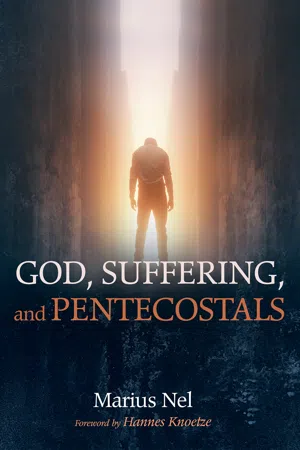
Pentecostals emphasize that God is still the Healer of all illnesses, implying that God answers all prayers. What about those who are not healed? How do we explain suffering? Why does a good God allow suffering? Is God not powerful enough to prevent it? In this publication, the author reconsiders these questions from a Pentecostal hermeneutical perspective to develop a novel way to think about God's involvement with suffering among people. His experimental theology speculates how a Pentecostal ethos accommodates a theodicy that acknowledges suffering and God's involvement in people's lives. Although the book is a theologically constituted attempt, anyone can follow and understand its arguments. It concludes with alternative views of suffering, evil, God's loving attention to people, the doctrine of original sin, and Satan. The author also suggests some ways to respond to suffering.
Information
Topic
Theology & ReligionSubtopic
Christian Denominations1
Pentecostals and Theodicy
Introduction
The question of theodicy is vast and can be approached from several angles. To limit the discussion and prevent it from becoming vague and generalized, this study focuses on several aspects. The first aspect is Pentecostalism and specifically classical Pentecostalism that started in the early decades of the twentieth century1 with the experience of Spirit baptism evidenced by speaking in tongues. It exists in distinction from the other two waves, the charismatic movement that started in the 1960s in established mainline churches and consisted of the adoption of the Pentecostalization of worship practices, and Neo-Pentecostal churches consisting of independent churches that utilized Pentecostalization along with their own emphasis, consisting of a variety of aspects such as a healing ministry, deliverance, or the propagation of prosperity theology.2 “Pentecostalization” is defined here as the acceptance of Spirit baptism, accompanied by the occurrence of spiritual gifts such as glossolalia (speaking in tongues), interpretation of tongues, gifts of healing, utterances of wisdom, utterances of knowledge, gifts of faith, etc. (see 1 Cor 12:4–11; 14; 1 Pet 4:11). It realizes in spontaneous worship practices characterized by charismatic phenomena.3
The second aspect used to limit the study is referencing one specific Pentecostal denomination from Africa that serves as a case study and representative of the classical Pentecostal movement. The Apostolic Faith Mission of South Africa (AFM of SA) is a significant role-player within the southern African and African Pentecostal movement. In discussing Pentecostal thinking about theodicy in chapter 3, reference is made to empirical work that was completed within this denomination.
The third aspect emphasizes the Pentecostal movement’s emphasis on divine healing as a means to study theodicean issues, since the Pentecostal movement rarely commits its thinking about theodicy to paper. To describe the theodicean ideas that function within the movement, one needs to analyze its preaching and teaching, given the underlying presuppositions of God’s providence, because it did not publish any significant works on theodicy. Divine healing provides a usable vantage point to define the movement’s theodicy, and publications in the AFM of SA are used to analyze its theodicy. Because “there is what seems sometimes like a limitless amount of literature on this subject in Pentecostal and Charismatic circles,”4 it is necessary to limit its study sensibly, and here it is done in terms of one denomination.
The study represents experimental theology that views the issue of theodicy from a Pentecostal hermeneutical perspective. “Experimental theology” implies that the author engages speculatively in theoretical endeavors. It asks the question, How can one think innovatively in line with the Pentecostal ethos? It does not try to provide traditional answers but to think innovatively and shift boundaries. The author’s previous research investigated hermeneutical possibilities, in the same innovative and innovative speculative ways, in terms of other issues, including pacifism, eschatology, the LGBTQIA+ issue, the prosperity gospel, and the creation narratives of Genesis 1–2.5 It is vital to note that as experimental theology it speculates as to possible meaning and value that hermeneutical considerations may add to traditional interpretations. When it does not subscribe to conventional thinking, it moves in the sphere of speculative thought.
Mark Cartledge distinguishes three levels of discourse that can characterize the study of a Pentecostal community: an “ordinary,” “official,” and “academic” level. This study starts with the ordinary found in Pentecostal preaching and teaching. Then, it compares it to the official level, as far as it is available, before proceeding to the academic level. It is motivated by the need for such a study to be based on Pentecostal realities.6 Therefore, I begin with my own experience and relate it to the church’s experience to extrapolate how the Pentecostal movement argues the issue of theodicy. Hopefully, the academic product can help inform the official and ordinary levels of preaching and practice.
The study draws on other disciplines within the theological enterprise to illuminate and clarify theodicy in order to present an alternative theological perspective and resultant practice in terms of the ordinary level. The ethos of the study is Pentecostal beliefs and practices, and the emphasis is on Pentecostals’ view of and use of Scripture (hermeneutics) and the practice derived from their theological perspectives on theodicy.7
It is legitimate to ask to what extent an interpretation of the teaching and practice of divine healing can provide a perspective on theodicy. Another question is to what extent the use of one Pentecostal denomination as a case study can be used to derive conclusions applicable to the classical Pentecostal movement as a whole. Stephen Torr writes of the dangers inherent in such a study, that it might create a strawman and present it as reality.8 I agree that a researcher cannot answer such questions because of subjective involvement. However, it is impossible to survey every classical Pentecostal church in the world to assess whether my conclusions are valid or to evaluate whether using one teaching to decide about another doctrine is proper and valid. The next best option is to locate the study to one doctrine and one denomination and trust peers to evaluate the validness of conclusions about Pentecostal theodicy and the alternatives that the study proposes in response to and in line with the new Pentecostal hermeneutics that has been developing during the last three decades among Pentecostal scholars.
The method applied here, a comparative literary study, examines the teaching of divine healing in historical terms within one denomination to use its conclusions to design a possible doctrine of theodicy lacking in the Pentecostal movement. The research shows that it is possible to analyze the teaching and the practice that accompanied it within the AFM of SA. Resources that are utilized refer to the ordinary and denominational or confessional levels. The literature surveyed represents ordinary theology but reflects at least some of the church’s official teaching, as shown in some cases. The study is done within the parameters of academic theology, but the language that is used reflects ordinary or street-level theology.
The second element in the method is to apply the data in terms of the new Pentecostal hermeneutics to develop a doctrine of theodicy within the context that is conducible to the Pentecostal ethos. If the correct practice is rooted in the right belief, as M...
Table of contents
- Title Page
- Foreword
- Research Justification
- Word of Recommendation
- A Word in Advance
- Abbreviations
- Chapter 1: Pentecostals and Theodicy
- Chapter 2: Philosophical-Theological Answers to the Challenges of Theodicy
- Chapter 3: Biblical Answers to Theodicy
- Chapter 4: Pentecostal Thinking about Theodicy
- Chapter 5: Reflecting on God in Theodicy from a Pentecostal Hermeneutical Perspective
- Chapter 6: Reflecting on Evil in Theodicy from a Pentecostal Hermeneutical Perspective
- Chapter 7: Conclusion
- Bibliography
Trusted by 375,005 students
Access to over 1.5 million titles for a fair monthly price.
Study more efficiently using our study tools.
Frequently asked questions
Yes, you can cancel anytime from the Subscription tab in your account settings on the Perlego website. Your subscription will stay active until the end of your current billing period. Learn how to cancel your subscription
No, books cannot be downloaded as external files, such as PDFs, for use outside of Perlego. However, you can download books within the Perlego app for offline reading on mobile or tablet. Learn how to download books offline
Perlego offers two plans: Essential and Complete
- Essential is ideal for learners and professionals who enjoy exploring a wide range of subjects. Access the Essential Library with 800,000+ trusted titles and best-sellers across business, personal growth, and the humanities. Includes unlimited reading time and Standard Read Aloud voice.
- Complete: Perfect for advanced learners and researchers needing full, unrestricted access. Unlock 1.5M+ books across hundreds of subjects, including academic and specialized titles. The Complete Plan also includes advanced features like Premium Read Aloud and Research Assistant.
We are an online textbook subscription service, where you can get access to an entire online library for less than the price of a single book per month. With over 1.5 million books across 990+ topics, we’ve got you covered! Learn about our mission
Look out for the read-aloud symbol on your next book to see if you can listen to it. The read-aloud tool reads text aloud for you, highlighting the text as it is being read. You can pause it, speed it up and slow it down. Learn more about Read Aloud
Yes! You can use the Perlego app on both iOS and Android devices to read anytime, anywhere — even offline. Perfect for commutes or when you’re on the go.
Please note we cannot support devices running on iOS 13 and Android 7 or earlier. Learn more about using the app
Please note we cannot support devices running on iOS 13 and Android 7 or earlier. Learn more about using the app
Yes, you can access God, Suffering, and Pentecostals by Marius Nel in PDF and/or ePUB format, as well as other popular books in Theology & Religion & Christian Denominations. We have over 1.5 million books available in our catalogue for you to explore.