Student literacy is a perennial concern in and across nations, with measurement and accountability continually ramped up at both individual student and school levels. Debates about literacy and how it can best be improved are never far from media headlines. However, relatively little consideration is given to the role that school libraries and their staff play in building and maintaining student literacy, despite research linking school libraries and qualified staff to student literacy gains. With the number of students who struggle with basic literacy skills increasing in many nations, school libraries can play an important role in improving the academic, vocational and social outcomes for these young people, thereby increasing their opportunities. Fostering student wellbeing is also a key priority for schools given the challenges young people face in current times. This book seeks to promote greater understanding of the links between reading, literacy and wellbeing that could help students cope with these challenges, and the role of the school library in leading this approach. It explores the current role of school library professionals and highlights how literacy and wellbeing education and support sit within this, paying specific attention to how school library professionals build reading engagement and promote student wellbeing through various approaches, such as fostering health literacy and creating nurturing environments. Readers will be empowered to build a case for the importance of their role and library, and audit their current literacy and wellbeing offerings, and adjust or extend them where applicable based on best practice. The book also explores some of the many challenges facing school libraries and their professional staff that may need to be mitigated to ensure that they can reach their full potential for supporting student literacy and wellbeing.
- English
- ePUB (mobile friendly)
- Available on iOS & Android
eBook - ePub
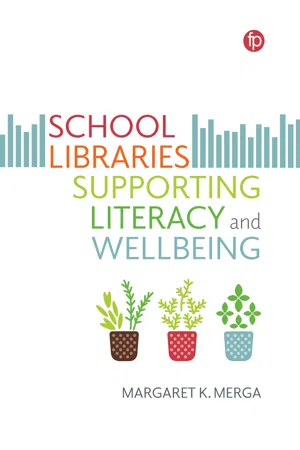
School Libraries Supporting Literacy and Wellbeing
About this book
Information
1
What Do School Library Professionals Contribute to Student Learning and Support? A Focus on Australia and the UK
What do school library professionals contribute to student learning and support? It will come as no surprise to you that the answer is a lot!
This is the longest chapter in the book, simply because school library professionals make a substantial and multifaceted contribution to student learning and support, but we need to start here and be expansive. The book is interested in the role of school libraries and their professional staff in supporting literacy and wellbeing, so it is important that these specific aspects of the role of school library professionals are considered within this broader frame of their role. Furthermore, school libraries and their staff are expected to contribute to student learning in contemporary schools, though the relationship between libraries and student achievement may not be well understood, so this chapter can also be used by school library professionals seeking to articulate some of the diverse facets of their role, as I will explore further in this chapter.
Associations between school libraries and student achievement have been extensively explored over time (Farmer, 2006; Lance & Kachel, 2018; Merga, 2019). While we can always do with more and higher quality research from diverse contexts (Stefl-Mabry et al., 2019), the evidence we have suggests that school libraries and their professional staff can make an important difference in the lives of young students. Although studies have often focused on the impact of libraries and library access on student performance in literacy testing (Francis et al., 2010; Hughes et al., 2014), this is only part of the whole picture around what libraries have to offer. This chapter takes a close look at the specific roles of teacher librarians in Australia and school librarians in the UK, exploring what they specifically do to enhance student learning, relating these practices to the research we already have around best practice and student learning.
Teacher librarian and school librarian: What is the difference?
First, I need to be clear that I do not conflate the roles teacher librarian and school librarian, even though I use the term school library professional commonly in this book to refer to both. Teacher librarians in Australia and school librarians in the UK obviously work in different national contexts and schooling systems, with different curricular and regulatory constraints, and they may have different professional standards and requirements.
In Australia, teacher librarians are conceptualised as follows.
A qualified teacher librarian is defined as a person who holds recognised teaching qualifications and qualifications in librarianship, defined as eligibility for professional membership for the Australian Library and Information Association (ALIA).
Within the broad fields of education and librarianship, teacher librarians are uniquely qualified. This is valuable because curriculum knowledge and pedagogy are combined with library and information management knowledge and skills.
Teacher librarians support and implement the vision of their school communities through advocating and building effective library and information services and programs that contribute to the development of lifelong learners.
(Australian School Library Association (ASLA), 2019, paras. 1–3)
In my experience with the ASLA, I have seen that Australian teacher librarians are very protective of their titles, as they hold tertiary qualifications in both education and librarianship. In my observation, teacher librarians are not protective of their titles in order to feel superior or promote division and exclusivity; rather, they have justifiable concerns that their roles will be replaced by staff who often have qualifications in neither area, but who are cheaper to employ due to remuneration structures in Australian schooling systems. For example, a recent study focused on South Australia found that while ‘94% of schools have someone to manage the library collection and to select resources’, in only ‘23% of schools the person in this role is a qualified teacher librarian’ (Dix et al., 2020), and Erickson (2019) reported on a small sample of Canadian paraprofessionals managing their school libraries. Teacher librarians are devalued despite the fact that they ‘have the capacity to provide tailored lessons and classroom support for their school communities, saving time and potentially decreasing workloads for classroom teachers’ (Willis, 2020, p. 15). I explore the issue of deprofessionalisation further in Chapter 7.
The School Library Association (SLA) supports and advocates for school library professionals in the UK, and they also provide some information around expectations of the role. Their website states that ‘the School Library Association believes that the School Librarian/Library Manager has an essential and unique specialist role to play in supporting pupils’ learning and their development into effective, independent learners and readers’ (SLA, n.d.-a, para. 1). Furthermore, it contends that the School Librarian should be:

(SLA, n.d.-a, para. 2)
Their website also contains a job description for the primary school librarian role, which details its core purpose, specific responsibilities and person-specific criteria (SLA, n.d.-b).
In the UK, the Chartered Institute of Library and Information Professionals (CILIP) is the library and information association involved with librarians’ professional registration. On their webpage on school librarians, CILIP states that ‘the school library or learning centre will house books and journals alongside internet access and audio-visual materials and the librarian is responsible for promoting the use of the service and engaging with teaching and management staff to ensure this’. Qualifications and capacities are also mentioned, as they note that ‘an accredited degree or postgraduate qualification in library and information science is usually required and for some roles a teaching qualification is also beneficial’, and that ‘many employers also look for CILIP Chartership or a willingness to work towards Chartership’. Furthermore,
You’ll need to be adept at teaching information literacy skills and encouraging and assessing reader development through activities like shadowing the Carnegie Medal for children’s and young people’s fiction. Sometimes the librarian is also responsible for the virtual learning environment.
(CILIP, n.d., para. 2)
Interestingly, while the UK school librarian is expected to be ‘adept at teaching’, the limited available research suggests that it is rare for them to be a qualified teacher (Streatfield et al., 2011). Furthermore, having a teaching qualification as well as a qualification in librarianship may not necessarily be deemed desirable by UK school librarians.
For example, a small study by Brackenbury and Willett (2011) found that school librarians were typically viewed as support staff, with respondents disappointed to be viewed in this light ‘when they had either worked hard for academic qualifications in order to be able to call themselves a librarian or had contributed to the teaching and learning outcomes of the school by teaching “library lessons”’ (p. 241). In response,
interviewees were asked whether the situation would improve if librarians received dual training, and came with teaching qualifications, as well as library qualifications. It was felt that this idea might help more librarians to be considered as teaching staff, which was evidently an issue for many of the librarian interviewees, but the responses to this suggestion were very mixed. For example, one interviewee suggested that if somebody had a teaching qualification then they would immediately be given additional teaching duties at the expense of their library responsibilities; and another suggested that having two qualifications would lead to substantially enhanced salary expectations (with the possible implication that these would not be met). (p. 242)
While a larger scale study is needed to explore whether these views hold broader generalisabil...
Table of contents
- Cover
- Praise for School Libraries Supporting Literacy and Wellbeing
- Half-title Page
- Title Page
- Copyright
- Contents
- List of Tables
- Acknowledgements
- Abbreviations
- Introduction
- 1 What Do School Library Professionals Contribute to Student Learning and Support? A Focus on Australia and the UK
- 2 School Libraries and Reading Engagement for Literacy
- 3 Librarians Supporting Struggling Literacy Learners Beyond the Early Years
- 4 School Libraries and Reading Engagement for Student Wellbeing
- 5 School Libraries, Health Resourcing and Information Literacy
- 6 Librarians Creating Environments for Reading and Wellbeing
- 7 Challenges to Visibility and Advocacy for School Libraries and Staff
- Conclusions and Directions for Future Research
- Appendix 1: Background and Methods of My Research Projects
- Appendix 2: A Place to Get Away from It All: Five Ways School Libraries Support Student Wellbeing
- Index
Trusted by 375,005 students
Access to over 1.5 million titles for a fair monthly price.
Study more efficiently using our study tools.
Frequently asked questions
Yes, you can cancel anytime from the Subscription tab in your account settings on the Perlego website. Your subscription will stay active until the end of your current billing period. Learn how to cancel your subscription
No, books cannot be downloaded as external files, such as PDFs, for use outside of Perlego. However, you can download books within the Perlego app for offline reading on mobile or tablet. Learn how to download books offline
Perlego offers two plans: Essential and Complete
- Essential is ideal for learners and professionals who enjoy exploring a wide range of subjects. Access the Essential Library with 800,000+ trusted titles and best-sellers across business, personal growth, and the humanities. Includes unlimited reading time and Standard Read Aloud voice.
- Complete: Perfect for advanced learners and researchers needing full, unrestricted access. Unlock 1.5M+ books across hundreds of subjects, including academic and specialized titles. The Complete Plan also includes advanced features like Premium Read Aloud and Research Assistant.
We are an online textbook subscription service, where you can get access to an entire online library for less than the price of a single book per month. With over 1.5 million books across 990+ topics, we’ve got you covered! Learn about our mission
Look out for the read-aloud symbol on your next book to see if you can listen to it. The read-aloud tool reads text aloud for you, highlighting the text as it is being read. You can pause it, speed it up and slow it down. Learn more about Read Aloud
Yes! You can use the Perlego app on both iOS and Android devices to read anytime, anywhere — even offline. Perfect for commutes or when you’re on the go.
Please note we cannot support devices running on iOS 13 and Android 7 or earlier. Learn more about using the app
Please note we cannot support devices running on iOS 13 and Android 7 or earlier. Learn more about using the app
Yes, you can access School Libraries Supporting Literacy and Wellbeing by Margaret K. Merga in PDF and/or ePUB format, as well as other popular books in Languages & Linguistics & Library & Information Science. We have over 1.5 million books available in our catalogue for you to explore.