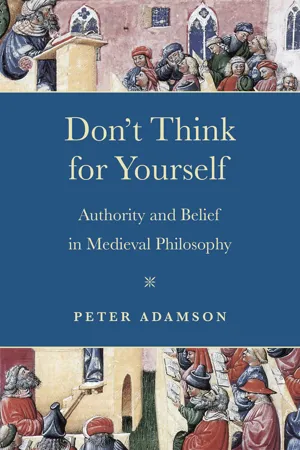
Don't Think for Yourself
eBook - ePub

Don't Think for Yourself

Authority and Belief in Medieval Philosophy

  1. English
  2. ePUB (mobile friendly)
  3. Available on iOS & Android
eBook - ePub

Don't Think for Yourself

Authority and Belief in Medieval Philosophy

About this book

How do we judge whether we should be willing to follow the views of experts or whether we ought to try to come to our own, independent views? This book seeks the answer in medieval philosophical thought.

In this engaging study into the history of philosophy and epistemology, Peter Adamson provides an answer to a question as relevant today as it was in the medieval period: how and when should we turn to the authoritative expertise of other people in forming our own beliefs? He challenges us to reconsider our approach to this question through a constructive recovery of the intellectual and cultural traditions of the Islamic world, the Byzantine Empire, and Latin Christendom.

Adamson begins by foregrounding the distinction in Islamic philosophy between taql?d, or the uncritical acceptance of authority, and ijtih?d, or judgment based on independent effort, the latter of which was particularly prized in Islamic law, theology, and philosophy during the medieval period. He then demonstrates how the Islamic tradition paves the way for the development of what he calls a "justified taql?d," according to which one develops the skills necessary to critically and selectively follow an authority based on their reliability. The book proceeds to reconfigure our understanding of the relation between authority and independent thought in the medieval world by illuminating how women found spaces to assert their own intellectual authority, how medieval writers evaluated the authoritative status of Plato and Aristotle, and how independent reasoning was deployed to defend one Abrahamic faith against the other. This clear and eloquently written book will interest scholars in and enthusiasts of medieval philosophy, Islamic studies, Byzantine studies, and the history of thought.

Frequently asked questions

Yes, you can cancel anytime from the Subscription tab in your account settings on the Perlego website. Your subscription will stay active until the end of your current billing period. Learn how to cancel your subscription.
No, books cannot be downloaded as external files, such as PDFs, for use outside of Perlego. However, you can download books within the Perlego app for offline reading on mobile or tablet. Learn more here.
Perlego offers two plans: Essential and Complete
  • Essential is ideal for learners and professionals who enjoy exploring a wide range of subjects. Access the Essential Library with 800,000+ trusted titles and best-sellers across business, personal growth, and the humanities. Includes unlimited reading time and Standard Read Aloud voice.
  • Complete: Perfect for advanced learners and researchers needing full, unrestricted access. Unlock 1.4M+ books across hundreds of subjects, including academic and specialized titles. The Complete Plan also includes advanced features like Premium Read Aloud and Research Assistant.
Both plans are available with monthly, semester, or annual billing cycles.
We are an online textbook subscription service, where you can get access to an entire online library for less than the price of a single book per month. With over 1 million books across 1000+ topics, we’ve got you covered! Learn more here.
Look out for the read-aloud symbol on your next book to see if you can listen to it. The read-aloud tool reads text aloud for you, highlighting the text as it is being read. You can pause it, speed it up and slow it down. Learn more here.
Yes! You can use the Perlego app on both iOS or Android devices to read anytime, anywhere — even offline. Perfect for commutes or when you’re on the go.
Please note we cannot support devices running on iOS 13 and Android 7 or earlier. Learn more about using the app.
Yes, you can access Don't Think for Yourself by Peter Adamson in PDF and/or ePUB format, as well as other popular books in Philosophy & Epistemology in Philosophy. We have over one million books available in our catalogue for you to explore.

Table of contents

  1. Title
  2. Copyright
  3. Contents
  4. Acknowledgments
  5. Introduction
  6. Chapter 1 Taqlīd: Authority and the Intellectual Elite in the Islamic World
  7. Chapter 2 Too High a Standard: Knowledge and Skepticism in Medieval Philosophy
  8. Chapter 3 Testing the Prophets: Reason and the Choice of Faiths
  9. Chapter 4 Using the Pagans: Reason in Interreligious Debate
  10. Chapter 5 Some Pagans Are Better than Others: The Merits of Plato and Aristotle
  11. Chapter 6 Finding Their Voices: Women in Byzantine and Latin Christian Philosophy
  12. Chapter 7 The Rule of Reason: Human and Animal Nature
  13. Further Reading
  14. Notes
  15. Index