This book is available to read until 23rd December, 2025
- English
- ePUB (mobile friendly)
- Available on iOS & Android
eBook - ePub
Available until 23 Dec |Learn more
The Bulgarian Contract
About this book
Newly-found evidence presented in The Bulgarian Contract changes our understanding of how and why the Great War ended precipitously on November 11, 1918. Graeme Sheppard describes how two young British army officers, POWs in Bulgaria, witnessed a secret act of Balkan propaganda that proved to be the catalyst for the collapse of the Central Powers, panicking the German high command into seeking an armistice in a conflict that was otherwise destined to continue well into 1919 with hundreds of thousands of extra deaths.
Frequently asked questions
Yes, you can cancel anytime from the Subscription tab in your account settings on the Perlego website. Your subscription will stay active until the end of your current billing period. Learn how to cancel your subscription.
No, books cannot be downloaded as external files, such as PDFs, for use outside of Perlego. However, you can download books within the Perlego app for offline reading on mobile or tablet. Learn more here.
Perlego offers two plans: Essential and Complete
- Essential is ideal for learners and professionals who enjoy exploring a wide range of subjects. Access the Essential Library with 800,000+ trusted titles and best-sellers across business, personal growth, and the humanities. Includes unlimited reading time and Standard Read Aloud voice.
- Complete: Perfect for advanced learners and researchers needing full, unrestricted access. Unlock 1.4M+ books across hundreds of subjects, including academic and specialized titles. The Complete Plan also includes advanced features like Premium Read Aloud and Research Assistant.
We are an online textbook subscription service, where you can get access to an entire online library for less than the price of a single book per month. With over 1 million books across 1000+ topics, we’ve got you covered! Learn more here.
Look out for the read-aloud symbol on your next book to see if you can listen to it. The read-aloud tool reads text aloud for you, highlighting the text as it is being read. You can pause it, speed it up and slow it down. Learn more here.
Yes! You can use the Perlego app on both iOS or Android devices to read anytime, anywhere — even offline. Perfect for commutes or when you’re on the go.
Please note we cannot support devices running on iOS 13 and Android 7 or earlier. Learn more about using the app.
Please note we cannot support devices running on iOS 13 and Android 7 or earlier. Learn more about using the app.
Yes, you can access The Bulgarian Contract by Graeme Sheppard in PDF and/or ePUB format, as well as other popular books in Historia & Historia europea. We have over one million books available in our catalogue for you to explore.
Information
Topic
HistoriaSubtopic
Historia europea1
Ludendorff learns of Balkan disaster
Saturday, September 28, 1918, within an upstairs room at the Hotel Britannique in the occupied Belgian town of Spa, the headquarters of the German High Command. That evening, word reached General Erich Ludendorff, working in his office, that Bulgaria, Germany’s ally, was about to sign an armistice with the enemy. In one day’s time, the Balkan state would no longer be in the war. For Ludendorff it was a body-blow, a disaster for the Central Powers, the scale of which he grasped immediately. Ludendorff walked almost disbelieving to the door to the landing. In the space of only two short weeks, Bulgaria, the bulwark to the southern front, had gone from a position of defensive strength to that of complete capitulation. How was it possible? There had to be more to it than military factors alone.
For several months, the war on the Western Front, in France and Belgium, had been going badly for Germany. The optimism and near victory of early 1918 had foundered and been followed by reverse after reverse. At one point within touching distance of Paris, the front was now only a few hundred kilometers from pretty Spa. With virtually no men, armaments, or resources left in reserve, and with American troops arriving in France in their tens of thousands, Ludendorff had come to realize that the war had become unwinnable: Germany could perhaps hold off defeat, but it could no longer force a victory. Now, the sudden loss of Bulgaria, leaving a massive defensive gap to the south of Germany and Austria-Hungary, augured total disaster. The cause of the Bulgarian collapse was a mystery to the German High Command, the Oberste Heeresleitung, commonly called the OHL. But whatever lay behind it, Ludendorff now believed that the game was up entirely. With Bulgaria gone, Germany’s position was untenable.1
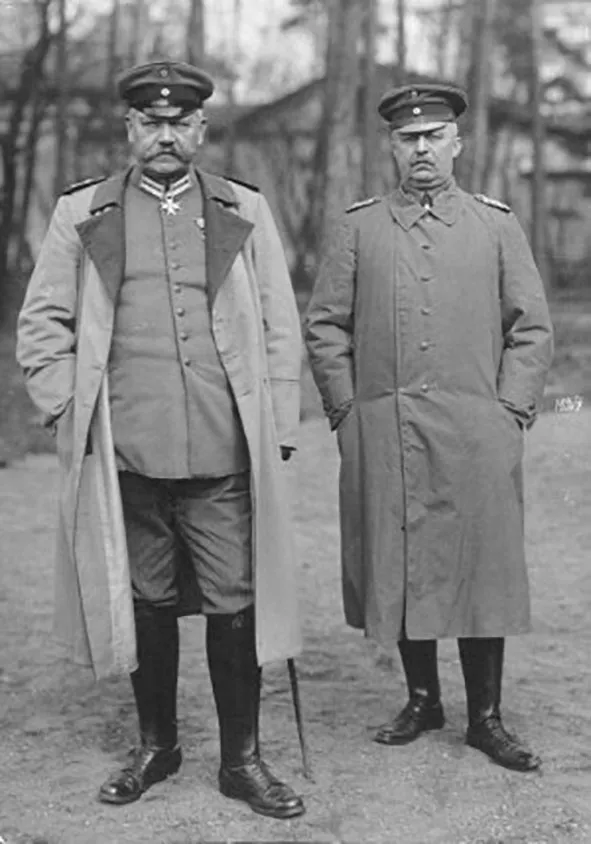
Paul von Hindenburg and Erich Ludendorff
Ludendorff trod resignedly downstairs and entered the office of his nominal superior, Field Marshal Paul von Hindenburg. For the previous two years the two men had not only commanded all of Germany’s land forces, but such was their influence that they also held sway over the Kaiser and Berlin’s politicians. The two generals were the most powerful men in the country. But of the pair, it was Erich Ludendorff who was Germany’s de facto dictator, with the calm and avuncular Hindenburg being the figurehead and the foil for the younger man’s energy and tactical dynamism.
“I could see in his face what had brought him to me,” wrote Hindenburg, recalling the decisive moment.
Without preamble, Ludendorff declared that Germany must seek an immediate armistice. Fighting must be ended, before it became too late; total defeat must be averted. “Our one task is to act definitely and firmly, and without delay,” he declared. Hindenburg, with tears in his eyes, agreed without hesitation: “As had so often happened since 22 August 1914, our thoughts were at one before they found expression in words.”
The two men shook hands. The Kaiser and the Foreign Minister were due to arrive in Spa the following morning. They would inform them then.2
It was a desolate moment for the pair - the end of hope for the great victory they and all Germany had long strived for. A mere six weeks later, on November 11, the Great War came to an end. Though during its four-year duration, tens of millions had been involved in the conflict, only a few souls knew anything of the secret events in Bulgaria that came to trigger its sudden end. One of them, a young British army officer, a second lieutenant, had just finished dining beside a group of enemy German staff officers in the Grand Hotel’s restaurant in far-off Sofia.
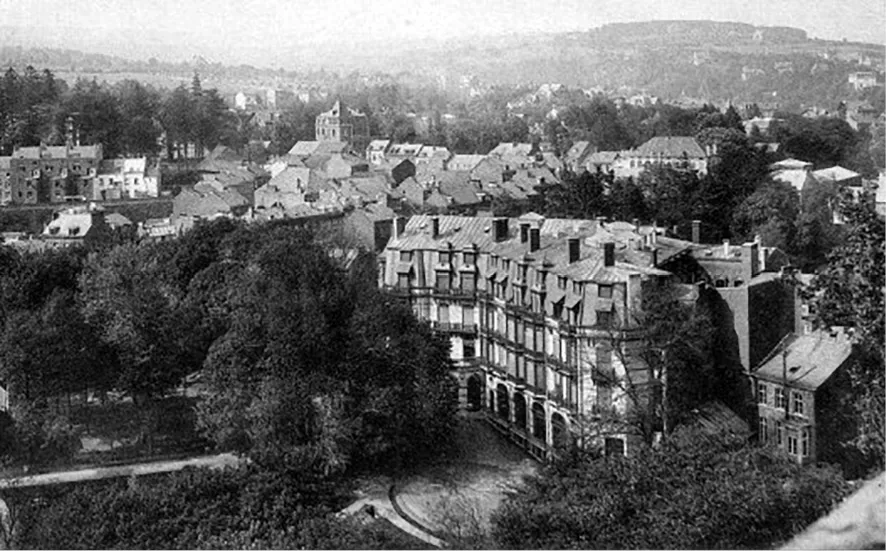
Hotel Britannique, Spa
Cornwall, over fifty years later, within an eight-bed country house on the edge of the small town of Lostwithiel, in the final months of 1970. An elderly widower and World War I veteran sat alone in his study before a typewriter, contemplating writing his memoirs. Robert Howe had enjoyed an eventful life, including a career in the Foreign Office that had taken him around much of the world, and through many scrapes. It was a life very much worth recording. But nothing of his post-war life could compare with his three years as a prisoner-of-war in Bulgaria, in a near-forgotten corner of the Great War. It was a peculiar captivity, one of extremes, during which Howe experienced the contrasts of months in a typhus-ridden death-camp and the liberty of living virtually free within an enemy village, and much else in between. Crucially, he and a fellow British escapee, Lieutenant ‘John’ Cowan, both junior officers, had been deep inside Bulgaria, far behind enemy lines, and witnessed at first-hand the Balkan state’s capitulation.
With his old friend long since dead, Howe was perhaps in the unique position of knowing how and why Bulgaria and the Macedonian front had folded in September 1918. For Howe knew and could be certain because a few years later he heard it from no less than the lips of the man who had orchestrated the collapse, the mastermind behind the plan.
But though completed during the winter of 1970-71, Howe’s memoirs were never published. On his death, the document passed into the possession of his family and, as a result, his remarkable testimony on how the Great War ended early was effectively forgotten. In his manuscript, Howe recalled the final days in Bulgaria with clarity; an incredible time in late September 1918, when the whole country seemed to disintegrate and he and Cowan simply walked out of their captivity - a prison camp several hundred kilometers from the front in neighboring Macedonia. Rumor in the camp was that the fighting had stopped. Given the degree of liberty the pair enjoyed in their final months there, together with their assessment of Bulgarian morale, the news came as no great surprise to them.
“When we heard this, we asked the Commandant what was going on. He told us that his information was that some units of the army had refused to fight and that a revolution had broken out in Sofia. We said goodbye to the Commandant, [and] packed our belongings…”3
There was no effort made to prevent Howe and Cowan from leaving, which was just as well given the friends’ determined mood. After three long years as prisoners, this was the moment they had been waiting for.
Departing the camp, the pair hired a droshky at the local market place and drove to the nearest station and took the first train going south toward Sofia. It was packed with disbanded Bulgarian soldiers bound for home – as seemed also the entire country. No tickets were issued, and none checked. The soldiers, most of who had thrown away their guns, were welcoming: “They greeted us with chants of ‘Anglichani, Anglichani, comrades’, embraced us, gave us food, helped us on our way. It was fantastic, incredible. Pure Greenmantle.”
Two days later the pair arrived at Sofia railway station – to a scene of chaos with soldiers demanding trains home in all directions. Finding themselves ignored, Howe and Cowan ordered another droshky to take them through the city’s deserted streets and squares to the Ministry of War. “At the entrance of the Ministry we demanded to see the Minister. The answer was: noma - there is not.”
They eventually discovered a general in a back room, where Howe recalled Cowan lordly demanding, in his fluent Bulgarian: “We are British officers, come to take over the city, in the name of the British Army. We require a staff-car and a good driver to take us to inspect the defenses.”
A large car and driver were produced and the friends spent the next hour enjoying a tour of the city-sites, including the boarded-up British legation, before ordering the driver to take them to Sofia’s Grand Hotel. Here their triumph continued. “At the Hotel we informed the clerk in reception that we required the two best bedrooms and dinner in an hour’s time.”
Bathed, shaved, and their uniforms brushed, they descended to the dining room, only to discover that the hotel was the headquarters of the local German high command; and there they all were, senior officers sitting gloomily eating their dinner.
A waiter hurried forward....
Table of contents
- Copyright
- Introduction
- 1 Ludendorff Learns Of Balkan Disaster
- 2 A Revolution From Above
- 3 The Road To Kosturino
- 4 Bulgaria And The Macedonian Front
- 5 Enter Ferdinand
- 6 Alexander Stamboliski
- 7 The Balkan Wars 1912-13
- 8 The Catalyst For Conflict
- 9 Ludendorff
- 10 Ferdinand Weighs His Options
- 11 Escaping Over The Mountains
- 12 Escaping Again And Word Of The Contract
- 13 Backing The Wrong Horse
- 14 Breakthrough At Dobro Pole
- 15 The British Try Again At Doiran
- 16 Rebellion And Abdication
- 17 Panic In Spa
- 18 Ludendorff The Fragile Dictator
- 19 President Wilson And The 14 Points For Peace
- 20 Max The Kaiser And The Armistice
- 21 Howe And A New World Order
- 22 Meeting The Man Behind The Contract
- 23 Assassination
- 24 Ludendorff And The Stabbed In The Back Myth
- 25 The Contract Hides From History
- 26 The Contract Both Saves And Costs Lives
- Afterword
- Acknowledgements
- About The Author