This book is available to read until 23rd December, 2025
- English
- ePUB (mobile friendly)
- Available on iOS & Android
eBook - ePub
Available until 23 Dec |Learn more
Behind the Red Door
About this book
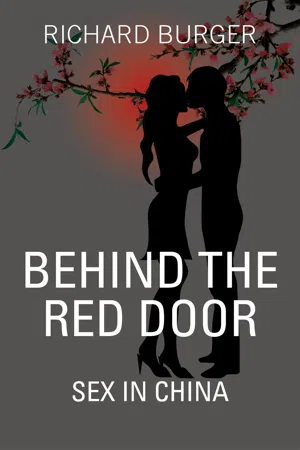
A sexual revolution is underway in China. Traditional morals and behavior are being turned on their head as the country's climb towards economic prosperity brings sex into the open. But it is a revolution distinctly different from the one experienced in the West, and has taken many unexpected twists and turns. Written in a highly engaging and readable style, Behind the Red Door: Sex in China takes the reader on a journey from ancient days, when China's rulers relied on shockingly vivid Daoist sex manuals, to the present, where China is torn between sexual orthodoxy and Western-style openness.
Frequently asked questions
Yes, you can cancel anytime from the Subscription tab in your account settings on the Perlego website. Your subscription will stay active until the end of your current billing period. Learn how to cancel your subscription.
No, books cannot be downloaded as external files, such as PDFs, for use outside of Perlego. However, you can download books within the Perlego app for offline reading on mobile or tablet. Learn more here.
Perlego offers two plans: Essential and Complete
- Essential is ideal for learners and professionals who enjoy exploring a wide range of subjects. Access the Essential Library with 800,000+ trusted titles and best-sellers across business, personal growth, and the humanities. Includes unlimited reading time and Standard Read Aloud voice.
- Complete: Perfect for advanced learners and researchers needing full, unrestricted access. Unlock 1.4M+ books across hundreds of subjects, including academic and specialized titles. The Complete Plan also includes advanced features like Premium Read Aloud and Research Assistant.
We are an online textbook subscription service, where you can get access to an entire online library for less than the price of a single book per month. With over 1 million books across 1000+ topics, we’ve got you covered! Learn more here.
Look out for the read-aloud symbol on your next book to see if you can listen to it. The read-aloud tool reads text aloud for you, highlighting the text as it is being read. You can pause it, speed it up and slow it down. Learn more here.
Yes! You can use the Perlego app on both iOS or Android devices to read anytime, anywhere — even offline. Perfect for commutes or when you’re on the go.
Please note we cannot support devices running on iOS 13 and Android 7 or earlier. Learn more about using the app.
Please note we cannot support devices running on iOS 13 and Android 7 or earlier. Learn more about using the app.
Yes, you can access Behind the Red Door by Richard Burger in PDF and/or ePUB format, as well as other popular books in Social Sciences & Sociology. We have over one million books available in our catalogue for you to explore.
Information
DATING AND MARRIAGE
Dating and marriage based on romance and love were practically unheard of in China from ancient times until the 1980s. Casual dating did not exist and took many years to become accepted. Dating as a means of seeking fun or entertainment would have been considered immoral in earlier times. Pre-marital sex would have been absolutely unimaginable. Even now, most Chinese believe that marrying the wrong person will bring disgrace to the entire family, and the family should play an active role in the process of finding the right mate.
In the 1950s, China passed a sweeping marriage law declaring that marriage must be based on “the complete willingness of both man and woman.” But it took some decades before this concept was embraced by the population at large, and in some rural parts of China today the notion of marriage by free choice is still unknown.
Throughout China’s history, marriage was an institution designed to continue the family’s lineage and fulfill the Confucian ideal of filial piety. In earlier times it was out of the question that young people could make such a vital decision as choosing a life partner. Often marriages were arranged upon the child’s birth. Dating etiquette was rigidly structured, starting with a matchmaker presenting the man’s proposal to the woman’s family. Her family, and especially her father, would make the final decision as to the man’s suitability. The couple’s stars would be charted based on their birthdates. If they got to the next level, the prospective groom would offer gifts to the woman’s family, and finally the matchmaker would determine the best date, based on feng shui and astrology, for the wedding itself.
Any discussion about the evolution of dating in China must take into account that there is more than one China. Attitudes toward dating and casual sex in large international cities like Shanghai and Beijing remain markedly different from those in lower-tier cities, let alone villages in the countryside. Dating and one-night stands have only become commonplace in larger cities because of relatively recent Western influences and dramatic modernization. Even so, dating in China remains considerably different than in the West. What we see in China today is a rapidly evolving hybrid of modern Western dating practices and traditional Chinese courtship conventions. And while casual sex is now routine in the big cities, especially now that the Internet makes hook-ups easy, in the countryside and many smaller towns and cities the dating process is still bound by convention.
Professor Li Yinhe, an expert on family and marriage at the Chinese Academy of Social Science, in an interview in 2010, said that in 1989 only 15 percent of people in China had pre-marital sex. Today, she said, more than 60 percent of urban Chinese have sex before they are married.
In China today the family still plays a considerable role in the dating process, providing perspective on whether the potential spouse lives up to their expectations in terms of personality, temperament, wealth, title and education. It doesn’t compare to the arranged marriages of times past, but it is a far different cry from how marriages come about in the West. In less developed parts of China, parents may still analyze the couple’s compatibility using ancient astrological charting.
But throughout China one thing remains the same: Parents are consulted and usually become actively involved before a couple agrees on marriage. If it actually gets to the point where the woman invites her boyfriend to meet her family it means she expects to marry him, and Chinese men understand this arrangement. If he doesn’t intend to marry her, the man will decline the invitation. As soon as the girl hints that she has spoken to her mother about the man, he knows she means business.
“Wuhan is a second-tier city but just like in Shanghai, our parents remain deeply involved in the dating process,” said Ada, who was born in Wuhan and now lives in Shanghai. “Your parents won’t force you to stop seeing someone, but they might suggest he’s not the right man. They want us to marry, to settle down and be happy. In my hometown, many parents will try to introduce a good match for you, and some families will try to force you to accept their choice, others will just suggest it. My mom just called me and tried to set me up with a man she was told about. She won’t force me, but she will keep an eye open for me.”
Stella grew up in Shanghai and agrees that while the parents might leave to her the final decision of who to marry or not, their opinion still matters:
Parents want to get as involved in your relationship as much as they can. When you date they want to know, where did you go and what did you do? They want details about how the relationship is going and they try to offer you advice. Girls especially value what their parents think of their boyfriends, and if they do not approve the girl may not be happy. I don’t have a boyfriend now and my parents are going crazy, so they’re telling me everyday, ‘You’re almost 24, you should be going out to find a boyfriend. Your career is secondary to your marriage.’ They think I should prioritize my goals in life and make finding a boyfriend my first priority. It’s annoying for me to hear them talk like that because I want to get a degree. Their intentions are good, but they’re based on their own judgment and experience and they are trying to force their ideas on me and prove my own ideas are wrong. I try not to discuss this issue with them. Still, it’s much different than in the countryside, where the marriage is usually arranged and the girl only meets the boy once or twice before they get married.
Everywhere in China, courtship is typically taken very seriously. Even in the big cities, serial dating is frowned upon, even as it becomes increasingly common. In the eyes of most Chinese, frequent dating with different suitors is a good measurement of the person’s character and reputation, signaling they might be immoral or promiscuous. The Chinese still see dating as a means of finding a spouse, and as the first step in a process leading to marriage. Young Chinese rarely date until they have finished high school, and more often they wait until their early twenties. As of 2010, the average age for men to marry was 24 years old, and for women it was 22 years old. Both men and women who are still single in their thirties are looked at with suspicion.
While young singles in many parts of China now date, they are not likely to bounce from partner to partner to size up who makes the best match. Dating is an opportunity to show honor and respect. Often it starts with friends setting up a dinner for a couple interested in one another, with the friends acting as matchmakers, steering the conversation toward topics that reveal the characteristics of the couple so they can weigh whether or not they are a good match. Afterwards, if the girl agrees to go out on a date with the man, she sends the signal that she considers him a viable candidate for marriage.
More casual, serial dating occurs in the big cities, but is still marked by “Chinese characteristics.” For example, the woman on the first date may ask her suitor how much money he makes, almost as casually as she would ask him about his day. She will ask about his education and his health (most Chinese women today prefer to marry non-smokers). Stability, loyalty and dependability are important, and the woman wants to make sure her potential spouse will be committed to her, physically and financially, throughout their lifetimes. China’s current gender imbalance gives girls the upper hand in the dating process, since she has more potential husbands to choose from. Dating and marrying can be compared to an auction in which the bride will go to the highest bidder, i.e., the man who can offer her the most financial longevity.
Unlike in the West, much of the courtship process may take place outside on the sidewalk if the couple cannot afford to go to a restaurant or Starbucks. If they are in a university together, they may well whisper romantically to each other in a corner of the classroom. Privacy is often hard to come by in China.
The Internet is another factor changing the face of dating in China. Although meeting for the first date is still frequently arranged by family or friends, China now has thousands of dating sites that have become home to millions of young people. Online dating sites and social media are especially useful if the parties live far apart but find they have mutual interests. They get to know each other online first, and then arrange at some point to finally meet, and maybe even marry. (Of course, such sites also lead to lots of hook-ups and one-night stands.) Some of China’s leading online dating sites boast millions of registered users, and some charge a small fee to register, making Internet dating a huge business. One of the largest sites, Jiayuan, has more than 50 million paid users, and went public in 2011.
Prior to the start of China’s sexual revolution in the 1980s, Chinese couples usually did not kiss or touch one another until the day of marriage. Nowadays, many young, urbane Chinese who have been exposed to Western influences have rejected these traditional virtues. Public displays of affection have become common in big cities, though they are nonexistent in less developed areas. Even in Beijing and Shanghai, many couples feel more comfortable holding hands in a secluded park than on the street, though that is changing. Most single adults in China still live with their parents and if they are going to have sex, chances are they will do it in rented apartments or when their parents are at work. For one-night stands and affairs, couples with enough money often check into cheap “love hotels “ run specifically for customers who want to have a quick sexual encounter.
Most Chinese women still believe it is best to date only one man and to marry him. Once the man invites her on a second or third date, he is indicating that he’s serious, that he is hoping for an exclusive relationship, and that marriage may be in the cards. If the girl tells him at some point that she likes or misses him, or if she casually touches him, the man knows that she, too, is getting serious.
Despite the liberalization of the cosmopolitan cities, traditional Confucian values still influence young people. Stella, a white-collar worker, notes the ongoing conflict between the sexual revolution and classical values. “In Shanghai, it’s hard to generalize because people are more open-minded than in the smaller cities. But even so, there are lots of girls in Shanghai who have no sexual activities with their boyfriends until they get married. Due to pressure to keep their virginity, girls are in a dilemma if their boyfriend wants intimacy, they have to struggle about whether to conform to him or wait until they get married.”
In a class by itself is the dating process for young migrant workers who have flooded China’s big cities from rural villages. Tricia Wang, a sociologist and ethnographer who has spent years in China studying social trends said in an interview:
The migrant workers have brought the countryside to the city. These young people bring with them strong ties to their families and friends, and often they migrate to a location based on their family knowing someone there. They are still closely tied to their village through these networks. When they are in their early twenties the family puts pressure on them to marry, getting involved, often through their networks, and encouraging friends and relatives to make introductions. If the son or daughter returns to their village with a boyfriend or girlfriend, it usually means they plan to marry.
In the towns and cities, young migrants are free from the watchful eye of their parents and are more likely to engage in pre-marital sex. If they do, however, it will usually be with the partner they intend to marry. Sex with multiple partners is not common. This is very different from the urbanites, who are more inclined toward casual dating and pre-marital relations without the expectation of marriage.
Many of these young migrant workers also find partners to “date” in virtual Internet communities. Some of these are similar to the popular Second Life community, self-contained worlds in which virtual partners can live and sleep together, wash dishes together and enjoy a feeling of being connected and being cared for, if only online. Message boards, chat services like MSN and its Chinese equivalent QQ, and a Twitter-like microblogging platform called Weibo offer migrant workers a variety of Internet communities to stay connected and find friends.
These sites are critical to millions of migrants longing for a sense of connectedness and bonding. Young workers from all around China who cannot afford their own PCs flock to Internet cafes where they use these tools to connect with friends, find dates, stay in touch with their families, play games, watch porn and even sleep. For about two dollars they can stay for eight hours in what is a welcome escape from the city outside, which often treats migrant workers with dismissal, if not outright contempt. These digital tools help to urbanize young migrant workers and allow them to have hopes and dreams. Their adoption of technology and greater exposure to the outside world can help move them toward eventual assimilation into China’s middle class.
Pre-Marital sex generally does not occur in rural areas for two main reasons: most young people of dating age have moved to urban areas to work, and the lack of privacy in the small villages makes it nearly impossible to carry on an affair.
Yellow Fever
In 2006 an English teacher in Shanghai, later revealed to be one David Marriott from the UK, started a blog that meticulously detailed his sexual exploits, including the seduction of former students. He wrote under the name China Bounder, and his blog was appropriately titled “Sex in Shanghai.” The blog left nothing to the imagination. In one typical post Marriott describes his excitement as he prepares to make love to one of his many one-night stands:
And so while she freshened up I lay on the bed, reaching down to pick a pair of panties from the floor, feeling their slick silk texture under my fingers, pressing them to my nose to inhale her scent, and once again running through in my mind what was about to happen.
And he tells what happened in shocking detail, in story after story. Descriptions of intercourse and oral sex and panty-sniffing with a seemingly endless stream of young Chinese girls, all told with a wry wit and a good deal of writing talent, ensured that he would get noticed, both by fellow expatriates and the Chinese. He makes it abundantly clear that he cares nothing for the girls, who are there only to give him pleasure. In one of many humorous if somewhat depraved posts he describes his hunt for a condom that would fit him:
The [drug store] rep told me this was a frequent problem with Western guys, and that as far as she knew nowhere in the city sold a bigger size. But, she said, foreign guys said such and such a line of Durex was the least bad fit; and so we bought a few packets of those.
Anyhow, back to Sweetie and her mouth. The condom being too small, it first of all threatened to come off, sitting as it was on my helmet like - well - a helmet - so I had to pull it further down me, making it yet more tight, and thus constricting me, reducing feeling and making it rather tougher to come, meaning I had to pump her pretty hard and fast, which began to exacerbate her discomfort. But come I did, covered in sweat and roaring.
Yeah, it was a pretty good fuck, and she’s a good lover - though her oral technique could do with some improvement.
Such candor and graphic detail, especially from a teacher seducing his own students, was sure to get attention. At first it was the expatriates who took notice. More established English-language blogs began reporting on this newcomer who was pushing the envelope. Some argued he should be congratulated for having the nerve to tell the truth. Others said he was a psychopath. Sex aside, Marriott was a merciless critic of the Chinese Communist Party and Chinese society. His writing style was compelling and often hilarious, and if he had left the sex out, odds are he would have become a popular political blogger.
The reaction of Chinese readers to the blog, not surprisingly, was far different than that of the foreigners. The image of this “Ugly European” spitting in the face of his host nation and repaying it by fornicating with every girl in sight including his students was an assault on the Chinese psyche on multiple levels. The Chinese look down on serial seducers, especially foreigners who are going after Chinese girls. One way a foreigner can guarantee being unpopular with his neighbors is to bring a different girl up to his apartment every night. Also, the Chinese have long seen themselves, with a lot of justification, as victims of Western and Japanese imperialism. This image of the callous Westerner deflowering young Chinese girls aroused more than a hundred years of resentment against exploitative foreigners. When word of the sex blog burst onto the Chinese Internet, the reaction was predictably explosive. On August 25, 2006, Zhang Jiehai, a professor of psychology at the Department of Sociology in the Shanghai Academy of Social Sciences, wrote a blog post bristling with outrage, condemning the sex blogger and raising a rallying cry for his expulsion from China. From the translation by Roland Soong of the “East South West North” blog:
Today, with tremendous anger, I will tell you the story of an immoral foreigner and I call upon all Chinese compatriots to get together and kick this immoral foreigner out of China. This is how it is: Several days ago, a friend told me about a blog run by an English man in Shanghai. I read it and I was shocked, angered and disgusted … after I read his blog, I had only one idea: This is intol...
Table of contents
- Cover
- Full Title
- Copyright
- Contents
- Introduction
- Sex in Imperial China
- Dating and Marriage
- The Sex Trade
- The Family
- Homosexuality
- Education and Health
- China’s Shifting Sexual Landscape
- Parting Thoughts
- Selective Bibliography