Reinvention of Health Applications with IoT
eBook - ePub

Reinvention of Health Applications with IoT

Challenges and Solutions

  1. 191 pages
  2. English
  3. ePUB (mobile friendly)
  4. Available on iOS & Android
eBook - ePub

Reinvention of Health Applications with IoT

Challenges and Solutions

About this book

This book discusses IoT in healthcare and how it enables interoperability, machine-to-machine communication, information exchange, and data movement. It also covers how healthcare service delivery automates patient care with the help of mobility solutions, new technologies, and next-gen healthcare facilities with challenges faced and suggested solutions prescribed.

Reinvention of Health Applications with IoT: Challenges and Solutions presents the latest applications of IoT in healthcare along with challenges and solutions. It looks at a comparison of advanced technologies such as Deep Learning, Machine Learning, and AI and explores the ways they can be applied to sensed data to improve prediction and decision-making in smart health services. It focuses on society 5.0 technologies and illustrates how they can improve society and the transformation of IoT in healthcare facilities to support patient independence. Case studies are included for applications such as smart eyewear, smart jackets, and smart beds. The book will also go into detail on wearable technologies and how they can communicate patient information to doctors in medical emergencies.

The target audiences for this edited volume is researchers, practitioners, students, as well as key stakeholders involved in and working on healthcare engineering solutions.
Frequently asked questions

Yes, you can cancel anytime from the Subscription tab in your account settings on the Perlego website. Your subscription will stay active until the end of your current billing period. Learn how to cancel your subscription.
No, books cannot be downloaded as external files, such as PDFs, for use outside of Perlego. However, you can download books within the Perlego app for offline reading on mobile or tablet. Learn more here.
Perlego offers two plans: Essential and Complete
  • Essential is ideal for learners and professionals who enjoy exploring a wide range of subjects. Access the Essential Library with 800,000+ trusted titles and best-sellers across business, personal growth, and the humanities. Includes unlimited reading time and Standard Read Aloud voice.
  • Complete: Perfect for advanced learners and researchers needing full, unrestricted access. Unlock 1.4M+ books across hundreds of subjects, including academic and specialized titles. The Complete Plan also includes advanced features like Premium Read Aloud and Research Assistant.
Both plans are available with monthly, semester, or annual billing cycles.
We are an online textbook subscription service, where you can get access to an entire online library for less than the price of a single book per month. With over 1 million books across 1000+ topics, we’ve got you covered! Learn more here.
Look out for the read-aloud symbol on your next book to see if you can listen to it. The read-aloud tool reads text aloud for you, highlighting the text as it is being read. You can pause it, speed it up and slow it down. Learn more here.
Yes! You can use the Perlego app on both iOS or Android devices to read anytime, anywhere — even offline. Perfect for commutes or when you’re on the go.
Please note we cannot support devices running on iOS 13 and Android 7 or earlier. Learn more about using the app.
Yes, you can access Reinvention of Health Applications with IoT by Ambikapathy, Shobana R., Logavani, Dharmasa, Ambikapathy,Shobana R.,Logavani,Dharmasa in PDF and/or ePUB format, as well as other popular books in Computer Science & Computer Science General. We have over one million books available in our catalogue for you to explore.

Information

1Deep Machine Learning for Sensing, Analysis, and Interpretation in IoT Healthcare

S.O. Owoeye, K.I. Adenuga, O.J. Odeyemi, and C.B. Emele
DOI: 10.1201/9781003166511-1

CONTENTS

  • 1.1 Introduction
  • 1.2 How IoT Works
    • 1.2.1 Sensors
    • 1.2.2 Connectivity
    • 1.2.3 Data Processing
    • 1.2.4 User Interface
  • 1.3 Applications of IoT
    • 1.3.1 Consumer Applications
    • 1.3.2 Commercial Applications
    • 1.3.3 Industrial Applications
    • 1.3.4 Infrastructure Applications
  • 1.4 IoT for Healthcare
    • 1.4.1 Medical Diagnosis
    • 1.4.2 Robotic Surgeries
    • 1.4.3 Recuperation
    • 1.4.4 Monitoring and Destroying Pathogens
    • 1.4.5 Hospital Operations Management
  • 1.5 Overview of Deep Machine Learning
  • 1.6 Approaches to Deep Learning
    • 1.6.1 Supervised Learning
      • 1.6.1.1 Regression
      • 1.6.1.2 Classification
    • 1.6.2 Unsupervised Learning
      • 1.6.2.1 Clustering
      • 1.6.2.2 Association
      • 1.6.2.3 Dimensionality Reduction
    • 1.6.3 Semisupervised Learning
  • 1.7 Deep Machine Learning Neural Network Architectures
    • 1.7.1 Artificial Neural Networks
    • 1.7.2 Deep Neural Networks
    • 1.7.3 Generative Adversarial Networks
    • 1.7.4 Recurrent Neural Networks
    • 1.7.5 Deep Belief Networks
  • 1.8 Application of Deep Learning in IoT Healthcare
    • 1.8.1 Classifying Image Data for Disease Detection (Malaria)
    • 1.8.2 Predicting Epidemic Outbreaks
    • 1.8.3 Pattern Imaging Analytics
  • References

1.1 INTRODUCTION

The world has witnessed a giant leap in science and technology over the past few decades. Smart technology is now the order of the day, from smart devices, smart appliances, and smart vehicles to even smart houses—all made possible with the introduction of Internet of Things (IoT). The idea of networking smart devices came to light in 1982 when a Coca-Cola vending machine was modified to report its inventory over the internet [1]. The term ā€œInternet of Thingsā€ was first mentioned in the early 1990s by Kevin Ashton [2].
IoT is used to describe a system of interrelated computing devices, mechanical and digital machines, objects, animals, or people provided with unique identifiers (UIDs) and has the ability to transfer data over a network without requiring human-to-human or human-to-computer interaction [3]. This definition is continuously changing with introduction of new technology such as deep machine learning, embedded systems, and robotics. An increasing number of industries are automating their operations through IoT to ensure higher efficiency and increasing their business worth. As IoT applications continue to increase, there arises a need for more secured systems to ensure that consumers’ privacy is protected; such concerns can be addressed by ensuring that IoT-based devices meet an acceptable standard before they are rolled out to consumers for use. One such standard is that companies should adopt a ā€˜defence in depth’ approach to IoT development and encrypt data at each stage [4].

1.2 HOW IoT WORKS

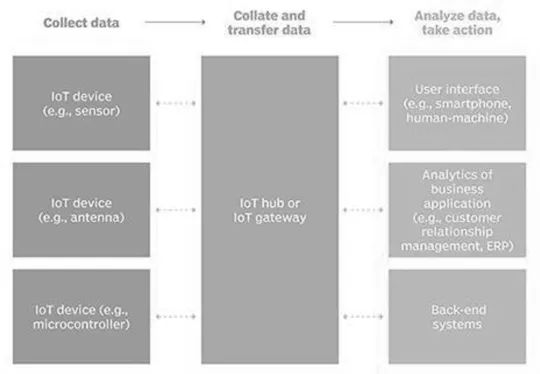
An IoT system consists of processors that collect data from the environment, this is the first stage of communication, and the data collected are then transferred to an IoT gateway or hub that collates the incoming data. After collation, data is transferred to a back-end user interface system, a smart phone, or human–machine interface (HMI) where it is accurately analysed. Accurate analysis is essential for a functional IoT system. This analysis could be done with artificial intelligence (AI), machine learning, deep learning, neural networks and reinforcement learning, the result from the analysis will then prompts the system to take a specific action. Figure 1.1 shows how the IoT system works [3].
FIGURE 1.1 How the IoT system works [3].
Every IoT system needs four major components to function effectively: sensors, connectivity, data processing, and a user interface.

1.2.1 SENSORS

A sensor is an input device that collects data from its immediate environment by detecting or sensing changes. Sensors are used in our everyday life, from simple light sensors that sense ultraviolet (UV) rays to soil sensors that sense the soil's relative PH.

1.2.2 CONNECTIVITY

The data received by the sensor is transmitted to the cloud or any other gateway, through a source of network connectivity, which could either be cellular, satellite, Wi-Fi, Bluetooth, or any other means of data transmission. The choice of connectivity varies across different smart devices, but it performs a particular function, which is the transmission of data from an input source to an IoT gateway.

1.2.3 DATA PROCESSING

The collected data is now in the cloud. At this stage, a processing algorithm is needed to analyse the data accurately. AI and machine learning then come into play. An AI could be deployed to perform statistical and numerical analysis of the data.

1.2.4 USER INTERFACE

Early computer users could only communicate and perform tasks from the computer's terminal. However, this is not the case anymore. A user interface is needed to ensure the end-user understands the received information.

1.3 APPLICATIONS OF IoT

IoT has found diverse applications in our daily lives, as millions of smart devices are connected over the internet through which they continually transmit and receive data, thereby expanding the potential applications of IoT. Some of the areas where IoT can be applied are discussed in subsequent sections [5].

1.3.1 CONSUMER APPLICATIONS

An increasing amount of IoT devices are created for consumer use, a typical example is in home automation. One in ten homes is now either fully or partially automated with IoT-based lighting systems, camera systems, heating and air conditioning, and security systems. IoT devices are also used to assist people with disabilities. We have smart wheelchairs that perform autonomous opera...

Table of contents

  1. Cover Page
  2. Half-Title Page
  3. Series Page
  4. Title Page
  5. Copyright Page
  6. Contents
  7. Preface
  8. About the Editors
  9. Chapter 1 Deep Machine Learning for Sensing, Analysis, and Interpretation in IoT Healthcare
  10. Chapter 2 IoT-Based Personalized Health and Fitness Monitoring System: The Next Big Thing
  11. Chapter 3 A Novel LC-DEH Algorithm to Enhance Efficiency and Security for Reliable Data Transmission in Blockchain with IoT-Based Healthcare Systems
  12. Chapter 4 Introduction to Blockchain Technology and Its Role in the Healthcare Sector
  13. Chapter 5 Emerging IoT Applications: Smart Dialysis Monitoring System
  14. Chapter 6 Role of Analytics in IoT: A Development of AAAS
  15. Chapter 7 IoT in M-Health Care
  16. Chapter 8 IoT-Based Anaesthesia Control and Monitoring System
  17. Chapter 9 Implantable Electronics: Real-Time Adaptive Image Security of Smart Visual Sensor Nod
  18. Chapter 10 Security Concerns with IoT-Based Health and Fitness Systems
  19. Chapter 11 Emerging eHealth IoT Applications: A Review on Kiosk-Based Systems
  20. Chapter 12 Early Identification of Medical Image Analysis for Normal and Abnormal Fetal Heart Rate: A Predictive Optimization Design