This book centers on negotiations around cultural, governmental, and individual constructions of COVID-19. It considers how the coronavirus pandemic has been negotiated in different cultures and countries, with the final part of the volume focusing on South Asia and Pakistan in particular. The chapters include auto-ethnographic accounts and ethnographic explorations that reflect upon experiences of living with the pandemic and its implications for all areas of life. The book explicates people's dealings with COVID-19 at various levels, situates the spread of rumors, conspiracy theories, and new social rituals within micro- and/or macro-contexts, and describes the interplay between the virus and various institutionalized forms of inequalities and structural vulnerabilities. Bringing together a variety of perspectives, the volume relates to the past, describes the Covidian present, and offers futuristic implications. It enlists distinct imaginaries based on current understandings of an extraordinary challenge that holds significant importance for our human future.
eBook - ePub
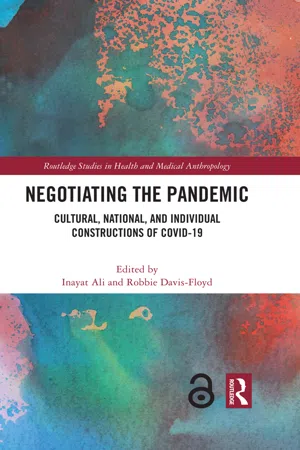
Negotiating the Pandemic
Cultural, National, and Individual Constructions of COVID-19
- 328 pages
- English
- ePUB (mobile friendly)
- Available on iOS & Android
eBook - ePub
Negotiating the Pandemic
Cultural, National, and Individual Constructions of COVID-19
About this book
Information
Part IAutoethnographic Reflections on Negotiating the Coronavirus Pandemic
1My Great-Grandmother, Malinowski, and My “Self”An Autoethnographic Account of Negotiating the COVID-19 Pandemic
Inayat Ali
DOI: 10.4324/9781003187462-3
Introduction
In this chapter, I provide an autoethnographic account of living in and living with the pandemic, in which I also reflect on what I had learned about anthropology and how I had learned it. Within the arena of what my co-editor Robbie Davis-Floyd and I are calling “Covidian anthropology,” I situate my first-hand experiences of this pandemic and how I negotiated them and related them to anthropological theories, methods, and existing inequalities. After becoming presumably infected by the coronavirus, herein I reflect on the transformations in my personality that resulted both from my anthropological work and from my experiences of COVID-19.
During my voluntary yet enforced months of isolation, when danger seemed to lurk everywhere, and after becoming extremely ill, I continuously thought, read, followed news reports, and wrote. Putting myself in self-quarantine in one room for 15 consecutive days, I spent time communicating and negotiating with myself in an effort to better understand my “self.” The inspiration for dissecting myself came from the book Soul Mountain, written by Gao Xingjian in 2000, for which he won the Nobel Prize for Literature. In his own self-dissection, Xingjian (2000) responds to the “devastation of the self” due to the Cultural Revolution in China that led him to choose to be a political refugee. As I describe in this chapter, to effectively communicate with myself to deal with anxiety and loneliness, and to keep life interesting, I dissected myself into the singular pronouns “I” and “me,” and used “You” to communicate closely with myself, to critically reflect on the COVID-19 situation as it personally affected me, and to examine my relationship with anthropology—my chosen field.
Moreover, while I was alone in that room, I longed to go somewhere. In my imaginaries, the two best places for me to go were the Trobriand Islands, an archipelago of Papua New Guinea, Melanesia, where famed early anthropologist Bronislaw Malinowski conducted his original ethnographic fieldwork during the First World War, and Mars. I really wanted to see these places, both for personal and for academic inspiration. Yet both were impossible to reach. This chapter will dissect my personal imaginaries during the pandemic, seek to autoethnographically explore my negotiations with it and myself, and will analyze what I have learned in relation to certain fundamental anthropological theories and methods.
Literature Review: Autoethnography Revisited
The debate about “objectivity” and “subjectivity” in the social sciences has long remained a prime area of academic inquiry (Foucault 1970; Diesing 1972; Longino 1990; Hastrup and Hervik 2003).1 Is it acceptable for anthropologists to write about their subjective experiences and present themselves as sources of data, or must we focus on “objective” knowledge about others? This “crisis of representation” in the 1980s paved the way for autoethnography to present the self as a site of study (Campbell 2016). Thus Reed-Danahay (1997: 1) views that this was the beginning of a “renewed interest in personal narrative, in life history, and autobiography.” Crawley (2012) noted that “auto” ethnography has its roots in the ethnographic tradition, as Karl Heider (1975) used it for the first time in regard to “the natives’” ability to offer insights about their personal experiences and emotions; Heider considered such insights to be autoethnographic.
Autoethnography, formerly considered too “subjective,” has now become an accepted source of first-hand data (Chang 2016) and is also considered to be pivotal for extending sociocultural understandings (Sparkes 2000; Wall 2008). Autoethnography centers the scholar’s emotions and requires a great deal of self-reflexivity (Styhre and Tienari 2014) to comprehend the links between “self” and “society,” and it rejects the positions of positivism about reliability and validity (ibid.; Campbell 2016). In other words, autoethnography considers the researcher as an individual who is also a member of society. In her article “Personal Narratives as Sociology,” Barbara Laslett (1999: 392) described the individual/social relationship as a new window on theoretical debates in the social sciences, as self-accounts vividly highlight “micro-macro linkages; structure, agency and their intersections; social reproduction and social change.” Thus, focusing on the researcher’s lived experiences and emotions has received satisfactory agreement across academic circles (Ellingson and Ellis 2008). For Reed-Danahay (1997: 4), as a postmodernist lens, autoethnography “involves a rewriting of the self and the social.”
Wall (2008: 39) deconstructs the term auto + ethno + graphy, stating that each part represents a strand focusing on “self,” “sociocultural connection,” and “the application of the research process,” respectively. Reed-Danahay (1997: 2) and Crawley (2012) note that there are several strands of autoethnography, yet two appear to be major types: “evocative” and “analytic” (Denshire and Lee 2013). Some of the most famous works in evocative autoethnography include Ellis (1997, 1999) and Behar (2014); in analytic autoethnography such works include Anderson (2006), Denzin (2006), and Vryan (2006).2
Emphasizing narrative presentations, evocative autoethnography focuses on telling “embodied stories about self and other, including the author’s emotions,” while seeking to evoke “emotional conversations with readers” (Bochner and Ellis 2016: 39–40). In contrast, analytic autoethnography views a researcher as: “(1) a full member in the research group or setting; (2) visible as such a member in published texts; and (3) committed to developing theoretical understandings of broader social phenomena” (Anderson 2006: 373).
This chapter is simultaneously both evocative and analytical. I see it as a synthesis of both approaches, as I tell embodied stories about myself while also seeking to evoke emotional “conversations” with my readers. And I analyze these stories via Geertzian “thick description” in order to develop “theoretical understandings of broader social phenomena” while recalling my past emotions (as did Mcgreehan [2017]), and also living in the present, challenging moment.
“You” and “I” Converse: Living with COVID-19
“Hello! How do you live during the days of COVID-19—these testing, challenging, frightening and overwhelming times?” “You” asked “I.”
“Well! I really don’t know, I have mixed feelings, after consuming news reports all the time, living inside the room, coughing, sneezing, high temperature, away from my family, productive, alone, exploring,” I replied to You.
“Could you please elaborate on that a bit further?” You asked.
I replied, “Okay! I will tell you the entire story. Please bear with me! At the end of February, my housemate, whom I will call Jacob, became very ill with apparent ‘flu,’ fever, and cough, and we called in a doctor on an emergency basis because Jacob was unable to walk. The doctor diagnosed a common flu and recommended medication accordingly. It is important to mention that Jacob took quite a long time to recover. In the early days of March 2020, I too became seriously ill with the same symptoms. The intensity of the symptoms increased gradually. I became worried about my situation, in part due to Jacob’s long illness and because we were all becoming aware of COVID-19 as a global pandemic. After I got sick, the dustbin in my room was full of tissues and masks that I consumed. Jacob was constantly telling me about the growing rates of COVID-19 infection in Vienna, including a few of his classmates. This news only increased my worries. I did not even want to tell my family about my aggravating situation, mainly due to not wanting to worry them. I understood that even if I did tell them, there was nothing they could do, as they were in Pakistan and I was in Austria.”
While nodding his head and taking deep breaths at my request, You said to I, “Please continue.”
I responded, “One evening, my situation was so critical that I was unable to speak due to constant coughing. Many serious thoughts were dominating my mind. Jacob suggested that I should see a doctor, saying, ‘Perhaps it is COVID-19.’ In the evening, we decided to go to a hospital. Jacob asked, ‘Can you please walk?’ Although I felt really unable to walk, due to an intense fever, repetitive sneezing, and cough, I said that I was fine and could walk to the bus stop, to avoid more worries for him. The bus stop was around one kilometer away from the hostel where we lived. With Jacob’s help, we reached it. Because it was going to take 10 minutes for the next bus to arrive, and that bus was not going directly to the hospital, and also because I was reluctant to travel by bus as I was continually sneezing and coughing that could make other passengers worried, Jacob booked a car via the Ober online taxi service; the price would be one Euro. After five minutes, a black Mercedes stopped to pick us up. When we entered the car from the back door, the driver looked at me in surprise, as I was wearing a mask—something that most Viennese were not yet doing. I observed that he felt a fear of infection. Our journey to the hospital began.”
You interrupted, “It seems an overwhelming story. Please continue.”
I said, “My roommate thought he was bringing me to the nearby hospital. Although he had only been in Vienna for a few weeks, I trusted that he knew where we were going. My roommate gave the hospital’s address to the driver to put into google maps. The approximate time to reach the hospital was around 14 minutes. However, the drive took around 40 minutes, as the hospital was not in the city center but on its periphery. The driver seemed angry due to not finding the hospital and receiving only one Euro, which was already paid online. This long journey disturbed me too, as I was trying very hard not to sneeze in the car. Somehow, I also felt bad that I had not asked Jacob about the hospital prior to the journey. The driver dropped us off when the google map showed that the hospital was only a few meters away, although we could not see it. I was happy to leave the car and feel the fresh air on my face. When we started searching for the hospital, it took us around 20 minutes to reach a place showing some hospital signs. But it turned out to be a psychiatric hospital, and I told Jacob that we were at the wrong place. I did not want him to feel bad, because he showed great concern. I asked him to go back to our hostel because I was feeling so weak. Since an Ober would take too long to come, we took a bus to reach a tram stop and then back to our hostel. When I entered the bus, the driver was constantly looking at me in his rearview mirror because I was fully masked.”
You showed his great concern, “Interesting indeed…what happened afterward?”
I continued, “Back at the hostel, I threw myself on my bed. I was too exhausted to do anything else. My roommate was eager to take me to a closer hospital, but I rejected that option without telling him that I now felt weaker and more exhausted. I preferred to call a doctor. My roommate called an emergency doctor, who said he would be here within half an hour.”
You promptly inquired, “Did a doctor then visit you? What did s/he say? What treatment did the doctor recommend?”
I shared the tale further, “Yes, a team of two male medical personnel—one doctor and his assistant—visited me almost after half an hour. They checked my temperature, tongue and lungs. Thereafter, the doctor said, ‘Since you have neither been to China nor to Italy, you do not have a COVID-19 infection, but the common flu,’ and recommended some medication.
It made me happy that I was not infected by COVID-19—although I now think that doctor was wrong—which, starting in December 2019, had turned into a global pandemic. In a matter of 100 days—by March 2020, when I got sick—the virus had infected around 2 million people worldwide and killed 120,000. Everything is interrupted: offices, institutions, shops, and houses. Perhaps these are the times to live in new forms of ‘caves’ but with modern technologies inside: television, mobile phones, Internet, light, laptops.
After spending more than a month with restrictions, dangers, fears, uncertainties, and chaos, I started to think that people might turn mainly into two forms: (1) a highly focused and wise person—a new Buddha; (2) a highly shattered person—an anti-Buddha. I am uncertain which I would turn into, as living in this new form of ‘caves’ is still not over. Nonetheless, one thing that is already clear is that that I am too tired to consume ‘news’ anymore, so I am watching old movies that contrast with this modern world. I am too exhausted to cook, so I am merely making efforts to fill my stomach but certainly with healthy food, such as fruits and fresh juices.”
You, while nodding his head, said, “That is rather interesting—most especially your concept of the ‘new Buddha’ and the ‘anti-Buddha.’ Please tell me more about what you mean by these concepts.”
I responded, “Well! What I mean by ‘new Buddha’ could entail almost everyone sitting in self-quarantine—either infected or due to fear of being infected or of infecting others. This has given us an opportunity to gather our thoughts, re-examine our priorities, and spend time with self. Spending time with ‘self’ could potentially enable ...
Table of contents
- Cover
- Half-Title Page
- Series Page
- Title Page
- Copyright Page
- Dedication
- Contents
- List of Figures
- List of Tables
- Notes on Contributors
- Introduction: Constructing and Negotiating COVID-19
- Part I Autoethnographic Reflections on Negotiating the Coronavirus Pandemic
- Part II Conceptualizing and Negotiating the Pandemic Across Professions, Cultures, and Countries
- Part III Culturally Constructing and Negotiating COVID-19 in South Asia
- Part IV Negotiating COVID-19 in Pakistan: Cultural Conceptions and Pandemic Responses
- Conclusions: Global Negotiations Around COVID-19
- Index
Trusted by 375,005 students
Access to over 1.5 million titles for a fair monthly price.
Study more efficiently using our study tools.
Frequently asked questions
Yes, you can cancel anytime from the Subscription tab in your account settings on the Perlego website. Your subscription will stay active until the end of your current billing period. Learn how to cancel your subscription
No, books cannot be downloaded as external files, such as PDFs, for use outside of Perlego. However, you can download books within the Perlego app for offline reading on mobile or tablet. Learn how to download books offline
Perlego offers two plans: Essential and Complete
- Essential is ideal for learners and professionals who enjoy exploring a wide range of subjects. Access the Essential Library with 800,000+ trusted titles and best-sellers across business, personal growth, and the humanities. Includes unlimited reading time and Standard Read Aloud voice.
- Complete: Perfect for advanced learners and researchers needing full, unrestricted access. Unlock 1.5M+ books across hundreds of subjects, including academic and specialized titles. The Complete Plan also includes advanced features like Premium Read Aloud and Research Assistant.
We are an online textbook subscription service, where you can get access to an entire online library for less than the price of a single book per month. With over 1.5 million books across 990+ topics, we’ve got you covered! Learn about our mission
Look out for the read-aloud symbol on your next book to see if you can listen to it. The read-aloud tool reads text aloud for you, highlighting the text as it is being read. You can pause it, speed it up and slow it down. Learn more about Read Aloud
Yes! You can use the Perlego app on both iOS and Android devices to read anytime, anywhere — even offline. Perfect for commutes or when you’re on the go.
Please note we cannot support devices running on iOS 13 and Android 7 or earlier. Learn more about using the app
Please note we cannot support devices running on iOS 13 and Android 7 or earlier. Learn more about using the app
Yes, you can access Negotiating the Pandemic by Inayat Ali, Robbie Davis-Floyd, Inayat Ali,Robbie Davis-Floyd in PDF and/or ePUB format, as well as other popular books in Social Sciences & Anthropology. We have over 1.5 million books available in our catalogue for you to explore.