Due to its depletion and the environmental damage it causes, hydrocarbons are being replaced by energy from renewable sources. One such form of energy source is Biomass. Biomass is a renewable raw material generated by living organisms and found in agricultural waste in large quantities. The three main components of biomass are cellulose, hemicellulose and lignin. The first two components are sugar polymers, being cellulosic ethanol a desirable goal for converting those. The truth is that the production of cellulosic ethanol has never passed the pilot unit phase, due to the lack of economic competitiveness. New ways must be found to make this viable. From the latest finding of the biomass structure, new biomass processing pathways are being advanced, constituting new biorefinery models, which will make it possible to obtain cellulosic ethanol concomitant with the production of different bioproducts such as xylitol, oligosaccharides, antioxidants and analogues to carbon fiber, etc.
Lipid rich biomass is the source of foods oils. With population growth, the amounts of waste volume will increase. It is important to improve the processes of valorization of these residues, through their conversion into alcoholic esters of fatty acids, which can be used as fuel or in other domestic and industrial applications.
This volume reviews advances and innovative applications in this field. It will encourage the use of new works and even unpublished works to use biomass or its components for the production of bioproducts and biofuels.
Biomass is a renewable organic material that comes from plants, animals and microrganisms. Its origin is diverse and is spread everywhere—forests, agricultural activity and its residues, animals, microorganisms, aquatic biomass, etc. In the latter case, microalgae, which have only recently begun to be better studied, have proved to be very promising in the production of biomass, given the rapid growth that can be done in reservoirs that occupy a very small area of land.
The biomass accumulated in small areas such as agricultural land, etc., is especially interesting, due to its availability in large quantities, examples occur in vegetable residues originating from extensive agricultural production of cereals and sugarcane. These materials represent a portion of the biomass from which derivative products at competitive prices can be obtained, however, biomass collection activity is expensive, unless it is done by mechanical means. Residues from the production of cereals in the food chain with high consumption, such as wheat and rice, are of particular interest as biomass is already being created by the normal processing of the cereal as residue which has no or very limited use.
Special importance is given to these residual biomasses in this book. They have limited use, in Europe mainly as food and as bedding for animals, and their excess is often burned, contributing to the already serious level of carbon dioxide emissions (Xiao et al. 2001). Some countries have already issued regulations and laws that prohibit or oblige to reduce this burning. Often, the biomass is deposited in landfills or simply left in the soil. In 2018, the total amount of residual agricultural and forest biomass produced in the world was estimated at around 105 or 100000 billion metric tons, with the largest producers being the USA and Brazil (Kumara and Behera 2018).
Terrestrial biomass was designed by Nature to give plants mechanical resistance and robustness to deal with adverse environmental conditions, while having characteristics necessary for the life and growth of the plant, which involve different mechanisms, an example will be the transport of substances through the tissues.
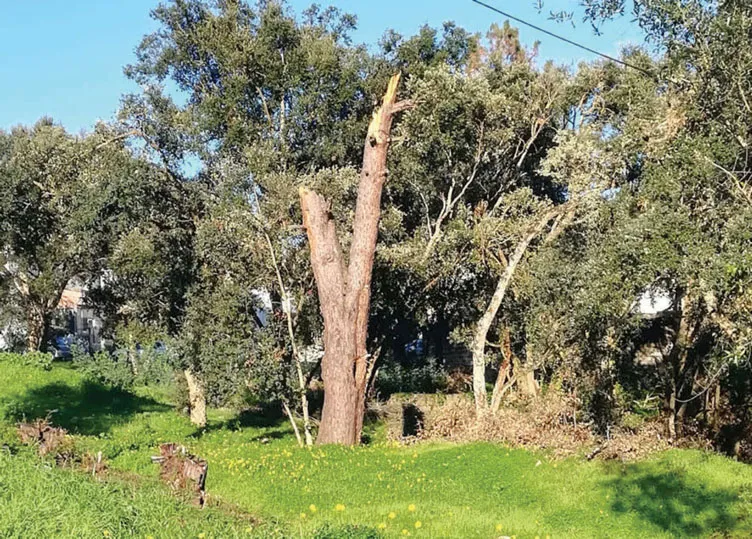
Wood is an example of a type of biomass used by man in multiple ways, it has good availability, adequate mechanical properties for construction, along time duration, ease of cutting, etc. Pinewood, for example, without any chemical treatment is capable of sustain the roof of a house for more than a century, being only susceptible to attack by several species of microorganisms in the last few years. Despite this strong structure, pines are often not strong enough to deal with adverse weather conditions, such as storms and hurricanes, an example among many others is shown in Figure 1, with the effect on Pinus Pinaster pines from Hurricane Leslie in Coimbra, Portugal, on the night of October 13, 2018 (10:40 pm).
Figure1 Pinus pinaster tree broken by the strong winds of Hurricane Leslie, on the night of October 13, 2018, in the “Quintada Portela” area, Coimbra, Portugal.
Structurally, biomass is a lignocellulosic material, synthesized mainly in the primary cell wall of plants. The involvement of the secondary wall seems to be at the level of intussusception as the main contribution, since the growth of the plant occurs essentially in the primary wall. Its exact structure is difficult to precisely define. The cell wall has a composite nature consisting of the combination of different materials with different mechanical and physical-chemical properties that are sometimes complementary, making it a particularly resistant material. Biomass has a high polymorphism, depending on the type of plant and, on the plant, its location.
The composite nature of lignocellulosic materials has been known for sometime and its main components are, in decreasing order of mass; cellulose, hemicellulose and lignin. Some types of biomass may have other important secondary constituents, such a spectin, lipids, terpenes and sugars. Table 1 shows the chemical composition of some common types of biomass, in different types of wood, residues from agricultural activity and from different grasses. The relative content of each of the three main constituents is presented.
Both hemicellulose and cellulose are carbohydrates polymers in their nature, when considering their total percentage, values as high as 70–80% of the dry matter can be found in the biomass samples (see Table 1), making it possible infer at first sight its saccharification and subsequent fermentation to produce substances such as ethanol, lactic acid or any other product that can be obtained from sugars. As will be seen below, obtaining sugars, especially from the cellulose component, is far from easy and constitutes the main obstacle to the successful conversion of biomass into a variety of useful products.
Table 1 Main component compositions of some examples of lignocellulosic biomass types (adapted from Isikgor and Becer 2015).
Lignocellulosic biomass
Cellulose (%)
Hemicellulose (%)
Lignin (%)
Hardwood
Oak
40.4
25.9
24.1
Eucalyptus
54.1
18.4
21.5
Softwood
Pine
42.0–50.0
24.0–27.0
20.0
Scots Pine
40.0
28.5
27.7
Agricultural waste
Wheat Straw
35.0–39.0
23.0–30.0
12.0–16.0
Barley Hull
34.0
36.0
13.8–19.0
Barley Straw
36.0–43.0
24.0–33.0
6.3–9.8
Rice Straw
29.2–34.7
23.0–25.9
17.0–19.0
Rice Husks
28.7–35.6
12.0–29.3
15.4–20.0
Oat Straw
31.0–35.0
20.0–26.0
10.0–15.0
Ray Straw
36.2–47.0
19.0–24.5
9.9–24.0
Corn Cobs
33.7–41.2
31.9–36.0
6.1–15.9
Corn Stalks
35.0–39.6
16.8–35.0
7.0–18.4
Sugarcane Bagasse
42.0
25.0
20.0
Sorghum Straw
32.0–35.0
24.0–27.0
15.0–21.0
Grasses
Ryegrasses
29.0
30.0
6.7
Switchgrass
35.0–40.0
25.0–30.0
15.0–20.0
The spatial arrangement of the three main components of biomass has been the focus of intense debate in recent decades (Wang and Hong 2016). The problem is relatively complex, considering the many different types of existing biomass, with Nature organizing the constituents in a wide variety of ways to meet the specific needs of plants. These biomass heterogeneity properties present great difficulty in the analytical characterization of the biomass structure, since the analytical techniques available have difficulty in the precise determination of the different components, and their organization is often deduced by indirect measurements.
A large number of simplified models for the structure of biomass have been published in the literature (Li et al. 2016). To add understanding to this problem, a detailed structure of each of the three main components of biomass is discussed and based on this knowledge an update of the biomass structure is proposed.
2 Biomass main components
2.1 Cellulose
A detailed understanding of the cellulose structure is essential for the project that pursues its disassembly into simple sugars or other bioproducts such as a cellulose microcrystalline or nanocellulose. The glycosidic bond prevalent in cellulose is the β(1,4), which causes the next glucose unit to rotate 180° in relation to the previous one. The glucose polysaccharides polymerized through this link form a single homogeneous chain that extends rectilinearly to form a single fibril. On the other hand, the use of the α(1,4) bond in polyglycosides gives rise to a helix structure, for example that found in amylose, a component of starch.
Multiple simple cellulose fibrils are synthesized on the outside of the plant’s cell wall in a matrix of several enzymes per cell, the cellulose synthase enzymes (CESA), often called rosettes (Li et al. 2017). The number of individual single fibril which are synthesized simultaneously, range from values as low as 6 to a greater number, as 36 or more. These are organized in microfibrils showing crystalline parts and amorphous zones, the factors that lead to this differentiation are not well known, possibilities are the need to cause curvature in some polymer points or manipulations in CESA rosettes.
The coupling of multiple fibrils gives rise to the formation of macrofibrils that are stabilized through a network of hydrogen bonds between the fibrils. In macrofibrils growth intervention of multiple cells is expected in their elongation and thickening process. The way this is achieved should involve coupling of new sets of microfibrils to those previously made, and is supported by visible details in SEM biomass images where finger-shaped ends are common, suggesting the completion (or beginning) of microfibril assembly at certain points.
The number of individual microfibrils in the macrofibrils can reach thousands. The average length of each individual fiber can be determined by the degree of polymerization (DP), values from 900–6000 (Hallac and Ragauskas 2011) to 15,000 (Mittal et al. 2011) are considered.
Both microfibrils and macrofibrils show crystal...
Table of contents
Cover Page
Title Page
Copyright Page
Dedication
Preface
Contents
1. Biomass Structure and Disassembling
2. New Uses for Hemicellulose
3. Biomass Delignification with Biomimetic Enzyme Systems
4. Bioproducts Derived from Lignin Obtained from Micro- and Nanocrystalline Cellulose Preparation
5. Carbon Fiber Analogues by Fusion of Biomass Polymers
6. The Methanol/Sulfuric Acid System for Cellulose Saccharification
7. Microalgae Biomass as an Alternative to Fossil Carbons
8. The Phase Inversion in the Preparation of Batch Biodiesel from Triglycerides and Methanol
9. Preparation and use of Biodiesel in a Continuous Process using Alcohol/Water Mixtures
Index
Trusted by 375,005 students
Access to over 1.5 million titles for a fair monthly price.
Study more efficiently using our study tools.
Frequently asked questions
Yes, you can cancel anytime from the Subscription tab in your account settings on the Perlego website. Your subscription will stay active until the end of your current billing period. Learn how to cancel your subscription
No, books cannot be downloaded as external files, such as PDFs, for use outside of Perlego. However, you can download books within the Perlego app for offline reading on mobile or tablet. Learn how to download books offline
Perlego offers two plans: Essential and Complete
Essential is ideal for learners and professionals who enjoy exploring a wide range of subjects. Access the Essential Library with 800,000+ trusted titles and best-sellers across business, personal growth, and the humanities. Includes unlimited reading time and Standard Read Aloud voice.
Complete: Perfect for advanced learners and researchers needing full, unrestricted access. Unlock 1.5M+ books across hundreds of subjects, including academic and specialized titles. The Complete Plan also includes advanced features like Premium Read Aloud and Research Assistant.
Both plans are available with monthly, semester, or annual billing cycles.
We are an online textbook subscription service, where you can get access to an entire online library for less than the price of a single book per month. With over 1.5 million books across 990+ topics, we’ve got you covered! Learn about our mission
Look out for the read-aloud symbol on your next book to see if you can listen to it. The read-aloud tool reads text aloud for you, highlighting the text as it is being read. You can pause it, speed it up and slow it down. Learn more about Read Aloud
Yes! You can use the Perlego app on both iOS and Android devices to read anytime, anywhere — even offline. Perfect for commutes or when you’re on the go. Please note we cannot support devices running on iOS 13 and Android 7 or earlier. Learn more about using the app
Yes, you can access Biomass, Bioproducts and Biofuels by Jorge M.T.B. Varejão in PDF and/or ePUB format, as well as other popular books in Technology & Engineering & Biology. We have over 1.5 million books available in our catalogue for you to explore.