In the 5G era, edge computing and new ecosystems of mobile microservices enable new business models, strategies, and competitive advantage. Focusing on microservices, this book introduces the essential concepts, technologies, and trade-offs in the edge computing architectural stack, providing for widespread adoption and dissemination.
The book elucidates the concepts, architectures, well-defined building blocks, and prototypes for mobile microservice platforms and pervasive application development, as well as the implementation and configuration of service middleware and AI-based microservices. A goal-oriented service composition model is then proposed by the author, allowing for an economic assessment of connected, smart mobile services. Based on this model, costs can be minimized through statistical workload aggregation effects or backhaul data transport reduction, and customer experience and safety can be enhanced through reduced response times.
This title will be a useful guide for students and IT professionals to get started with microservices and when studying the use of microservices in pervasive applications. It will also appeal to researchers and students studying software architecture and service-oriented computing, and especially those interested in edge computing, pervasive computing, the Internet of Things, and mobile microservices.
The 5th-generation mobile communication technology (5g) and edge computing have become important network infrastructure and are expected to be widely used in the coming decade. They not only tremendously increase the network capacity and capabilities but also help to complete the convergence of computing and communications to make computing truly pervasive [8]. Pervasive computing environments enable access to diverse resources and services over networked computing systems. Such a system includes traditional computers as well as embedded devices, information appliances, and sensors [18, 190].
During the last decade, breakthroughs in achieving faster and energy-efficient wireless communication as well as smarter and thinner embedded devices have accelerated human users’ shift away from traditional computers and towards mobile and embedded devices for resource access and information sharing. The emergence of the Internet of Things (IoT) further enables the connections among massive, diverse entities such as vertical systems, communication networks, smart devices/things, and applications. These entities enrich IoT with a plethora of data and various new applications. Thus, there is an increasing demand for developing pervasive applications that are feasible in 5G and edge computing environments.
Service-oriented computing (SOC) is a major paradigm in pervasive computing [77, 151]. It packages heterogeneous resources as services or microservices that are discoverable, accessible, and reusable. It also provides unifying interfaces for microservices to ease users’ access via communication networks. To address a particular user requirement, a combination of multiple microservices may be required, and so a fully functional service composition process will tackle complex user requests with a flexible composition of value-added services. This makes the microservice-oriented model an ideal way to create flexible applications and to tackle the mobility issue of the computing environment.
Except for the conventional services from the Internet industry, communications service providers have started to position themselves as partners in key verticals to secure their place as priority providers of pervasive applications [15, 87, 214]. Edge computing inspired many early attempts to combine communication services with traditional service computing platforms to support pervasive applications [76, 132, 167]. Edge computing pools the distributed computing resources to support applications, and service platforms will be at anywhere along with the cloud-to-things continuum, including in the cloud, at the edge of the network, or on the things [41]. This allows an end-user to offload tasks from the cloud (or from the end device) to edge devices that reside in the vicinity of the end-users or the data sources, which will reduce the latency and bandwidth required for transporting data to the cloud.
This book establishes concrete, technology-centric coverage with a focus on the concept, architectures, well-defined building blocks, and prototypes for mobile microservice platforms and pervasive application development. Subsequent to the technology-centric coverage, the book proceeds to establish metrics that allow for the economic assessment of connected, smart mobile services. In some cases, edge computing enables new business models, strategies, and competitive differentiation, as with ecosystems of mobile microservices. In other cases, costs can be minimised through statistical workload aggregation effects or backhaul data transport reduction, customer experience, and safety can be enhanced through reduced response time, revenue, and competitive advantages can also be enhanced through new edge-enabled service provisioning models.
Topics covered include:
The Challenges and Requirements of 5G and Edge Computing
How to Design a flexible Mobile Microservice-based Application
Microservices Architecture and Models
Prototype Development and Examples for AI-based applications
Performance and Maintenance
1.1Book Structure
This book focuses on the application level and addresses the combination of microservices instead of edge devices.
Design Concepts for Pervasive Applications.Chapter 2 points out the service composition challenges with regard to the features of open and dynamic pervasive computing environments. It then investigates the state of the art and explores how it meets the challenges in the target computing environment. It applies an assessment metric to review the feasibility of these solutions and classify them. Based on the analysis results, the chapter proposes a set of design concepts and shows how the design addresses the challenges.
Microservices Deployment in Edge/Fog Computing Environments. Edge computing allows microservices to be pushed down from the cloud to the edge devices, which enables low-latency services access between end-users and edge devices. Service composition has an execution flow that requires multiple edge devices’ participation. To reduce the latency of service access between edge devices, Chapter 3 focuses on the deployment of microservices in edge/fog computing environments to achieve the shortest service execution route and the adaptation issues that tackle dynamic environments.
Microservices Composition Model.Chapter 4 describes the design objectives and lays out the system model in detail. In particular, it begins by describing the requirements that should be satisfied and the trade-off based on the analysis in Chapter 2. It then describes the service composition model as a proposed solution to the problem of service composition in open and dynamic pervasive computing.
Cooperative Microservices Provisioning. Edge devices can be owned by heterogeneous third-party providers. There is a lack of a central management entity to offload service execution tasks. To optimal the distribution of microservices and increase the efficiency of service composition. Chapter 5 explores the selfishness of edge devices and proposes a game-based microservice provisioning model to improve the overall service availability.
Implementation.Chapter 6 describes the implementation of the above models and introduces a support middleware. It also presents two prototypes. A Java-based prototype realises the proposed models as a middleware application. A C++ implementation integrates the proposed service composition model with the network simulator NS-3 for evaluation. It is realised as an extension module on the NS-3 platform. Chapter 7 demonstrates a detailed implementation for enabling intelligence services in a pervasive application at the network edge.
Evaluation.Chapter 8 evaluates how the proposed solution fulfills the identified challenges and research questions by comparing to baseline solutions from state of the art. It begins with the introduction of evaluation metrics for a measurement of the proposed models and the baseline approaches in the target environment. Evaluation metrics include measurements of composition success rates under various mobility models, the composition model’s scalability and performance, the efficiency of service redeployment, and the availability of microservices. This chapter continues by introducing a prototype case study that demonstrates the proposed service composition model’s feasibility on real mobile devices, and a simulation-based experiment. Simulation results illustrate both the strengths and the limitations under different network density and composite complexity conditions.
Discussion.Chapter 9 analyses this book’s achievements, summarises this work, and presents a list of interesting open issues that require further research.
CHAPTER2Design Concepts for Pervasive Applications
DOI: 10.1201/9781003272960-2
Pervasive computing environments have evolved from closed (special purpose) and static to open and dynamic (mobile)[18, 39, 77] A large number of third-party mobile entities (e.g., wearable technologies, smartphones, IoT devices, etc.) can be included in such environments. As modern wireless communication technology facilitates wireless data exchange for mobile users, various information captured by smart mobile devices like news, locations, air quality, reviews, routes/directions, and even parking/loading data, can be shared through wireless networks [89, 100, 141].
2.1Motivating scenario: A Smart Public Space
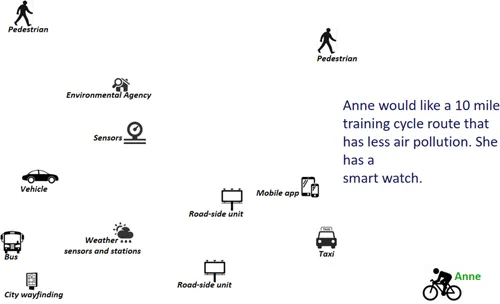
As a motivating scenario, Anne is on a bicycle near a street, using her smartwatch to plan routes. She would like a 10-mile training cycle route that has less air pollution (see Fig. 2.2). There is a local smart traffic system including various embedded devices owned by public transportation companies, weather service providers, taxi drivers, or pedestrians, etc. These devices can package their capabilities, like GPS, navigation, translation, real-time weather services, or city map to be accessible via network connections. Anne’s smartwatch has been configured to incorporate surrounding communication networks to make use of available resources.
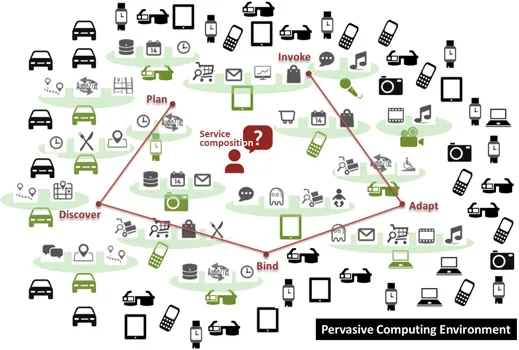
Figure2.1Motivating scenario: a smart public space system. (A user issues a complex service request to a pervasive computing environment. Connected entities offer their hardware/software capabilities and local data as microservices.)
Figure2.2Anne's service composite
This smart traffic system is capable of allowing (possibly third-party) service providers to join the environment, discovering services based on the given requirements in a flexible way, producing a service workflow for data transition, and invoking service instances for execution. It has the potential to help Anne get the routing result she needs without browsing websites or utilising the full capabilities of her hardware and software (see Fig. 2.3). Thus, her smartwatch may be able to get a composite service (left picture in Fig. 2.4) directly via a local network that forms from different devices in the pervasive computing environment, such as a ...
Table of contents
Cover Page
Half-Title Page
Title Page
Copyright Page
Dedication Page
Contents
Preface
Contributors
CHAPTER 1 ◾ Introduction
CHAPTER 2 ◾ Design Concepts for Pervasive Applications
CHAPTER 3 ◾ Microservices Deployment in Edge/Fog Computing Environments
APPENDIX A ◾ Further Implementation Detail: Prototypes
APPENDIX B ◾ Evaluation Results' Validity
APPENDIX C ◾ Glossary of Terms
Bibliography
Trusted by 375,005 students
Access to over 1.5 million titles for a fair monthly price.
Study more efficiently using our study tools.
Frequently asked questions
Yes, you can cancel anytime from the Subscription tab in your account settings on the Perlego website. Your subscription will stay active until the end of your current billing period. Learn how to cancel your subscription
No, books cannot be downloaded as external files, such as PDFs, for use outside of Perlego. However, you can download books within the Perlego app for offline reading on mobile or tablet. Learn how to download books offline
Perlego offers two plans: Essential and Complete
Essential is ideal for learners and professionals who enjoy exploring a wide range of subjects. Access the Essential Library with 800,000+ trusted titles and best-sellers across business, personal growth, and the humanities. Includes unlimited reading time and Standard Read Aloud voice.
Complete: Perfect for advanced learners and researchers needing full, unrestricted access. Unlock 1.5M+ books across hundreds of subjects, including academic and specialized titles. The Complete Plan also includes advanced features like Premium Read Aloud and Research Assistant.
Both plans are available with monthly, semester, or annual billing cycles.
We are an online textbook subscription service, where you can get access to an entire online library for less than the price of a single book per month. With over 1.5 million books across 990+ topics, we’ve got you covered! Learn about our mission
Look out for the read-aloud symbol on your next book to see if you can listen to it. The read-aloud tool reads text aloud for you, highlighting the text as it is being read. You can pause it, speed it up and slow it down. Learn more about Read Aloud
Yes! You can use the Perlego app on both iOS and Android devices to read anytime, anywhere — even offline. Perfect for commutes or when you’re on the go. Please note we cannot support devices running on iOS 13 and Android 7 or earlier. Learn more about using the app
Yes, you can access Mobile Microservices by Nanxi Chen in PDF and/or ePUB format, as well as other popular books in Computer Science & Cloud Computing. We have over 1.5 million books available in our catalogue for you to explore.