In recent years, the comings and goings on the nation's major corporate boards have garnered almost as many headlines and as much scrutiny as the drafting of athletes for the nation's most beloved major league teams. Most of that heightened interest, especially in the wake of the Black Lives Matter movement, has been sparked by corporate America's broad and deeply entrenched resistance to diversity, especially at the top.
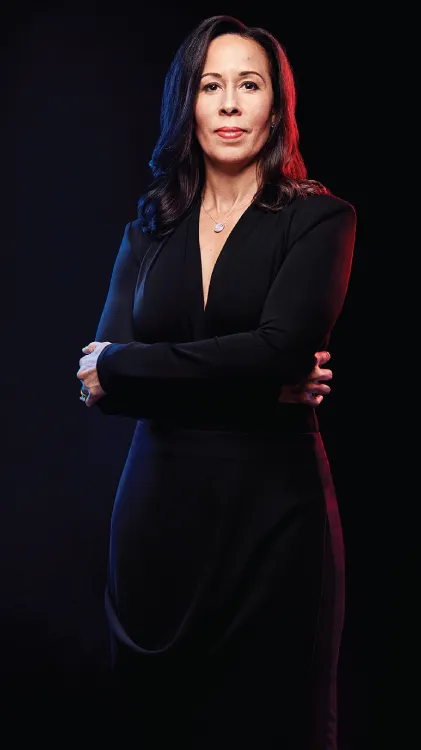
So when Peggy Alford was named to Facebook's board in 2019, it was big news—and for good reason. Not only was she the first Black woman to gain a seat at the table with those who help govern the powerful if ceaselessly embattled Internet services company, Alford is also on the leadership team at PayPal. That heady sphere of influence makes her a bona fide unicorn in Silicon Valley, where everyone seeks such storied status but few other than white men with Ivy League degrees actually attain it.
Blending in was never an option for Alford, who was adopted by white parents as an infant, along with several siblings of various races. So not being white, male, or an engineer trained at Stanford or MIT never fazed her. And while she's eager to leverage her skills and influence to make a difference for the companies and clients she manages, personally making news was never on her laser‐sharp list of goals.
Despite Alford's steady rise in tech over more than a decade, she moved from one groundbreaking success to another largely outside of the spotlight. Using her accountant's training as a springboard, she ran Rent.com (an eBay Inc. company) and was COO of PayPal Asia Pacific before becoming CFO and Head of Operations at Chan Zuckerberg Initiative, Facebook CEO Mark Zuckerberg's philanthropic fund.
By her own admission, this mother of three (two of whom are under age 10) still struggles in social networking situations. In fact, she once described herself as “unapologetically reserved.” But there's nothing reserved about her ambition or her determination to leave a meaningful mark on the world.
When the news came out about my joining the Facebook board, I honestly wasn't prepared for the headline and all the focus on my being the first Black woman. Of course, I should have been, but it caught me off‐guard, which goes back to my beginnings and who my parents are.
My mother was a professor with a PhD in math and computer science and my father was an electrical engineer. They are white, and they adopted six children and fostered even more, of all races. I found out later in life that my [biological] father was Puerto Rican and my [biological] mother was Black and Italian, but when I was growing up, I didn't know what I was.
I was born the first year that interracial adoption was allowed in Pennsylvania, where I was adopted and, in those early days, you could be [mixed with] anything and white people could adopt you, but if you had Black in you, that wasn't allowed. So, the agency lied to my parents and told them that I was Portuguese and white. But it was very clear that I was at least partially Black and, growing up in the Midwest, people made all kinds of comments about what I was.
In second grade, in one of those dreaded assignments about tracing your family's roots, I remember saying that I wasn't sure what I was, but because all of my classmates indicated they were from somewhere in Europe and I knew my adoptive parents were German, I chose Europe too. The teacher said, “That's not true. You're not from Europe.” She pulled out a map and pointed to Africa. “This is where you're from.”
I went home and asked my parents, “Why is she saying this? How could she even know?” and my parents just said some people don't act nice, don't worry about it.
I still vividly remember being good friends with this girl whose house was near ours. When I rode my bike over there with all the other kids to play, her brothers and her dad told me in front of the others that I wasn't allowed in their house. I played in the backyard by myself until they came back out—and I never told my parents because I knew that they would never let me go there again. It's crazy when I look back on it.
Even though those types of incidents happened over and over, I was never taught that it was about race. I remember feeling sad but not really understanding what was going on. I was very clear that it was about difference. At least at that time, in Middle America, you were either Black or white and there was a very singular view of what that meant. Our family would walk into church and everyone would turn and be like, What the heck is this?
There were two sets of us—the older set of three and, after seven years, three more that are very close in age. Two of the younger set are half Black and half white. I was about 13 when they were starting grade school and I remember talking to my parents about moving to a more diverse area so my siblings wouldn't be “the onlies” at school. I explained to my parents why it was important to be around kids that are like you. I was constantly made fun of because my hair was a mess so I tried to help my sister with her hair and convinced my mother about the importance of that.
I was very careful with my messaging and, to my parents' credit, we moved a lot closer to the city. Even now, with my teams, I'm very careful to say things not to criticize but because I want something to change. My parents had to deal with a lot, having us around, and they did their absolute best. I honestly feel so blessed.
Think about the times we're in and the struggles that a lot of us have assimilating, trying to be who we are and to be seen for our whole selves. While I've had some of those same struggles, I also had a better chance of making it all work because, from my earliest days, I was exposed to different races and lots of white people and I lived in a home and a community where I never felt a sense of total belonging. All my life, people have expressed lots of strong, often critical, opinions about interracial adoption, but the reality is that it prepares you for being able to get along with just about anyone, and to do it even when you're uncomfortable.
My parents always made us feel like we were as beneficial to their experiences as they were to ours. That helped me form this belief that I could do whatever I wanted to do and barriers were just something you needed to overcome. They taught us that there are excellent teachers everywhere and the purpose of college is to get a good job—none of this basket weaving.
So, I took a very pragmatic approach to education and thinking about my career. I ran cross country track in high school and was pretty competitive, so I had an opportunity to go to University of Dayton and get some of it paid for. That was really what drove where I went. My first visit to campus was when I was being dropped off. I remember thinking, Oh my God, what did I just do? I'm literally in the middle of nowhere.
I fell in love with the idea of becoming a criminal defense attorney in seventh grade when I participated in a program where we were able to attend a trial. But in my sophomore year in college, I realized I would not have the financial means to go to law school, so I switched my major to accounting because I had found out that pretty much everyone with an accounting degree could get a job.
College and the few years after were where I finally started to become much more comfortable with who I was, but it was tough. I wish I had become more familiar with Black America earlier. I had gone to a diverse high school but—I mean, my last name was Abkemeier! So the Black Student Union didn't know what to make of me, and at 18 (as if being 18 isn't hard enough), that was hard to navigate.
Freshman year I became close to a girl from Connecticut whose father worked for IBM and theirs was the only Black family in their town. She was also Pentecostal and had never been to a movie, so the other Black students were like, Who is this girl? We became roommates and she had a big impact on my life in terms of shifting the narrative to one where we are who we are and no one can tell us who we need to be.
I started to realize I was on a path to actually being able to build some success for myself. I had a good set of friends and, even though it took many years to get there, I knew what I wanted in a relationship. So, I started to worry a little less about what everybody else thought and was able to focus on building the kind of life I wanted.
There were six large accounting firms. Arthur Andersen was number one at the time, and I had the opportunity through a relationship of my uncle's to interview for a job there. Public accounting is a very up‐or‐out culture. If you're doing well, you get promoted every year and make a little more money, so it's hard to say maybe I should go do something else. I ended up being there for nine years.
I had no understanding of how big my career could be, but I was always focused on continuing to build my skill set so that I could do big things. I started in Arthur Anderson's St. Louis office and felt like it was very limiting for women and people of color back then. I was working my butt off and the conversation was always, “We want to grow your career because we need the organization to be more diverse,” rather than talking about what I was bringing to the table. It got super frustrating.
I was always trying to overcome what I felt were stereotypes being placed on my potential, so I was an auditor, and then did M&A consulting which enabled me to do transactional work and help companies go public. Then I went to work for eBay, which grew out of my consulting and, after about four years, I got the opportunity to be the CFO of Rent.com, a company that eBay had acquired. I went on to run that company as the president and GM for three years. When I returned to finance at PayPal, I also took on some operating roles including co‐running HR for a while. I wanted to understand all the levers it takes to run a company because my aspiration was more on the CEO track than in a particular functional area.
Sales was something that I felt was really important and also a little bit counter to my personality. I still struggle with having to go up to people in work environments and start conversations socially. I've had to practice that and it totally drains me. But to learn how to do that well not only helps in every facet of your life, it truly makes you a better executive.
My reserved personality is grounded in not feeling completely comfortable with myself when I was younger. As you get older, you learn to appreciate who you are and not worry so much about what others think. I also have noticed, through observing other leaders I respect, that there is not one successful personality type. Mark Zuckerberg, as an example, is not somebody who's the center of attention in every room and I think he appreciates the quiet confidence of somebody who is really good at what they do but is not necessarily trying to always be talking.
People appreciate authenticity, so it is really important that you always try to become a better you, not someone else or someone you're not. It's about gaining confidence in what you're good at, letting that show, and building relationships around that. That enables people to tap you for opportunities that you might not even have thought were within the realm of possibility.
That was the case when I first heard from Mark about the CFO role at Chan Zuckerberg Initiative literally two weeks after I had my youngest son. I had no plans to leave PayPal and that's not a time when you want to add a lot of change to your life, anyway. You're happy with things being steady so that you can just survive that particular moment. But then I started to learn what he and his wife, Priscilla, were doing, and I've always wanted to be able to drive change at scale, doing good in the world in a way that is good business.
I assess opportunities based on what is going to add to my learning and development, and am I going to enjoy it. The am I ready question almost always pops up ...