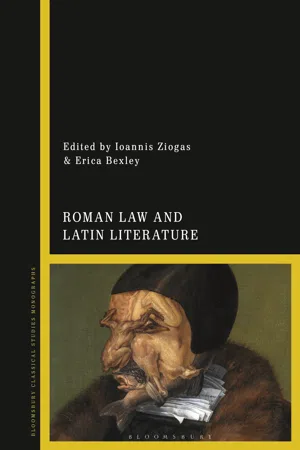
This volume offers a long overdue appraisal of the dynamic interactions between Roman law and Latin literature. Despite there being periods of massive tectonic shifts in the legal and literary landscapes, the Republic and Empire of Rome have not until now been the focus of interdisciplinary study in this field. This volume brings vital new material to the attention of the law and literature movement.
An interdisciplinary approach is at the heart of this volume: specialists in Roman law rarely engage in constructive dialogue with specialists in Latin literature and vice versa but this volume bridges that divide. It shows how literary scholars are eager to examine the importance of law in literature or the juridical nature of Latin literature, while Romanists are ready to embrace the interactions between literary and legal discourse. This collection capitalizes on the opportunity to open a fruitful dialogue between scholars of Latin literature and Roman law and thus makes a major, much-needed contribution to the growing field of law and literature.
- 320 pages
- English
- ePUB (mobile friendly)
- Available on iOS & Android
eBook - ePub
About this book
Information
1
Introduction: Roman Law and Latin Literature
Ioannis Ziogas and Erica Bexley
What has law got to do with literature or literature with law? Law, it would seem, claims dispositive powers and aspires to intervene in the world around it by regulating behaviour, framing constitutions, establishing rules and punishing transgression, while literature constructs fictional worlds through which it explores – without any definitive goal – the permutations of what may broadly be called the ‘human condition’. This distinction is more apparent than real, however. Closer inspection reveals that law and literature have a lot in common: both are grounded in language (oral or written), which invites interpretation and dispute; both engage in acts of persuasion; both vacillate between being reflections and projections of the world around them. Literature, like law, aspires to intervene in people’s actual lived experience from the micro level of affecting its audiences to the macro level of dictating normative behaviour and instigating cultural change. Shelley’s claim that ‘poets are the unacknowledged legislators of the world’ (1994: 660) celebrates precisely this ability of literature to interrogate and propose ways – or in Shelley’s words, laws (1994: 637) – of social conduct.
From the other side, law, like literature, is deeply invested in the creation of alternative worlds. Far from being concerned with unimaginative practicalities, law pursues the dream of a utopian society, whether as a future projection of cultural ideals or a wish to return to a prelapsarian state of absolute justice. Law and literature are deeply and inevitably entangled with the origins of morality, even though, if not especially when, they are trying to break free from sociomoral conventions and feature as self-regulated discourses. Nor is law more hermeneutically stable than literature, despite its ostensible striving to suppress ambiguities and separate right from wrong. Against literature’s shades of grey, law might be expected to stand out in black and white, but the reality is much murkier. Laws are redefined continually, their every enactment an act of interpretation. Like any other text, they accrue meaning over time, and context affects their content. One need look no further than the debate between originalist and textualist interpreters of the US constitution for a clear view of the hermeneutic struggles embedded in the legal profession.
Law and literature have a special interrelationship. This is not simply a case of comparing apples with oranges on the basis that both are round. Derrida’s Before the Law (2018: 46) argues that law and literature share a particular ‘narrative’ quality, not just in the sense of their arising from and telling stories, but also in their aspiring to universalizing force, largely cut off from historical referents. Derrida contends that law and literature have a common origin in the form of mythological narrative (he cites Freud’s analysis of Oedipus), which is ‘without an author or end, but … inevitable and unforgettable’ (2018: 46). Both are stories predicated on an originary judgment, both contain the seeds of moral regulation, both appeal to a reality beyond mere fact.
At a simpler level, we may just say that law exhibits literary qualities and literature legal ones. The former of these two assertions is the mainstay of the Law and Humanities movement, which arose from study of the literary – chiefly, rhetorical and narrative – features of legal texts, and the reading of literature to augment law’s ethical component.1 ‘Law as literature’ and ‘law in literature’ were the discipline’s foundational concepts, the former represented by scholars as diverse as James Boyd White (1973), Stanley Fish (1989) and Peter Goodrich (1990), while the latter has been championed by Richard Weisberg (1984) and Ian Ward (1999), among many others. The two approaches have a lot in common and frequently overlap, as for instance in Aristodemou (2000). Both categories of analysis are represented in our volume, too. On the side of ‘Law in literature’, McGinn in Chapter 9 below (‘The Sea Common to All’) discusses the possible presence in Plautus’ Rudens of the legal concept res communes omnium; Bexley in Chapter 3 (‘Saturnalian Lex’) investigates Claudius’ role as judge in the Apocolocyntosis, and Alekou in Chapter 12 (‘Law in Disguise’) traces Ovid’s ambivalent use of legal language in Metamorphoses 6.1–145. For ‘Law as literature’, Dugan in Chapter 6 (‘Beachcombing at the Centumviral Court’) examines the rhetorical and metaphorical qualities of Crassus’ legal reasoning, and Wibier in Chapter 7 (‘Marcus Antistius Labeo and the Idea of Legal Literature’) investigates how one of Rome’s most famous jurists combined legal with literary learning. In keeping with the core principles of the Law and Humanities movement, all of these papers show legal and literary concepts shading into each other, so that law resembles literature and vice versa. The two disciplines, the two endeavours, combine in fruitful marriage.
Until recently, however, law has been the dominant partner in this marriage, with literature playing an ancillary role as a repository of rhetorical techniques and/or a supplement to legal knowledge. Work by Fortier (2019) attempts to shift the balance more towards literature, and the edited collection by Dolin (2018) places the two fields on a more even par. As Fortier (2019: 13–15) acknowledges, the ‘and’ in ‘law and literature’ conveys a lot: does it designate a harmonious relationship, or a conflict? Does it establish balance, identification, or a hierarchy? A major aim of our present volume is to continue this growing emphasis on the literary side of the law and literature debate by showing how literature anticipates, imitates, supplants or complements law’s role in constituting rules and norms. To paraphrase Northrop Frye (1970: 70–7), literature is the basis of the social imagination that produces law and guarantees its respect. A more recent claim by Reichmann (2009: 5) also encapsulates our volume’s central concerns: ‘the texts of law and literature jointly contribute to … a normative universe’. To the aforementioned categories of ‘law as literature’, ‘law in literature’, and ‘law and literature’, we add: ‘literature as law’.
At this point it is worth pausing to consider how law and literature are defined, where their boundaries lie – not easy questions for a Roman context. An obvious answer is that law comprises codified statutes and offers a basis for adjudication, but the line between legal concepts and social norms is not always clear cut. The technical language of Roman law disperses into discourse. To what extent is law synonymous with sovereign power, or behavioural precepts, or certain forms of reasoning (e.g. from precedent)? As Lowrie’s contribution (‘The Force of Literature’) demonstrates, Rome’s unwritten ‘constitution’ often acquired legal force despite its lack of codification. A similar if not greater range of definition confronts the category of ‘literature’, especially in an ancient Roman context where ‘fiction’ was sometimes an inadequate classificatory principle (Lowrie 2009a: 67; 2016: 75; in this volume). Latin epic was inextricably related to history and contemporary politics. Elegy, lyric, and epigram frequently addressed contemporaries and conveyed lived experience (Lowrie 2016: 75). The Romans defined literary production broadly, as litterae (‘letters’), and included in this category a wide range of written work from courtroom speeches to historiography and technical treatises; the very discipline of ‘Latin literature’ reflects this diversity. So, rather than close off any avenues of potentially fruitful analysis, this volume does not police the boundaries of law and literature too strictly; doing so would risk silencing too much of the dialogue between law and literature that we wish to promote. Although a lot of the literature covered in this volume is, by modern definition, ‘fictional’ (comoedia palliata, epic, satire) and although we sometimes refer to it as such, we stress that it does not inhabit an enclosed sphere, cut off from the everyday social realities with which the law is deeply engaged. Literature has as much bearing on the actual world as law does on imaginary ones.
Hence, arguments for a special interrelationship between law and literature are all the more pertinent in the context of ancient Rome, where the two pursuits often overlapped, their production arising from roughly the same group of upper-class individuals, schooled in rhetoric and ‘letters’ (litterae). Notably, the Romans were fully aware of literature’s importance in fleshing out concepts of legality. As Clifford Ando (2015a) demonstrates, interaction between fiction and social reality was crucial to the functioning of Roman law. Legal fiction extended Roman law beyond the original scope of any individual source of law. Since imaginary stories, plots, archetypes and stock characters make what is particular universal, fictional narratives became the foundation of Roman legal discourse rather than its reflection.
The genre of Roman declamation, for instance, highlights the importance of fictional laws and trials not only for training young Romans for a career in the courtroom, but also for educating them about the controversial origins of taboos and morality. The plots and stock characters of declamations strongly evoke those of Roman comedy and tragedy (see Gunderson 2016; cf. Langlands 2006: 250–1). The laws quoted in the declamations are imaginary, yet many of them clearly evoke early laws, praetorian edicts or Greek laws (see Lowrie 2016: 76; Bonner 1949: 83–132). Declamatory plots and laws are fictional, yet they feel real; they are outlandish, yet familiar; they are at once culturally specific and universal. In the end, it is the idea of law that matters and not its specific directives. And that is why we need to take law and literature in Roman declamations seriously (cf. Gunderson 2003).
A division between law as factual and literature as fictional clearly cannot be sustained. Although critics of the law and literature movement, such as Richard Posner (2009), aver that legal scenarios presented in literature have little bearing on actual legal practice, or on legal history, fictional narratives are in fact major sources of legal consciousness. Kafka’s The Trial may not increase our understanding of Austro-Hungarian criminal procedure, as Posner (2009: 143) maintains, but it substantially increases our concept or impressi...
Table of contents
- Cover
- Half-Title Page
- Series Page
- Title Page
- Contents
- List of Contributors
- Acknowledgements
- 1 Introduction: Roman Law and Latin Literature
- Part I Literature as Law
- 2 The Force of Literature
- 3 Saturnalian Lex: Seneca’s Apocolocyntosis
- 4 Iustitium in Lucan’s Bellum Ciuile
- Part II Literature and the Legal Tradition
- 5 Terence’s Phormio and the Legal Discourse and Legal Profession at Rome
- 6 Beachcombing at the Centumviral Court: Littoral Meaning in the Causa Curiana
- 7 Marcus Antistius Labeo and the Idea of Legal Literature
- Part III Literature and Property Law
- 8 Poetry, Prosecution and the Author Function
- 9 The Sea Common to All in Plautus, Rudens: Social Norms and Legal Rules
- 10 Intellectual ‘Property’: Ownership, Possession and Judgment among Civic Artes
- 11 Seneca’s Debt: Property, Self-Possession and the Economy of Philosophical Exchange in the Epistulae Morales
- Part IV Literature and Justice
- 12 Law in Disguise in the Metamorphoses: The Ambiguous Ecphraseis of Minerva and Arachne
- 13 What the Roman Constitution Means to Me: Staging Encounters between US and Roman Law on Equality and Proportionality
- Bibliography
- Index
- Copyright
Trusted by 375,005 students
Access to over 1.5 million titles for a fair monthly price.
Study more efficiently using our study tools.
Frequently asked questions
Yes, you can cancel anytime from the Subscription tab in your account settings on the Perlego website. Your subscription will stay active until the end of your current billing period. Learn how to cancel your subscription
No, books cannot be downloaded as external files, such as PDFs, for use outside of Perlego. However, you can download books within the Perlego app for offline reading on mobile or tablet. Learn how to download books offline
Perlego offers two plans: Essential and Complete
- Essential is ideal for learners and professionals who enjoy exploring a wide range of subjects. Access the Essential Library with 800,000+ trusted titles and best-sellers across business, personal growth, and the humanities. Includes unlimited reading time and Standard Read Aloud voice.
- Complete: Perfect for advanced learners and researchers needing full, unrestricted access. Unlock 1.5M+ books across hundreds of subjects, including academic and specialized titles. The Complete Plan also includes advanced features like Premium Read Aloud and Research Assistant.
We are an online textbook subscription service, where you can get access to an entire online library for less than the price of a single book per month. With over 1.5 million books across 990+ topics, we’ve got you covered! Learn about our mission
Look out for the read-aloud symbol on your next book to see if you can listen to it. The read-aloud tool reads text aloud for you, highlighting the text as it is being read. You can pause it, speed it up and slow it down. Learn more about Read Aloud
Yes! You can use the Perlego app on both iOS and Android devices to read anytime, anywhere — even offline. Perfect for commutes or when you’re on the go.
Please note we cannot support devices running on iOS 13 and Android 7 or earlier. Learn more about using the app
Please note we cannot support devices running on iOS 13 and Android 7 or earlier. Learn more about using the app
Yes, you can access Roman Law and Latin Literature by in PDF and/or ePUB format, as well as other popular books in History & Roman Ancient History. We have over 1.5 million books available in our catalogue for you to explore.