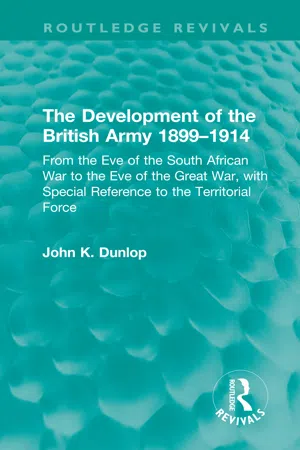
Originally published in 1938, this book was the first to be written which dealt with the history of Army Development during the confused years which followed the South African War. The period 1899–1914 marked the change from Victorian scarlet and pipeclay to the service dress of the Expeditionary Force of 1914. Similarly, it saw the growth of the Volunteer Rifle Corps of the nineteenth century into the Territorial Force of the Haldane Scheme. The writer, sometime history scholar of St John's College Cambridge, himself a Territorial of twenty-three years' service, was at the time one of the T.A. officers recently appointed to newly created posts at the War Office.
eBook - ePub
The Development of the British Army 1899–1914
From the Eve of the South African War to the Eve of the Great War, with Special Reference to the Territorial Force
- 346 pages
- English
- ePUB (mobile friendly)
- Available on iOS & Android
eBook - ePub
The Development of the British Army 1899–1914
From the Eve of the South African War to the Eve of the Great War, with Special Reference to the Territorial Force
PART I THE STATE OF THE BRITISH ARMY ON THE EVE OF THE SOUTH AFRICAN WAR
CHAPTER 1 INTRODUCTION
IN the summer of 1899 the British Army consisted, according to the terms of the Army Estimates, of the Regular Army and the Auxiliary Forces. Included in the Regular Army was the Army Reserve; included in the Auxiliary Forces were the Militia, the Yeomanry, and the Volunteers.
Within the compass of forty years each of these component parts had experienced very important changes. The Volunteers in their present form had sprung into existence in the year 1859. The Militia, after the post-Waterloo quiescence, had revived but not in the old character. As for the Regular Army, the military reforms associated with the names of Mr. Cardwell and Mr. Childers, the reforms of the years 1870 to 1882, were regarded by Sir John Fortescue, in his classic ‘History of the Army’ as so complete in their purview, so revolutionary in their scope, that they marked the end of a military age. The Old Army, that had endured from Stuart times had passed away and a New Army was to take its place. Three sentences from his final volume will show how vital, in the opinion of this judge, were the alterations effected by this series of legislation. ‘Two relics of the old system alone remained, long service for soldiers, and purchase for officers. The former was swept away in 1870, the latter in 1871; and therewith the knell of the Old British Army was rung. … Some other hand must record the vicissitudes of the New Army which grew up after. …’1
This conception of a complete change was also present in the minds of the authors of a work ‘The Army Book of the British Empire’ which was published in 1893. In a chapter entitled ‘The Modern System in Britain’ they made clear the prevalent feeling that the introduction of short service, the dependence upon an army largely composed of reservists, was a complete revolution which rendered comparison with the past difficult, if not impossible.1
The great series of new legislation had commenced with ‘The Army Enlistment Act’ of 1870. This measure had authorized enlistment for short service, such service to be partly with the Colours and partly with the Reserve.2 This was followed, in the following year, by the Royal Warrant of July 20, 1871, which abolished purchase of commissions, and the New Warrant of October 30th of the same year, which laid down the new conditions for first commissions and for subsequent promotion.3
In 1872, as a result of the Report of General MacDougall’s Committee on Military Organization, a scheme for the Territorial localization of die Army was laid before the House of Commons. Therein the Duke of Cambridge, as Commander-in-Chief of the Army, sketched out the new plan for the organization of the land forces.
The plan had provided, in brief, for the linking in pairs of all single battalion regiments of Infantry, and for the ‘localization’ of regular infantry by associating each regiment with a definite part of the country and with the militia battalions, already, so to speak, attached to the soil.4 The Brigade depot was established as the territorial nerve centre of the regiment.
In 1881, Mr. Childers carried the scheme to its logical conclusion by amalgamating die linked battalions.1
The last of the major reforms initiated by Mr. Cardwell had been to bring together, under the one roof of the War Office, the department of the Secretary of State for War, and the department of the Commander-in-Chief. At the same time, all the reserve forces as they were then called, the Militia, the Yeomanry, and the Volunteers, were brought under the control of the War Office.2
In 1899 these important changes were within the memory of many officers still serving. There were many in the senior ranks who had entered the Army in the days of purchase and a long service soldiery. It was perhaps inevitable that there had been controversy over the introduction of such far-reaching reforms. Even in 1899 echoes of the arguments were heard. ‘Lord Cardwell’s Reforms vital as they were to the well-being of the Army disturbed prejudices and interests in many quarters, and left behind them a long trail of grievances of which the War Office has been made the legatee.’3
The very controversies however had forced the Army to take itself seriously. Discussions at the Royal United Service Institution, and in the Service journals showed that a great weight of serious military opinion was in favour of the short service system with the Army Reserve. In any event the change was bound to come. The lesson of the Crimean War was perfectly clear. To engage upon a wasteful campaign with no system of reserves for the supply of regimental drafts was clear folly.
Lord Wolseley was a powerful advocate of the short service system, and he placed the evidence in its favour quite fairly when he said: ‘This at least is certain, that an Army Reserve of 80,000 men places us in a military position that for either offence or defence we have never before attained to in this country. … When that Army Reserve rejoins the colours, the home Army would then be immeasurably superior to any Army we have had in England for 100 years.’1
Some parts of the new system had already been tested on the battle-field. The short service soldiers had been engaged in a series of small wars. At a later period the Esher Committee spoke of the years between 1870 and 1899 as a ‘period of immunity from real stress, when the provision of relatively small expeditionary forces to operate against unorganized and ill-armed peoples has been the principal occupation of the War Office apart from its multifarious duties of purely peaceroutine’.2 Indeed during the last half of the nineteenth century the British Army had been almost continuously at War.3 InSouth Africa had come in rapid succession the Kaffir War of 1877, the Zulu Warof 1878–9, the Basuto War of 1879–80 and the BoerWar of 1880–1.
In North Africa, the period had commenced with Sir Garnet Wolseley’s decisive Egyptian campaign of 1882. To that had succeeded a period of almost continuous warfare against Mahdism. There had been disasters as well as victories, but the end had recently come with the crushing defeat of the Khalifa’s Army at Omdurman.4 In West Africa had been the expedition to Ashanti of 1873–4.
Further East had been the hard-fought Second Afghan War of 1878–80 made memorable by General Roberts’ occupation of Kabul and march to Kandahar. Also on the frontiers of India had been the campaigns of the Tirah and Chitral in 1897–8 and the Burmese War of 1885–7.
The only occasion on which reservists had been used overseas had been the Egyptian campaign of 1882, but the working of the new system had also been tested in 1885 at the time of the Pendjeh incident. The Army Reserve of one cavalry regiment and fifteen regiments of infantry had been called out. A total of 4,681 reservists rejoined the colours and served from April till August.1
Thus the British Army had, in the course of some thirty years, gained great experience of warfare of various kinds, and most of the high commands were filled with men who had seen active service, and had given proof of fighting ability and personal courage of a high order.
Internationally there was reason enough for considering the strength of the Army. Though it had been the success of Prussian militarism in the wars of 1864, 1866 1870 that had shocked Great Britain into Army Reform, so long as Bismarck retained power Germany was careful and friendly in her policy to this country. It was the France of Napoleon III which in 1859 had caused the formation in England of hundreds of Volunteer Rifle Corps, and the France of the Third Republic was very jealous of English activities in Egypt. Russia, also, was beginning to threaten. When Disraeli called out the Reserve as a challenge to the Treaty of San Stefano, and brought troops from India to the Mediterranean, he was indulging in a policy which led directly to the Second Afghan War.
However these distant scares of wars with great powers had paled before the very real tension of the Fashoda question. In the summer of 1899, that crisis was recent history. The French press was still strongly Anglophobe, while, in ...
Table of contents
- Cover
- Half Title
- Title
- Copyright
- Original Title
- Original Copyright
- Foreword
- Author’s Foreword
- Contents
- Part I The State of the British Army on the Eve of the South African War
- Part II The Mobilization and Expansion of the British Army During the South African War, 1899–1902
- Part III 1900–1905. A Period of Attempted Reforms
- Part IV The Haldane Reforms
- Conclusion
- Appendices
- Bibliography
- Index
Trusted by 375,005 students
Access to over 1.5 million titles for a fair monthly price.
Study more efficiently using our study tools.
Frequently asked questions
Yes, you can cancel anytime from the Subscription tab in your account settings on the Perlego website. Your subscription will stay active until the end of your current billing period. Learn how to cancel your subscription
No, books cannot be downloaded as external files, such as PDFs, for use outside of Perlego. However, you can download books within the Perlego app for offline reading on mobile or tablet. Learn how to download books offline
Perlego offers two plans: Essential and Complete
- Essential is ideal for learners and professionals who enjoy exploring a wide range of subjects. Access the Essential Library with 800,000+ trusted titles and best-sellers across business, personal growth, and the humanities. Includes unlimited reading time and Standard Read Aloud voice.
- Complete: Perfect for advanced learners and researchers needing full, unrestricted access. Unlock 1.5M+ books across hundreds of subjects, including academic and specialized titles. The Complete Plan also includes advanced features like Premium Read Aloud and Research Assistant.
We are an online textbook subscription service, where you can get access to an entire online library for less than the price of a single book per month. With over 1.5 million books across 990+ topics, we’ve got you covered! Learn about our mission
Look out for the read-aloud symbol on your next book to see if you can listen to it. The read-aloud tool reads text aloud for you, highlighting the text as it is being read. You can pause it, speed it up and slow it down. Learn more about Read Aloud
Yes! You can use the Perlego app on both iOS and Android devices to read anytime, anywhere — even offline. Perfect for commutes or when you’re on the go.
Please note we cannot support devices running on iOS 13 and Android 7 or earlier. Learn more about using the app
Please note we cannot support devices running on iOS 13 and Android 7 or earlier. Learn more about using the app
Yes, you can access The Development of the British Army 1899–1914 by John K. Dunlop in PDF and/or ePUB format, as well as other popular books in History & World History. We have over 1.5 million books available in our catalogue for you to explore.