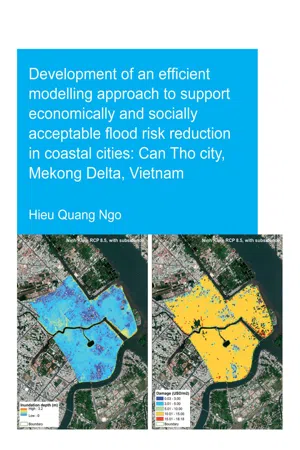
Flooding is one of the most frequently occurring and damaging natural disasters worldwide. Quantitative flood risk management (FRM) in the modern context demands statistically robust approaches (e.g. probabilistic) due to the need to deal with complex uncertainties. However, probabilistic estimates often involve ensemble 2D model runs resulting in large computational costs.Additionally, modern FRM necessitates the involvement of a broad range of stakeholders via co-design sessions. This makes it necessary for the flood models, at least at a simplified level, to be understood by and accessible to non-specialists. This study was undertaken to develop a flood modelling system that can provide rapid and sufficiently accurate estimates of flood risk within a methodology that is accessible to a wider range of stakeholders for a coastal city – Can Tho city, Mekong Delta, Vietnam. A web-based hydraulic tool, Inform, was developed based on a simplified 1D model for the entire Mekong Delta, flood hazard and damage maps, and estimated flood damages for the urban centre of Can Tho city (Ninh Kieu district), containing the must-have features of a co-design tool (e.g. inbuilt input library, flexible options, easy to use, quick results, user-friendly interface). Inform provides rapid flood risk assessments with quantitative information (e.g. flood levels, flood hazard and damage maps, estimated damages) required for co-designing efforts aimed at flood risk reduction for Ninh Kieu district in the future.
eBook - ePub
Development of an Efficient Modelling Approach to Support Economically and Socially Acceptable Flood Risk Reduction in Coastal Cities: Can Tho City, Mekong Delta, Vietnam
- 164 pages
- English
- ePUB (mobile friendly)
- Available on iOS & Android
eBook - ePub
Development of an Efficient Modelling Approach to Support Economically and Socially Acceptable Flood Risk Reduction in Coastal Cities: Can Tho City, Mekong Delta, Vietnam
About this book
Information
Chapter 1 Introduction
1.1 Background and motivation
Coastal cities are among the most urbanized and populated areas of the world (Small and Nicholls, 2003; Valiela et al., 2006; Ranasinghe and Jongejan, 2018). The continued human attraction to the coast, especially in the last five decades, has resulted in the rapid expansion of settlements, urbanisation, infrastructure, economic activities, and tourism. According to statistics of low elevation coastal zones (LECZs), of the world’s 20 megacities, 15 are in LECZs. RMS (Risk Management Solutions) and Lloyd’s (2008) predicted that around the year 2030 more than 50% of the global population is expected to live within 100 km of the coast, especially the population living in the LECZs projected to exceed one billion (by 2050) in all SSPs (Merkens et al., 2016) and likely to reach 1.4 billion by 2060 under the high-end growth assumption (Neumann et al., 2015).
Coastal cities are facing natural disasters including flooding, which is one of the most frequently occurring and damaging natural disasters in the world (Hirabayashi et al., 2013; Kundzewicz et al., 2014; Arnell and Gosling, 2016; Alfieri et al., 2017; Forzieri et al., 2017; Mora et al., 2018). About 250 million people in the world are affected by floods every year (UNISDR, 2013), and the annual average economic losses have exceeded 40 billion USD in recent years (OECD, 2016). Coastal and delta areas are among the most flood hazard-prone areas of the world (Nicholls, 2004; Nicholls et al, 2007; Wong et al., 2014; Neumann et al., 2015; Pasquier et al., 2019), and flood intensity and frequency are already increasing, especially in coastal and delta cities, due to changes in upstream river flows, downstream sea-level and local changes in rainfall and land use (Merz et al., 2010; Balica et al., 2012; Huong and Pathirana, 2013; Chen et al., 2018; Ngo et al., 2018).
Climate change is now recognized as a major global challenge in the 21st century and beyond. Future projections indicate that climate change will have implications on the trends of extreme events (e.g. extreme precipitation, hurricanes, etc.), which may lead to increases of flooding in the future (Panagoulia and Dimou, 1997; Menzel et al., 2002; Prudhomme et al., 2013; Alfieri et al., 2015). The massive global socio-economic impacts of climate change effects in coastal areas are discussed in detail by, among others, Stern (2007), Arkema et al. (2013), Kron et al. (2012), McNamara and Keeler (2013), Johnson et al. (2015), Brown et al. (2017). For example, the economic losses due to flooding alone in coastal cities are expected to be around USD 1 Trillion by 2050 (Hallegatte et al., 2013). Besides climate change, the population increases inevitably increase water demand, which is often satisfied by excessive groundwater extraction, which, more often than not, leads to land subsidence, further exacerbating the flood hazard (due to increased inundation levels). The combination of increased flood hazard and increased population/infrastructure will, in turn, lead to an increase in flood risk in these vulnerable areas (Nicholls et al., 2007; Lenderink and Van Meijgaard, 2008; Syvitski et al., 2009; Min et al., 2011; Balica et al., 2012; Rojas et al., 2013; Wong et al., 2014; Takagi et al., 2015).
Assessing flood risk is an essential part of FRM (including managing both hazard and the potential consequences) which is becoming a critical process for adapting to future changes (for example climate change, economic change and population growth). Flood risk assessment is performed to facilitate the implementation of risk-informed measures aimed at minimizing (or mitigating) flood damage (Hall et al., 2003; Meyer et al., 2009, Bureau Reclamation, 2020; Mishra and Sinha, 2020). However, FRM and planning decisions in many parts of the world have historically utilised flood hazard or damage maps associated with one or two pre-determined return period of water levels (e.g. 100year, 200-year). While this may have been sufficient in the past, the need to move from stationary to innovative time-dependent flood hazard and risk modelling approaches that can account for the uncertainty, arising from anthropogenic and climatic induced stressors, are rapidly increasing (Mosavi et al., 2018). Therefore, contemporary FRM is required to embrace much more statistically robust approaches. In this context, a probabilistic approach is a fundamental requirement for quantitative flood risk assessments, which aid urban planners and decision-makers to develop informed risk reduction strategies that minimize the damage caused by floods. This is especially important for coastal cities which are not only facing the impact of upstream flow changes due to human interventions (land-use change, dam construction) but also the effect of climate change on sea level (tide, sea-level rise, storm surges) as well as the effect of land subsidence in deltas.
Probabilistic flood risk assessment typically requires multiple (thousands of) river and flood model simulations to derive probabil...
Table of contents
- Cover
- Half Title
- Title Page
- Copyright Page
- Acknowledgements
- Summary
- Samenvatting
- Contents
- 1 Introduction
- 2 Development of an effective modelling approach to support probabilistic flood forecasting in Can Tho city, Mekong Delta, Vietnam
- 3 Developing probabilistic flood hazard maps for the urban centre of Can Tho city for present-day and future
- 4 Assessment of present and future fluvial flood damages and risk for Ninh Kieu district
- 5 Developing and testing an interactive, web-based flood risk management tool for co-design with stakeholders
- 6 General Conclusions
- Appendix
- References
- List of acronyms
- List of Tables
- List of Figures
- About the author
Trusted by 375,005 students
Access to over 1.5 million titles for a fair monthly price.
Study more efficiently using our study tools.
Frequently asked questions
Yes, you can cancel anytime from the Subscription tab in your account settings on the Perlego website. Your subscription will stay active until the end of your current billing period. Learn how to cancel your subscription
No, books cannot be downloaded as external files, such as PDFs, for use outside of Perlego. However, you can download books within the Perlego app for offline reading on mobile or tablet. Learn how to download books offline
Perlego offers two plans: Essential and Complete
- Essential is ideal for learners and professionals who enjoy exploring a wide range of subjects. Access the Essential Library with 800,000+ trusted titles and best-sellers across business, personal growth, and the humanities. Includes unlimited reading time and Standard Read Aloud voice.
- Complete: Perfect for advanced learners and researchers needing full, unrestricted access. Unlock 1.5M+ books across hundreds of subjects, including academic and specialized titles. The Complete Plan also includes advanced features like Premium Read Aloud and Research Assistant.
We are an online textbook subscription service, where you can get access to an entire online library for less than the price of a single book per month. With over 1.5 million books across 990+ topics, we’ve got you covered! Learn about our mission
Look out for the read-aloud symbol on your next book to see if you can listen to it. The read-aloud tool reads text aloud for you, highlighting the text as it is being read. You can pause it, speed it up and slow it down. Learn more about Read Aloud
Yes! You can use the Perlego app on both iOS and Android devices to read anytime, anywhere — even offline. Perfect for commutes or when you’re on the go.
Please note we cannot support devices running on iOS 13 and Android 7 or earlier. Learn more about using the app
Please note we cannot support devices running on iOS 13 and Android 7 or earlier. Learn more about using the app
Yes, you can access Development of an Efficient Modelling Approach to Support Economically and Socially Acceptable Flood Risk Reduction in Coastal Cities: Can Tho City, Mekong Delta, Vietnam by Hieu Quang Ngo in PDF and/or ePUB format, as well as other popular books in Biological Sciences & Environmental Science. We have over 1.5 million books available in our catalogue for you to explore.