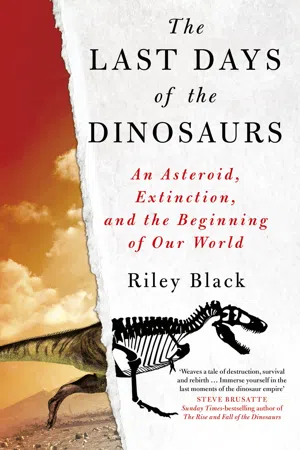
Some 66 million years ago, an asteroid some seven miles across slammed into the Earth, leaving a geologic wound over 50 miles in diameter. In the terrible mass extinction that followed, more than half of known species vanish seemingly overnight. But this worst single day in the history of life of Earth was as critical for us as it was for the dinosaurs, as it allowed for evolutionary opportunities that were closed for the previous 100 million years. In The Last Days of the Dinosaurs, Riley Black walks readers through what happened in the days, the years, the centuries and the million years after the impact. Life's losses were sharp and deeply felt, but the hope carried by the beings that survived sets the stage for the world as we know it now.
eBook - ePub
The Last Days of the Dinosaurs
An Asteroid, Extinction and the Beginning of Our World
- 304 pages
- English
- ePUB (mobile friendly)
- Available on iOS & Android
eBook - ePub
About this book
Information
Topic
Ciencias biológicasSubtopic
Historia natural
1
Before Impact
66.043 million years ago
The Triceratops reeks. Even though only hours have passed since the immense herbivore fell, black clouds of flies buzz around its still nose and glazed eyes—swarms only disturbed by the fluttering and squabbling of the airborne creatures that have settled on the carcass. They are waiting. The food has been laid out, but the opening ceremonies have not yet commenced.
Shortly before his death—a frothing, burning death from the inside, the creep of malignant cancer—the old bull Triceratops weighed ten tons. He wasn’t the largest T. horridus, but he had survived season after season, pushing and shoving other males with his tremendous horns to prove his point when necessary. Every season the competing tri-horns would bellow, cover themselves in shit and mud, and test their strength against each other in great fern-covered clearings that were soon churned into a mess by powerful hoofed feet. But in the past year, the bull started to feel ill. He felt a growing discomfort deep inside. He could no longer compete in the annual territorial fight to mate, and he began to shun the cantankerous company of other Triceratops. He was a lone shadow on the landscape, a small, horned hill of muscle and bone who spent much of his time busting rotten logs at the edge of the Cretaceous forest and wallowing in stinking mudholes that helped provide another layer of protection between his scaly skin and the biting insects that had adapted to winnow and nip in the crevices. It was in one such ceratopsian puddle that he one day dozed off and did not rise again.
The pterosaurs had noticed the carcass first. They had it easy. Held aloft on the warm thermals during the day, each of the fuzzy flying reptiles could circle on their membranous wings and spot carrion ripe for the plucking. All they had to do was dip down to pick off a few dried tatters of tendon and putrid viscera. They look somewhat like storks with bat wings, impossible creatures that had nonetheless been the first vertebrates to evolve powered flight. From their insulating coats of primitive down to the hollowness of their bones, this is precisely what pterosaurs evolved to do. Then again, the graceful airborne skills of these soaring scavengers mean little on the ground; while standing, they fold their wings—supported by an incredibly elongated fourth finger—and waddle here and there as if on stilts, a shambling, squawking gaggle. Each trip to the ground has to count. Shuffling about the Cretaceous floodplain expends more energy than simply twirling aloft, making the urge to snag a snack all the more important. And the careless or overconfident do not always make it back into the air.
Nothing of the horned dinosaur’s saurian bulk will be wasted. There is no sense of mourning here. A body of this size is food for innumerable bellies, a buffet that will energize the large and small alike as each morsel is taken back up into the ecosystem. A Triceratops is no soft piece of meat, though. The pterosaurs and fluttering birds, some with tiny teeth poking from their mouths, have already taken what soft parts they can winnow away from the carcass. Beaks poke at eyes, plunge into nostrils, and tear at the cloaca, the dead dinosaur’s body seeming to break out in small sores. But the riches inside require jaw power, a carnivore capable of biting through scaly skin, fascia, and thick muscle to the feast encapsulated in the dinosaur’s body wall. For more than a day after the bull expired in his patch of ferns, the flying scavengers have waited. They chitter and squabble and squawk from above and from their perches on the recalcitrantly tough hide of the body, anxious for a meal that cannot begin without the guest of honor.
At last, just as blue and purple light begins to overtake the floodplain on the second evening of the saprophilic watch, an immense shadow steps out from the tree line of bald cypress and ginkgoes. The carnivore is in no rush. Measuring thirty-five feet long, weighing more than eight tons, the grim reptile is at the absolute apex of her ecosystem. Not that she is invulnerable. Fractures, insect bites, and disease affect this creature just as any other. But the only immediate threat to this reptile would be another of her own kind, and even then there are few who are larger than this towering biped—essentially a set of massive, bone-crushing jaws with a body almost entirely dedicated to that purpose. A Tyrannosaurus rex, the top predator of Hell Creek.
Her reddish brown hide now draped in orange and gold from the low-angled light of the evening sun, she is absolutely radiant as she approaches the recumbent body. From snout to tail, she is covered in small, pebbly scales with a thin coat of wispy fuzz running from her neck to the end of her tapering tail. A few whisker-like filaments jut from her chin and upper jaws as well, the sensitive flesh all but concealing the ranks of seven-inch fangs in her mouth—an endless supply of fresh, serrated cutting edges that replace themselves throughout her entire life.
Another of her species might take note of her ornaments, too. Her skull is not a smooth sculpture, but a rich topography of hills, valleys, and ridges. A series of bumps sit along the midline of her nose, keratin-covered bosses jutting conspicuously above her eyes to give her perpetual resting dinosaur face. Perhaps these protrusions could be called horns, but their function is not so much defensive as ornamental. Each is a sign of maturity and prowess, easily recognizable to others of her kind and alluring in their own peculiar way during the loud and raucous courtship of the tyrants.
The rex keeps her tiny arms close to her chest as she approaches the Triceratops carcass. There is nothing for her to grab or flail at here. Each forelimb is powerful, technically capable of holding a carcass in place with two hooked claws on each hand as the terrible jaws go about their work, but most of the time these appendages are a liability rather than a help. An extended arm can easily be broken during the hunt or snapped by a rival in a fight. The entire body plan of the tyrannosaur evolved to emphasize her head, catching and killing and chomping with an overwhelming maw, and so those little arms are largely irrelevant. Still, despite all the weight-saving pockets and air sacs inside her skull, the amount of muscle and bone at the front of her body requires formidable strength behind. Muscular legs suited for long-distance walking and a long, counterbalancing tail keep the rex in a near horizontal posture most of the time, although, as some unfortunate mammals and birds learned, she is perfectly capable of rearing back to pluck morsels from the branches of trees as easily as fodder at ground level.
She has gone years without facing a significant threat. She’s too big now, secure in her place as an overwhelming carnivore. Much of the mottled camouflage she had when she hatched is gone now, only faintly visible as darker circles along the comparatively light coloring of her throat, belly, and inner thighs. The rest of her body is shaded brownish red—not from dried gore, but because the pattern helps her blend into the shadows at the edge of the forest during her favored hunting hours near sunrise and sunset. After all, a wily Edmontosaurus can outrun a rex on open ground. Charging directly into a herd of honking duckbills is only a waste of energy and a sure way to send prey snorting and farting their way to the next basin, wary of letting their guard down again. Better to wait near cover, step step step lunge, putting all eight tons behind a devastating first bite that will crush and maim. Even if the quarry manages to survive that first bite, the rex can watch and wait until shock and blood loss take their toll. Caution and care are key for this carnivore. Even though the hadrosaurs have no defensive horns like the Triceratops and are not covered in tough, crunchy bone armor like the waddling Ankylosaurus, those thick, muscular tails can still break ribs. A bucking, kicking Edmontosaurus can’t kill an adult tyrannosaur outright, but even a fractured arm or shin might lead to infection and pain that could take down even the mightiest predator.
In fact, the worst adversaries of the rex are the smallest. The female opens her mouth wide to yawn as she steps closer to the body, a terrible stench rising from her jaws. It is not just the odor of rotten meat and dinosaur breath. Barely visible beneath the great flat tongue are small lesions, the residence of microscopic parasites that are slowly burrowing their way through her jaws. She had inadvertently picked them up from a hadrosaur she had been dining on, a carrier for an organism that relied on both predator and prey for its life cycle. In time, the parasites will proliferate through her throat and leave holes in her lower jaws large enough to stick a thumb into—a set of painful, oozing sores that will make it nearly impossible to eat, much less hunt. But that will not transpire for some time yet. Today, approaching the ripening flesh of the Triceratops, she is still the ruler of her patch of Hell Creek.
Her earliest ancestors were not quite so regal. Over 160 million years before, in the early days of the Triassic, the ancestors of dinosaurs were tiny, meek creatures. Covered in downy fuzz, the largest among them stood about four inches high at the hips. They did not rend prey with tooth and claw. They did not have backs plated with armor and spikes. They did not flutter and flap and fly. These small, slender protodinosaurs hopped. The earliest dinosaurs could think of no finer meal than a shiny, crunchy beetle, and they made the most of their hot-running metabolism by skittering and jumping through forests patrolled by much larger, more menacing reptiles.
Even as the protodinosaurs grew larger, about German shepherd size, they still munched on beetles and leaves. They were not terrible, nor did they rule. Ancient relatives of today’s crocodiles were the most prominent vertebrates on the landscape back in those Triassic days, in some ways playing out what dinosaurs would later reinvent. Against this background, the very first dinosaurs evolved, and it would take almost to the end of the Triassic for any of them to grow to large size or become prominent parts of the world’s ecology. Were it not for a mass extinction, perhaps the earliest dinosaurs would have remained in competition with a menagerie of equally strange reptiles that happened to stake their claim first.
The dinosaurs couldn’t have known it, but the humble beginnings of their ancestors made all the difference. The insulating fluff, the hot-running metabolism, the limbs carried directly below the body—all of these traits gave them an evolutionary edge when an intense and exceptional bout of volcanic activity began along what is now North America’s East Coast about 135 million years before the age of T. rex. This wasn’t like some kind of cartoon set to Stravinsky, with gouts of angry lava projected into the air by underground pressure. The Earth oozed and suppurated, lava spreading for miles and miles, releasing tons of carbon dioxide into the air. The seas began to acidify. The climate became erratic, swinging from hot to cold. The hot-blooded dinosaurs survived, as did the warm little protomammals they sometimes dined on, perhaps insulated by their unique physiology and ability to keep warm. But the ruling crocodile relatives were decimated. Some persisted—enough to establish their own varied legacies through the rest of the Mesozoic—but now the roles were reversed. The dinosaurs were supreme, while the surviving crocs scampered and slopped around in swamps; this marked the beginning of tens of millions of years of dinosaurian proliferation.
As for the storied T. rex, the tyrants could trace their particular lineage back to the depths of the Jurassic. Their ancestors were small, lithe, three-clawed, and shallow-jawed. They were little nippers, not towering fluff monsters with horrific jaws. Other varieties of carnivorous dinosaurs had beat the tyrannosaurs to the punch—the allosaurs, megalosaurs, and ceratosaurs—and would continue to consume flesh in great volumes for tens of millions of years. Tyrannosaurs were there, but, for the most part, they were small fry—that is, until about 14 million years before the present scene we’re witnessing. In the Northern Hemisphere, the terrible predators of previous ages had faltered. There was an opening for the tyrannosaurs. Suddenly, these dinosaurs became predatory giants. The tyrannosaurs became larger and larger, their arms only standing out as tiny evolutionary afterthoughts compared with their huge, muscle-packed skulls. The back of their crania flared to the sides to accommodate even more musculature for slamming jaws shut and controlling prey with powerful neck muscles, so much so that the eye sockets shifted from pointing sideways to staring straight ahead—an unexpected gift of depth perception. Not only that, but these new tyrannosaurs could smell lunch from the barest odors on the wind. The olfactory bulbs of their brains were larger than the portion devoted to processing tyrannosaur thought. From tooth to tail, the new tyrannosaurs were carnivores unlike any that came before.
In these last Cretaceous days, the tyrannosaurs live up to their title. These terrible dinosaurs control their environments so thoroughly that they suppress the evolution of possible competitors. Smaller carnivores like Atrociraptor chase rodents and pluck at carcasses in Hell Creek, and the rare human-sized carnivore like Dakotaraptor might frighten a hatchling T. rex, but the tyrant lizard king has no real equal in these forests and floodplains. Instead of carnivorous roles being divided between multiple meat-eaters—with one specializing, say, on duck-billed hadrosaurs, another on scavenging, still another on Triceratops—Tyrannosaurus has taken almost the entire swath for itself.
The dramatic changes the tyrannosaurs go through as they age have allowed them to push out the competition. Changes manifest rapidly as they grow up, with the babies resembling T. rex ancestors more than the adult animals. Babies, when they kick their way out of eggs the size of grapefruit, are big-eyed, fuzzy, and leggy, appearing more like toothed roadrunners than nine-ton killers. They snatch insects, lizards, small mammals, and carrion when they can, their skulls remaining long and low as they go through childhood and adolescence. But around the age of eleven, something begins to change. Tyrannosaurus youngsters not only keep packing on the pounds, growing at a stupendous rate, but their skulls begin to shift into a different form. Their jaws become deeper and a greater volume of muscle lets them clamp down ever harder on flesh and bone. By the age of twenty, Tyrannosaurus can topple large prey and reduce the carcass of a horned or duck-billed dinosaur to little more than splinters and scat. That’s why there are no rival species of similar size here. T. rex has shouldered them out in a long-term evolutionary arms race in which infant, adolescent, and adult all take up different habits and prey menus, a single monstrous species thriving among the forests and streams of Hell Creek. And they need space. In the whole of North America, there are only about twenty thousand T. rex, each with their own territory.
The large female does not keep a lookout for other predators as she nears the carcass, leaving behind huge, three-toed footprints in the soft earth. Even if there were a competitor, she probably wouldn’t be deterred. The sweet, rancid stench already wafting from the erstwhile Triceratops is intoxicating. She’d picked it up hours ago, just a hint on an early afternoon breeze that shook the magnolia leaves over where she dozed. Through the glades and the towering stands of the dawn redwood, Metasequoia, she had followed the aroma of deceased Triceratops that grew stronger with each footstep.
She claps her jaws as she approaches. The sharp thok sound sends pterosaurs and toothed birds flying, scattering from the body like oversized flies. She wastes no time. Bracing her left foot on the ground, already damp with fluids that have begun to seep from the body, she rears back and draws up one of her great three-taloned feet, raking down the belly. The dead herbivore’s thick scales and skin resist the claws for the first stroke, and the second, but the third scrape draws a massive ragged gash as the body wall tears and gives way. A hefty pile of gore slides out, as the great tyrant dip...
Table of contents
- Cover
- Title
- Copyright
- Contents
- Preface
- Geologic Timeline
- Introduction
- 1. Before Impact
- 2. Impact
- 3. The First Hour
- 4. The First Day
- 5. The First Month
- 6. One Year After Impact
- 7. One Hundred Years After Impact
- 8. One Thousand Years After Impact
- 9. One Hundred Thousand Years After Impact
- 10. One Million Years After Impact
- Conclusion
- Appendix
- Acknowledgments
- Notes
Trusted by 375,005 students
Access to over 1.5 million titles for a fair monthly price.
Study more efficiently using our study tools.
Frequently asked questions
Yes, you can cancel anytime from the Subscription tab in your account settings on the Perlego website. Your subscription will stay active until the end of your current billing period. Learn how to cancel your subscription
No, books cannot be downloaded as external files, such as PDFs, for use outside of Perlego. However, you can download books within the Perlego app for offline reading on mobile or tablet. Learn how to download books offline
Perlego offers two plans: Essential and Complete
- Essential is ideal for learners and professionals who enjoy exploring a wide range of subjects. Access the Essential Library with 800,000+ trusted titles and best-sellers across business, personal growth, and the humanities. Includes unlimited reading time and Standard Read Aloud voice.
- Complete: Perfect for advanced learners and researchers needing full, unrestricted access. Unlock 1.5M+ books across hundreds of subjects, including academic and specialized titles. The Complete Plan also includes advanced features like Premium Read Aloud and Research Assistant.
We are an online textbook subscription service, where you can get access to an entire online library for less than the price of a single book per month. With over 1.5 million books across 990+ topics, we’ve got you covered! Learn about our mission
Look out for the read-aloud symbol on your next book to see if you can listen to it. The read-aloud tool reads text aloud for you, highlighting the text as it is being read. You can pause it, speed it up and slow it down. Learn more about Read Aloud
Yes! You can use the Perlego app on both iOS and Android devices to read anytime, anywhere — even offline. Perfect for commutes or when you’re on the go.
Please note we cannot support devices running on iOS 13 and Android 7 or earlier. Learn more about using the app
Please note we cannot support devices running on iOS 13 and Android 7 or earlier. Learn more about using the app
Yes, you can access The Last Days of the Dinosaurs by Riley Black in PDF and/or ePUB format, as well as other popular books in Ciencias biológicas & Historia natural. We have over 1.5 million books available in our catalogue for you to explore.