This concise yet comprehensive guide offers highly practical insights and advice to those wanting to plan weddings as a career choice.
Chapters take the reader through all the essential steps to creating the perfect wedding, including the clients, budgeting, the venue, the ceremony, food and beverages, stationery and so on. The many business aspects of starting a career in wedding planning are also covered, including marketing and pricing strategy. Written in an engaging and highly accessible style, this guide assumes no prior knowledge of the industry and is ideal for those just starting their careers. Packed full of case studies, activities, example forms, timetables, calendars and helpful checklists, this is a guide that readers will undoubtedly come back to again and again as they gain more experience in the world of wedding planning.
Written by a highly experienced ex-wedding planner, this will be invaluable reading for those looking to enter or progress in the world of wedding planning, those already working in the industry, studying an events management programme, or perhaps looking for a career change.
The joy and excitement felt just before a wedding day is hard to beat, this day above many others is one that the happy couple have longed for and everyone they love joins them to celebrate; rarely do we see everyone we share our lives with in the same place all at once, so this in itself is something to cherish. Whether this day will involve sharing a meal, dancing the night away or attending and offering gifts, this time of celebration is by far one of the most joyous occasions in most people’s lives and one that many look forward to with glee. However, roll back 4,000 or so years and the wedding day was for many a day to be dreaded and likely bring about sadness, loss and fear of the unknown. How different from today’s view of the happiest day of our lives.
The first ‘wedding’ as we know it today, where promises were made between one man and one woman, was recorded in 2350 BC. Before this, many villages would consist of men and women in fairly relaxed groups with childcare being shared between the community groups. About this time men would be keen to ensure any child born would be genetically theirs and so the institution of marriage began, where one woman (or sometimes several women of childbearing age) would be bound to one man. However, this was rarely out of love. The woman would become the man’s property from that day, and in fact, if we research Ancient Greeks, fathers would hand over their daughters on a promise of them producing children for her husband. Ancient Hebrews were free to take several wives, thus ensuring legitimate heirs were plentiful. Greeks and Romans would often entertain many lovers, and many held the right that if their wives did not produce the children, the man could return them and would then be free to marry another woman without cause for concern.
The French were one of the first to change the meaning of marriage to a union of love rather than a possession agreement, and around the 15th century we see this change begin to appear for the young couples of France. This is why many scholars believe marriage for love was initiated and adopted by France before the rest of the world.
The Roman Catholic religion grew stronger in Europe in the 15th and 16th centuries. Marriage was finally written into law during the Elizabethan Era, which paved the way for many traditions we still see in today’s wedding celebrations. Men were still the head of the family; however, women’s lives began to feel a little more worthy, divorce was forbidden, and children were not a guarantee of a union, although still desired, especially by men in high society. Even through to the Middle Ages, marriage still served a purpose other than to celebrate or secure a loving union; instead, marriage would usually be an advantageous opportunity to bring together families for mutual gain, perhaps to widen land ownership, secure a future for farming, to unite high societal families and strengthen power or to bring together wealth, which also served the purpose of ensuring united families’ stance in the community. During this time (late 1500s) we also begin to see the start of some of the traditions we know of today, such as brides carrying flowers. Although the history connected to these bouquets was more to cover up the smell of the lack of bathing rather than to add colour, thankfully today brides may choose favourite flowers for their fragrance or style rather than to cover up their lack of cleanliness.
It was during the Victorian era in England that more balance with regards to marriage began to be seen. Gentlemen would have to be introduced to a prospective partner and love was a primary factor to determine if a marriage were to take place. Women began to express their wishes; they also seemed to have more control over their choice of partner. By now, couples were coming together from mutual fondness and started to hold some power over whom they would marry.
During the Industrial Revolution and through the 19th century and beyond, young people would move away from their homes and seek out a partner, and marriage would quickly become a union of love and companionship, perhaps to secure a welcoming future for an unborn child – children born out of wedlock were frowned upon until later in the 20th century.
Today arranged marriages are still commonly found in some Eastern-based cultures. Young people in India or China, for example, may believe that their parents or other family members are far more experienced in choosing a partner for them. In fact, there are reports that during the 20th century, more divorces took place following a marriage for love than following an arranged marriage. Indian culture shows us that marriage is an alliance between two families rather than a union of just two people. Muslim arranged marriage culture in India will see the groom’s family seek out a potential bride; once one has been chosen the groom’s father will seek permission from the bride’s father for consent to marry. If this is accepted then an ‘asking’ celebration will take place, usually at the bride’s family home. The actual marriage will ideally take place within four years of the asking ceremony. Many women who remain single past the age of 24 will be seen as a disgrace or a burden to their family, therefore the pressure to remain favoured within the community is high for many parents of young adults. Many will recruit the services of an official matchmaker to ensure marriage proposals are forthcoming.
Traditionally the woman would give up her last name upon marrying and take her new husband’s surname, a declaration of possession which would secure him as the head of the union. A bride taking her husband’s surname continues today – however, now we see more independence with the marriage ‘rules’, and sometimes couples may form a unique new surname, formed by bringing both surnames together, as if starting a new family tree. We will look more at customs and traditions in our next section.
Despite the ever-changing face of marriage and the reasons and choices behind it, it is important to remember that marriage means different things to different people around the world, and respecting this is part of a wedding planner’s duties. Marriage will always be a reason to celebrate, and all celebrations that are going to be a success need careful planning. This is where the wedding planner comes in and hopefully helps the whole wedding and marriage process run smoothly.
The introduction and growth of wedding planners
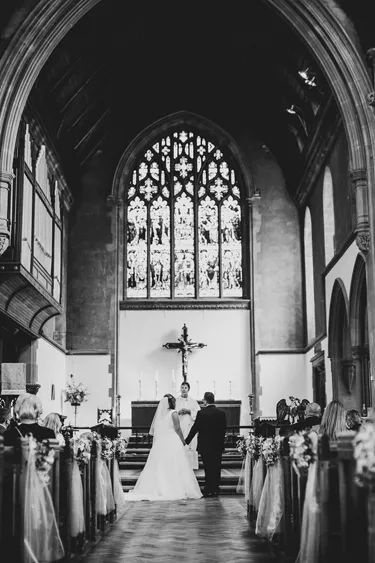
Figure1.2 Wedding ceremony
Source: Melissa Megan Photography
Wedding planners have been used to varying degrees and in differing formats for centuries, and usually this role, although unofficial, would fall on the shoulders of the bride’s mother or sister. Duties such as ensuring invitations were sent and arranging a celebration feast have been taken on by family members for years. However, as we progress through the 20th century, we see that lives for soon-to-be newlyweds become ever busier. Pressure to save for a family and running a home will see many people working later into their older ages; retirement ages increase, which means once well-meaning mothers may find themselves unable to help due to their own busy work life. We find that during the time of World Wars I and II, more women took on hard labour roles and sought out professions that would enable them to support their families in the absence of the men of the family, many of whom did not return after war.
Around 1980 we begin to see women seeking further independence, with many running their own businesses and working similar hours to their male counterparts, even returning to the workplace once children have been born. It could be argued that as both men and women take on more working hours, they may well find it challenging to juggle household commitments, let alone find time to plan such a major event as a wedding. We can then begin to understand why a couple may seek out the support of a professional event or wedding planner to help remove the burden of event planning from their already busy lives.
In 1981 the marriage of Lady Diana Spencer to Prince Charles took place in the United Kingdom. As a Royal celebration it would seem fitting that a wedding planner would take care of the arrangements to ensure all the requests from these influential families were taken care of. The duties were vast for this enormous celebration, more than 3,500 people attended, and millions watched around the world. It was expected that this couple would one day be the ruling family of the United Kingdom and everyone wanted to be part of their day. During the 1990s and onwards, couples started to seek out the help of wedding and event planners, realising they have excellent contacts and spend time building a network of useful suppliers and venue collaborators, invaluable to anyone looking to get married, manage a budget and produce a spectacular event for family and friends. The pressure for the experience to be unforgettable grows as we begin to see more magazines devoted to the wedding day, celebrity weddings are featured on TV, and around the world we begin to see how grand a wedding can be. Expendable income reaches an all-time high towards the end of the 20th century too, as countries recovered from depression following World War II. Having a little more expendable income will see people travelling abroad on holiday, investing in property and generally widening their experiences across the globe. What better way to celebrate your new-found wealth, freedom and worldly experience than ...
Table of contents
Cover
Half Title
Title Page
Copyright Page
Dedication
Table of Contents
List of figures
List of tables
List of boxes
1 Weddings and the event industry
2 The wedding planner
3 Where to start?
4 Your clients
5 The wedding budget
6 The vision
7 The venue
8 The ceremony
9 The stationery
10 Food and drink
11 The wedding team
12 The wedding day
Appendix: Helpful guides and checklists
Index
Trusted by 375,005 students
Access to over 1.5 million titles for a fair monthly price.
Study more efficiently using our study tools.
Frequently asked questions
Yes, you can cancel anytime from the Subscription tab in your account settings on the Perlego website. Your subscription will stay active until the end of your current billing period. Learn how to cancel your subscription
No, books cannot be downloaded as external files, such as PDFs, for use outside of Perlego. However, you can download books within the Perlego app for offline reading on mobile or tablet. Learn how to download books offline
Perlego offers two plans: Essential and Complete
Essential is ideal for learners and professionals who enjoy exploring a wide range of subjects. Access the Essential Library with 800,000+ trusted titles and best-sellers across business, personal growth, and the humanities. Includes unlimited reading time and Standard Read Aloud voice.
Complete: Perfect for advanced learners and researchers needing full, unrestricted access. Unlock 1.5M+ books across hundreds of subjects, including academic and specialized titles. The Complete Plan also includes advanced features like Premium Read Aloud and Research Assistant.
Both plans are available with monthly, semester, or annual billing cycles.
We are an online textbook subscription service, where you can get access to an entire online library for less than the price of a single book per month. With over 1.5 million books across 990+ topics, we’ve got you covered! Learn about our mission
Look out for the read-aloud symbol on your next book to see if you can listen to it. The read-aloud tool reads text aloud for you, highlighting the text as it is being read. You can pause it, speed it up and slow it down. Learn more about Read Aloud
Yes! You can use the Perlego app on both iOS and Android devices to read anytime, anywhere — even offline. Perfect for commutes or when you’re on the go. Please note we cannot support devices running on iOS 13 and Android 7 or earlier. Learn more about using the app
Yes, you can access The Practical Guide to Wedding Planning by Marie Haverly in PDF and/or ePUB format, as well as other popular books in Business & Entrepreneurship. We have over 1.5 million books available in our catalogue for you to explore.