1
What Is Process Control?
1.1What Is a Process?
A process is any operation or sequence of operations involving a change in a substance being treated. Examples of processes include the following:
•A change of energy, such as from hot to cold
•A change of state, such as from liquid to gas
•A change of composition, as occurs in a chemical reaction or in mixing different materials
•A change of dimension, as in grinding coal
This book considers processes in a broad sense. A process may be something as simple as pumping water from one place to another or as complex as deriving gasoline from the very complex mixture of chemicals in crude oil. Other industrial processes include pasteurizing milk, producing vaccines using bioreactors, crushing and grinding of mineral ores, generating steam to spin turbines and produce electricity, and turning trees into chips, then pulp, and finally into paper.
For all these processes, certain universal principles of measurement, control, and correction apply, although the hardware and techniques may differ greatly. The titles given to the people who supervise or direct the process may vary widely: plant operator, anesthesiologist, airplane pilot, astronomer, radar technician, and many more.
This book focuses on instrumentation and control as it is used in industry, particularly the so-called process industries. These industries include oil refining, chemical production, power generation, pulp and paper manufacturing, food and beverage processing, pharmaceutical production, mineral processing, and metal production. The hardware, software, and techniques mentioned in this book are typical for these industries.
Each process has several properties that may vary. Examples of properties are pressure, temperature, level, flow rate, acidity, color, quantity, viscosity, and many others. Each of these properties is known as a process variable. The changing values of the variables may be measured and sent to remote locations by means of signals. The measurements may be displayed, acted on for control, recorded or historized, trended, or analyzed.
1.2What Is Control?
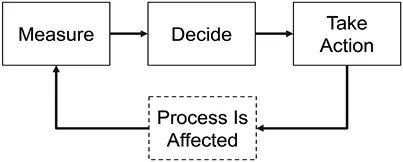
A broad definition of control is to “determine the behavior or supervise the running of” some process. This definition applies directly to process control. As shown in Figure 1-1, there are three steps to all forms of control:
1.Measurement
2.Decision
3.Action
Figure 1-1. The three steps of control.
Measurement is accomplished with instruments and analyzers. The most common measurements in industrial plants are flow, level, pressure, and temperature. Other instruments measure acidity (pH), chemical composition, moisture content, color, and many other characteristics of the process.
Analyzers are typically more complex devices that may give a multivariable analysis of the process or of product quality. Chapter 2 covers basic instrumentation, and Chapter 10 covers more complex measurement devices, such as analyzers.
The second step of control, decision, is usually made by some form of controller or control system. Older controllers were mechanical or pneumatic devices. These days, the controller or control system is more likely to be a combination of electronic hardware and software. In simple cases, the controller may be a dedicated device, such as a thermostat controlling the temperature of a room. Large industrial processes need hundreds or even thousands of controllers. Rather than add thousands of individual controllers, modern plants use special electronics and software designed for this job. Programmable logic controllers (PLCs), a distributed control system (DCS), or hybrid controllers manage the control of most modern plant facilities. These systems are explained in more detail in Chapter 3.
The third step, action, is handled by a final control element. When the controller decides to make changes to the process, it is the final control element that actually makes the correction. Valves, heaters, motors, and pumps are all forms of final control elements. These workhorses carry out actions that directly or indirectly affect the process. The selection, sizing, maintenance, and repair of these devices are critical to good process control. Chapter 5 provides an introduction to final control elements.
When the final control element makes an adjustment, the process changes. Then, a new measurement is taken, a new control decision is made, and the final control element moves. This “loop” is repeated again and again, sometimes many times per second. Chapters 6 and 7 explain the mathematics and algorithms used in control systems.
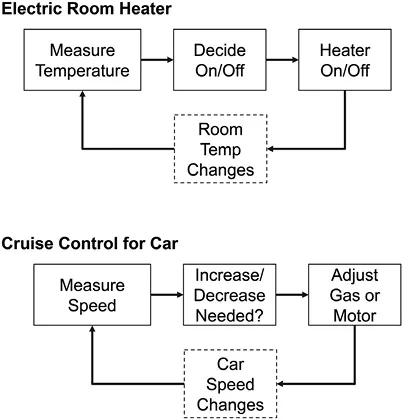
Figure 1-2 shows some example control loops that may be familiar to you. In each one, note the three steps: measurement, decision, and action.
Figure 1-2. Example control loops.
1.3Why Do We Need Process Control?
Industrial processes can be large, complex, and often dangerous. Massive plants with flammable, corrosive, or explosive chemicals are run by a handful of operators. Automated process control enables the operator to more effectively oversee and manage the large and complex process. The operator uses the control system for the following:
•Visibility – To display information from the instruments
•Stability – To respond to upsets and maintain process centerlines
•Correction – To adjust the process for varying conditions, raw materials, or equipment failures
•Management – To start up, to shut down, and to change recipes
Automated process control reduces the physical and mental demands of operation as well as the staffing requirements. Furthermore, process control helps to ensure that the process operates in a safe, effective, and efficient manner.
1.3.1Process Safety and Reliability
Above all else, the process control system must ensure that the process operates safely and reliably. When an industrial process fails to operate safely and reliably, the results can be catastrophic. The plant and its control system are designed to reduce the risks of personal injuries and fatalities. Furthermore, the plant should be controlled and operated to reduce the risk of equipment damage from both the short-term and long-term effects of operation. Instrumentation and the control system play a critical role to prevent and manage process upsets, keeping the plant operating within established safe conditions.
In an industrial context, reliability refers to the ability of the process to operate at its full production rate without losses from slowdowns and shutdowns. Shutdowns may be planned or unplanned, often due to equipment damage or failure. More details on reliability can be found in Chapter 9.
Even a simple process,...