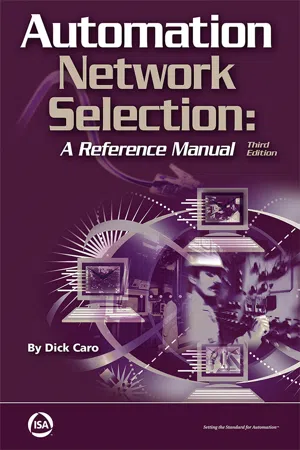
Automation Network Selection: A Reference Manual, Third Edition, is a practical and easy-to-follow guide that explains how the wiring, devices and software of industrial networks work together to operate factories and plants. Written in clear language for readers new to the subject, this book compares different network types (such as sensor networks, fieldbuses, Ethernet and wireless), addresses safety and power concerns and highlights real-world applications, from conveyor lines and packaging machines to process control and elevator systems, helping engineers select the best network for a project.
- English
- ePUB (mobile friendly)
- Available on iOS & Android
eBook - ePub
About this book
Information
Unit 1:
Prologue
Why are there so many different industrial automation networks? Why can’t there be just one network? We hear these questions very often. Indeed, it could have been, but … well, that would be a long story.
Here is the short version. In 1985, a bunch of us recognized the need for standardizing network communications for process control and we tried to prepare a standard in advance of the competition under the ISA50 standards committee. We called our effort fieldbus since it was meant for field instruments. Almost immediately, we were joined by suppliers of programmable logic controllers (PLCs) who believed that they needed to standardize their remote I/O networks and could share the same technology. We completed the physical layer protocol (wiring/cabling and signaling) in 1989 and the data link layer protocol in 1993. However, by then there were already numerous competitive commercial networks. The standards work was eventually completed in 1999 with the adoption of many of these commercial network architectures into the fieldbus standard IEC 61158 (International Electrotechnical Commission), which initially contained 8 different protocols (types) and now contains more than 23 types.
Market forces could not wait for a standard, and the standard could not incorporate all market forces into a single protocol. Not only that, but a standard cannot immediately, if ever, displace already implemented commercial products. Seven of the original eight network technologies included in the IEC fieldbus standard have been implemented in commercial products including the two specifications prepared by the Fieldbus Foundation that were based on IEC 61158 Types 1 and 5 that were originally developed from the ANSI/ISA-50.02 fieldbus standard. One of the original eight protocols has never been implemented, and was removed from IEC 61158.
I chaired both the ISA50 and the IEC SC65C/WG6 fieldbus committees during the completion of their efforts. They were very turbulent times. Cullen Langford, a user from DuPont, chaired these committees during most of the time that they were creating the fieldbus protocol, while I was the editor of the User Layer subcommittee that created the function block structure specified by the Fieldbus Foundation. Being surrounded by some of the brightest people in the universe was a rare privilege and the experience of a lifetime. I didn’t enjoy many of the competitive moves being made by major manufacturers, but it did provide a challenge to my management style.
While politics were raging in the ISA/IEC committees, discrete automation identified by the use of PLCs was also developing rapidly. For a while, it appeared that one of the standards bodies, National Electrical Manufacturers Association (NEMA), was going to use the high-speed version (H2) of ISA’s fieldbus. However, NEMA concluded that H2 standards were too expensive and too complex for use in discrete manufacturing.
As a result, most of the data communications buses developed by PLC manufacturers were incompatible with each other and did not conform to a standard set of specifications. Most of the manufacturers countered criticism about the “closed” nature of these protocols by forming “open” groups to make the longterm evolution for each of these bus technologies independent from the originating manufacturer. These open bus associations contributed five of the additional protocols to the IEC eight-part fieldbus standard.
In retrospect, it is clear that no single bus technology can satisfy the demands for multiple applications in the manufacturing marketplace. This is a political, not a technological, statement. We always knew that the wiring, cabling, and connecting solutions embedded in the physical layer could not span all markets, but the committees used the technique known as the “meld of best features” method of standardization to combine the simple elegance of WorldFIP with the pragmatism of PROFIBUS. In the process, we succeeded in developing a single protocol meeting the needs of both process control and factory automation, but with a complexity that caused it to not be accepted for discrete manufacturing. It was over these issues that the final approval of the IEC 61158 fieldbus standard was delayed for 7 years.
Also dating from the late 1980s were the development of very simple buses for sensors. These, too, were developed by independent manufacturers and typically share nothing in common with each other or with any of the higher-level bus architectures. They were designed for low cost and low complexity. However, this did not prevent some of these bus structures from being promoted by their sponsors for higher-level applications, thereby adding to the confusion.
This book gives you a perspective on the typical applications for industrial automation bus technology. The emphasis is on the intended application for each bus, rather than the range of applications for each bus, which you would find in the supplier’s literature. With that goes a note of caution—any bus can generally be used for any application; however, stretching a bus technology outside its intended area often creates more problems than it solves.
We will begin by discussing some bus applications and will propose the bus technologies that should be used to provide the needed communications services. Often, several different bus solutions will be appropriate, and their differences in the application context will be discussed. Then we will discuss the bus technologies and requirements from an end user point of view. Although the bus technology sections will talk briefly about the protocol used on the bus, the emphasis is on the wiring/cabling issues and the user interfaces. This book is generally free of mathematics except in those areas where the numbers have real application relevance.
Finally, I have always maintained my independence from all manufacturers to retain an unbiased viewpoint. This is an unbiased book, except for my fondness for the fine points of the fieldbus standard. I continue to be amazed at how little this formalized body of knowledge is used in industry, and I do reference some of these points.
Unit 2:
How to Use this Book
There are many books about networks, some written as implementer guides, some written as historical records of a protocol development, and some written as textbooks for the network protocol designer. This is different! This book is designed to assist the manufacturing process engineer in selecting the “right” network to use for a given application. I would like to have called it Industrial Networks for Dummies but that title is too similar to already existing books for IT (information technology) networks. The book is divided into two major sections: a discussion of applications and a reference guide for the various networks. Although there are some applications for which only one network protocol is the preferred answer, most applications can be served by more than one. In some cases, the answer is none of the above, but that only gives opportunity for more than one network architecture to be used.
2.1Application Guide
This portion of the book describes many classical network applications and the way in which these networks are used. I hope that you will find your application in this section, but I cannot possibly describe all applications. So, your job is to find an application most like yours. Very often, the problem is that your new networking project will have more than one application within it and they may be very different from each other. The normal answer is to use two or more different network architectures, but that may cause a measurable increase in installation cost and an even larger increase in long-term support/maintenance costs.
Network architecture selection is still an art form, not a science. Most of the network architectures have considerable overlap, so that many applications can be done with any of several networks. Pragmatically, most of the network architectures originated with the work of a single system or product manufacturer and are optimized about those applications with which they were most familiar. For this reason, it may be necessary to compromise your network selection to use the network supported by your major system or equipment manufacturer.
…it may be necessary to
… use the network supported by your major system or equipment manufacturer.
… use the network supported by your major system or equipment manufacturer.
2.2Technology Guide
More than 35 types of industrial networks are currently offered for sale. Many of these networks are proprietary to a single manufacturer and have a broad installed base. Sometimes, “affiliates” of these manufacturers are permitted to offer compatible, but not competitive, equipment using the same proprietary network architecture. The trend throughout industrial automation is to move away from proprietary networks and toward open or standard network architectures. For this reason, this book will not review proprietary network architectures. If the reader is determined to use these networks, they should contact the original supplier.
Network architectures are discussed in terms of the following criteria:
•Physical wiring/cabling requirements, sometimes called the wiring plant
•Power and safety requirements, including grounding
•Protocol in terms of efficiency, latency, and determinism
•Application support for the end user
Industrial automation networks are divided by class into sensor networks, remote I/O, smart I/O instrument (fieldbus) networks, and control networks. Some network architectures overlap these classifications, and each variation is presented together with its peer networks for direct comparison. This is difficult to explain, but you will know it when you see it. Overlap comes from attempts by the network designers to move the technology into as many niche applications as possible, sometimes with great success, and many times with failure.
Unit 3:
Introduction to Industrial Networks
At one time, it was thought that industrial automation networks were different from the kinds of networks used for IT. In fact, the earliest automation networks were not even considered as networks at all but as serial buses. The term fieldbus stems from these thoughts. Naturally, each network was designed to solve one problem, then extended to solve other, perhaps related, problems. Since each supplier’s business model was directed toward a slightly different business niche, the resulting bus turned out to be different from any other.
As long as industrial automation networks were slow and uncomplicated, no special components were required. For example, EIA-232,1 EIA-422/423, and EIA-485 were often used for the physical layers, supported by commodity semiconductors. Early protocols were simple enough to execute on 8-bit microprocessors such as the 8051, Z80, or 6809. When speeds became higher and protocols became richer in functionality, custom silicon became necessary to implement these networks. Custom silicon is expensive to design (nonrecurring engineering, or NRE) and, because the volumes are small compared with volumes in the IT market, expensive to manufacture.
The first approach to fix this problem was to standardize industrial automation networks through standards committees or the establishment of de facto standards by opening the specifications to multivendor committees. The theory was t...
Table of contents
- Cover
- Half Title
- Title Page
- Copyright Page
- Acknowledgment
- Contents
- Unit 1: Prologue
- Unit 2: How to Use this Book
- Unit 3: Introduction to Industrial Networks
- Unit 4: Network Applications
- Unit 5: Network Technology
- Unit 6: Answers for Review Questions
- Index
- About the Author
Trusted by 375,005 students
Access to over 1.5 million titles for a fair monthly price.
Study more efficiently using our study tools.
Frequently asked questions
Yes, you can cancel anytime from the Subscription tab in your account settings on the Perlego website. Your subscription will stay active until the end of your current billing period. Learn how to cancel your subscription
No, books cannot be downloaded as external files, such as PDFs, for use outside of Perlego. However, you can download books within the Perlego app for offline reading on mobile or tablet. Learn how to download books offline
Perlego offers two plans: Essential and Complete
- Essential is ideal for learners and professionals who enjoy exploring a wide range of subjects. Access the Essential Library with 800,000+ trusted titles and best-sellers across business, personal growth, and the humanities. Includes unlimited reading time and Standard Read Aloud voice.
- Complete: Perfect for advanced learners and researchers needing full, unrestricted access. Unlock 1.5M+ books across hundreds of subjects, including academic and specialized titles. The Complete Plan also includes advanced features like Premium Read Aloud and Research Assistant.
We are an online textbook subscription service, where you can get access to an entire online library for less than the price of a single book per month. With over 1.5 million books across 990+ topics, we’ve got you covered! Learn about our mission
Look out for the read-aloud symbol on your next book to see if you can listen to it. The read-aloud tool reads text aloud for you, highlighting the text as it is being read. You can pause it, speed it up and slow it down. Learn more about Read Aloud
Yes! You can use the Perlego app on both iOS and Android devices to read anytime, anywhere — even offline. Perfect for commutes or when you’re on the go.
Please note we cannot support devices running on iOS 13 and Android 7 or earlier. Learn more about using the app
Please note we cannot support devices running on iOS 13 and Android 7 or earlier. Learn more about using the app
Yes, you can access Automation Network Selection by Richard Caro,Richard H. Caro in PDF and/or ePUB format, as well as other popular books in Technology & Engineering & Automation in Engineering. We have over 1.5 million books available in our catalogue for you to explore.