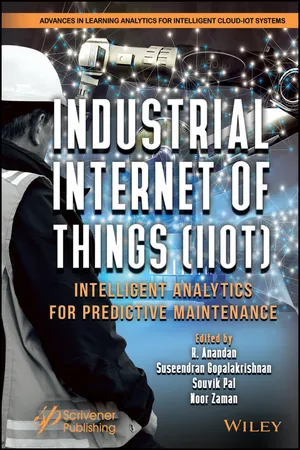
This book discusses how the industrial internet will be augmented through increased network agility, integrated artificial intelligence (AI) and the capacity to deploy, automate, orchestrate, and secure diverse user cases at hyperscale.
Since the internet of things (IoT) dominates all sectors of technology, from home to industry, automation through IoT devices is changing the processes of our daily lives. For example, more and more businesses are adopting and accepting industrial automation on a large scale, with the market for industrial robots expected to reach $73.5 billion in 2023. The primary reason for adopting IoT industrial automation in businesses is the benefits it provides, including enhanced efficiency, high accuracy, cost-effectiveness, quick process completion, low power consumption, fewer errors, and ease of control.
The 15 chapters in the book showcase industrial automation through the IoT by including case studies in the areas of the IIoT, robotic and intelligent systems, and web-based applications which will be of interest to working professionals and those in education and research involved in a broad cross-section of technical disciplines.
The volume will help industry leaders by
Advancing hands-on experience working with industrial architecture
Demonstrating the potential of cloud-based Industrial IoT platforms, analytics, and protocols
Putting forward business models revitalizing the workforce with Industry 4.0.
Audience
Researchers and scholars in industrial engineering and manufacturing, artificial intelligence, cyber-physical systems, robotics, safety engineering, safety-critical systems, and application domain communities such as aerospace, agriculture, automotive, critical infrastructures, healthcare, manufacturing, retail, smart transports, smart cities, and smart healthcare.
1 A Look at IIoT: The Perspective of IoT Technology Applied in the Industrial Field
Ana Carolina Borges Monteiro1, Reinaldo Padilha França1*, Rangel Arthur2, Yuzo Iano1, Andrea Coimbra Segatti2, Giulliano Paes Carnielli2, Julio Cesar Pereira2, Henri Alves de Godoy2 and Elder Carlos Fernandes2
1School of Electrical and Computer Engineering (FEEC), University of Campinas – UNICAMP, Av. Albert Einstein, Barão Geraldo, Campinas – SP, Brazil
2Faculty of Technology (FT), University of Campinas – UNICAMP, Paschoal Marmo Street, Jardim Nova Italia, Limeira, Brazil
Abstract
The advent of solutions with AI (Artificial Intelligence) technology means tools and software that integrate resources that automate the process of making algorithmic decisions. Simply put, AI consists of systems or machines that mimic human intelligence to perform tasks improving iteratively over time based on the information collected. Thus, IoT currently matches a series of hardware that works connected to the internet, from a refrigerator to a wearable watch that measures heart rate and sends this data to an application. In this sense, it is possible to interpret what part of these devices uses, even on a small scale, AI technology. This technological innovation connects everyday intelligent devices or even intelligent sensors, to the internet, linking the physical world increasingly closer to the digital world. In this scenario, the world is experiencing a digital transformation, and related to it, the Industrial Internet of Things (IIoT) aims to connect different devices to collect and transmit data present in an industrial environment. Performing this communication through essential industrial variables related to smart devices, effecting communication, data, and data analysis. In this sense, this chapter is motivated to provide an updated overview of IoT and IIoT, addressing its evolution along with AI technology and potential in the industry, approaching its relationship, with a concise bibliographic background, synthesizing the potential of technologies.
The concept behind the Internet of Things (IoT) is to connect several devices, through the internet which can exchange information with each other. Considering that this technology can be applied to industry, it makes this connection between these different devices generates Industry 4.0, which is reputable as the Fourth Industrial Revolution, being the new trend that is being adopted by large corporations to get ahead in the market, characterized by the introduction of information technology in the industry [1].
IoT in Industry 4.0 is basically responsible for the integration of all devices inside and outside the plant, considering that the concept represents the connection as it is a network of physical devices (objects), systems, platforms, and applications with embedded technology to communicate, feel or interact with indoor and outdoor environments [1, 2].
Industry 4.0 is the complete transformation of the entire scope of industrial production through the fusion of internet and digital technology with traditional industry, being motivated by three major changes in the productive industrial world related to the immense amount of digitized information, exponential advancement of computer capacity, and innovation strategies (people, research, and technology) [2, 3].
When it is said that the internet is in the industry, these changes allow everything inside and around an operational plant (suppliers, distributors, plants, and even the final product) to be digitally related and connected, affording a highly incorporated value chain, from the factory floor, is important to relate this to an environment where all equipment and machines are connected in networks and uniquely providing information [3, 4].
For Industry 4.0 to become feasible, it requires the adoption of a technological infrastructure made up of physical and virtual systems, aiming to create a favorable environment for new technologies to be disseminated and incorporated by the industry, with the support of Big Data Analytics technology (Figure 1.1), automated robots, simulations, advanced manufacturing, augmented reality, and the IoT, employing the monitoring of technological trends, assisting managers throughout the entire industrial chain [3, 5].
The Industrial Internet of Things has an IoT and IIoT layer in the industry, provoking a prognostic model, since automation, which in general already exists, answers questions regarding what is happening, what happened, and why it happened, considering its network of physical devices (objects and things, among others), systems, platforms, systems, and applications with embedded technology in industry sectors, aiming to promote automation of manufacturing and, thus, increase the productivity of production lines, generating greater competitiveness with the international industry through intelligent factories (smart manufacturing) [6].
Figure 1.1 Big data analytics illustration.
Generating an increasing number of connected devices (in some situations, it even include unfinished products), since the digitization of data from machines, methods, processes, procedures, and intelligent devices, integrates and complements the operational layer of an industrial plant, enabling communication and systems integration and controls and allowing responses and decision-making in real time. Thus, IIoT becomes a prerequisite for Industry 4.0 [1, 7].
The difference between IoT and IIoT is in the sense that the first relates systems that connect things, complement information, normally only produce data, and can be used in any sector of the industry, transforming the second, to manage assets and analyze maintenance trends [8–10].
IIoT forms a critical layer of the production process and can directly connect a product supplier in real time on the production line, which analyzes the quality and use of your product, as well as connecting the input and output logistics chain of materials and control production, in real time, at the optimum point of operation, becoming an application of production and consumption of data, with a critical profile [8–10].
The use of IoT and IIoT proposes the digital factory bringing benefits to productive plants as an improvement in the use of the asset, reduction of operations or asset cycle cost, improved production, reduction of operations or stoppages, improving asset use (performance), increased speed in decision-making, allow the sale or purchase of products as a service, generate opportunity for new business, among several others. Thus, the premise of digitizing all information can lead to a question about the reason and reason for digitizing so much data, since this information is all digitized and there are all the means (networks) for them to travel and exchange information with each other, it is expected that decisions can be made not only between operators and machines, but also between machine and machine, this is called M2M, Machine to Machine, which before were not available in real time and are now needed [8–11].
Thus, the architectures of industrial automation systems, which have adherence to Industry 4.0, manage to integrate different devices in favor of industrial evolution, with more and more sensors, cameras, and systems that will be monitoring the entire industrial production process, evaluating and supervising the performance of equipment, and providing, in addition to the already known layers of operational control and the entire control framework, the IoT and IIoT layer, where it will converge all this data into a Big Data, delivering operational control possibilities (Figure 1.2), with decision-making in prognoses and with the possibility of autonomous actions [10–12].
Optimizing the production process of the industry is the main reason for the application of IoT in the production line of the factories, since the IoT technology and its IIoT aspect allows the equipment that makes up the industrial yard of a company today that can be connected in a network. With the data collected and stored in the cloud, it allows the decision-makers of the companies to have quick and easy access to all the information of the company and its collaborators; in other words, this makes all the industrial machinery work automatically through of highly programmable intelligent sensors [13, 14].
Figure 1.2 Big data illustration.
Wherefore, this chapter is motivated and has the purpose to originate an updated overview of IoT and IIoT, addressing its evolution and branch of application potential in the industry, approaching its relationship with current technologies and synthesizing the potential of technology with a concise bibliographic background.
1.2 Relationship Between Artificial Intelligence and IoT
The emergence of solutions and tools with AI (Artificial Intelligence) technology means solutions, tools, and software that have integrated resources that automate the process of making algorithmic decisions. The technology to be used can be anything from independent databases employing Machine Learning to pre-built models that can be employed to a diversity of data sets to solve paradigms related to image recognition and text analysis. Applied in the industry, it can help a business achieve a faster time to evaluate, reduce costs, increase productivity, and improve the relationship with stakeholders and customers [15, 16].
Machine Learning is only part of AI, that is, it is an AI application in which it accesses a large volume of data and learns from it automatically, without human intervention. This is what happens in the case of recommendations on video streaming platforms and facial recognition in photos on social media pages. AI is a broader concept that, in addition to Machine Learning, includes technologies such as natural language processing, neural networks, inference algorithms, and deep learning, in order to achieve reasoning and performance s...
Table of contents
Cover
Table of Contents
Title Page
Copyright
Preface
1 A Look at IIoT: The Perspective of IoT Technology Applied in the Industrial Field
2 Analysis on Security in IoT Devices—An Overview
3 Smart Automation, Smart Energy, and Grid Management Challenges
4 Industrial Automation (IIoT) 4.0: An Insight Into Safety Management
5 An Industrial Perspective on Restructured Power Systems Using Soft Computing Techniques
6 Recent Advances in Wearable Antennas: A Survey
7 An Overview of IoT and Its Application With Machine Learning in Data Center
8 Impact of IoT to Meet Challenges in Drone Delivery System
9 IoT-Based Water Management System for a Healthy Life
10 Fuel Cost Optimization Using IoT in Air Travel
11 Object Detection in IoT-Based Smart Refrigerators Using CNN
12 Effective Methodologies in Pharmacovigilance for Identifying Adverse Drug Reactions Using IoT
13 Impact of COVID-19 on IIoT
14 A Comprehensive Composite of Smart Ambulance Booking and Tracking Systems Using IoT for Digital Services
15 An Efficient Elderly Disease Prediction and Privacy Preservation Using Internet of Things
Index
Also of Interest
End User License Agreement
Trusted by 375,005 students
Access to over 1.5 million titles for a fair monthly price.
Study more efficiently using our study tools.
Frequently asked questions
Yes, you can cancel anytime from the Subscription tab in your account settings on the Perlego website. Your subscription will stay active until the end of your current billing period. Learn how to cancel your subscription
No, books cannot be downloaded as external files, such as PDFs, for use outside of Perlego. However, you can download books within the Perlego app for offline reading on mobile or tablet. Learn how to download books offline
Perlego offers two plans: Essential and Complete
Essential is ideal for learners and professionals who enjoy exploring a wide range of subjects. Access the Essential Library with 800,000+ trusted titles and best-sellers across business, personal growth, and the humanities. Includes unlimited reading time and Standard Read Aloud voice.
Complete: Perfect for advanced learners and researchers needing full, unrestricted access. Unlock 1.5M+ books across hundreds of subjects, including academic and specialized titles. The Complete Plan also includes advanced features like Premium Read Aloud and Research Assistant.
Both plans are available with monthly, semester, or annual billing cycles.
We are an online textbook subscription service, where you can get access to an entire online library for less than the price of a single book per month. With over 1.5 million books across 990+ topics, we’ve got you covered! Learn about our mission
Look out for the read-aloud symbol on your next book to see if you can listen to it. The read-aloud tool reads text aloud for you, highlighting the text as it is being read. You can pause it, speed it up and slow it down. Learn more about Read Aloud
Yes! You can use the Perlego app on both iOS and Android devices to read anytime, anywhere — even offline. Perfect for commutes or when you’re on the go. Please note we cannot support devices running on iOS 13 and Android 7 or earlier. Learn more about using the app
Yes, you can access Industrial Internet of Things (IIoT) by R. Anandan, Suseendran Gopalakrishnan, Souvik Pal, Noor Zaman, R. Anandan,Suseendran Gopalakrishnan,Souvik Pal,Noor Zaman in PDF and/or ePUB format, as well as other popular books in Computer Science & Artificial Intelligence (AI) & Semantics. We have over 1.5 million books available in our catalogue for you to explore.