This volume is the first attempt to reconsider the entire corpus of an ancient canonical author through the lens of queerness broadly conceived, taking as its subject Euripides, the latest of the three great Athenian tragedians. Although Euripides' plays have long been seen as a valuable source for understanding the construction of gender and sexuality in ancient Greece, scholars of Greek tragedy have only recently begun to engage with queer theory and its ongoing developments. Queer Euripides represents a vital step in exploring the productive perspectives on classical literature afforded by the critical study of orientations, identities, affects and experiences that unsettle not only prescriptive understandings of gender and sexuality, but also normative social structures and relations more broadly.
Bringing together twenty-one chapters by experts in classical studies, English literature, performance and critical theory, this carefully curated collection of incisive and provocative readings of each surviving play draws upon queer models of temporality, subjectivity, feeling, relationality and poetic form to consider "queerness" both as and beyond sexuality. Rather than adhering to a single school of thought, these close readings showcase the multiple ways in which queer theory opens up new vantage points on the politics, aesthetics and performative force of Euripidean drama. They further demonstrate how the analytical frameworks developed by queer theorists in the last thirty years deeply resonate with the ways in which Euripides' plays twist poetic form in order to challenge well-established modes of the social. By establishing how Greek tragedy can itself be a resource for theorizing queerness, the book sets the stage for a new model of engaging with ancient literature, which challenges current interpretive methods, explores experimental paradigms, and reconceptualizes the practice of reading to place it firmly at the center of the interpretive act.
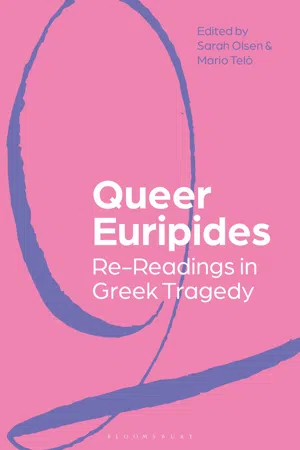
eBook - ePub
Queer Euripides
Re-Readings in Greek Tragedy
- 288 pages
- English
- ePUB (mobile friendly)
- Available on iOS & Android
eBook - ePub
About this book
Information
PART I
TEMPORALITIES
CHAPTER 1
HIPPOLYTUS—EURIPIDES AND QUEER THEORY AT THE FIN DE SIÈCLE AND NOW
Daniel Orrells
“Queer Euripides” might suggest that Euripides, the Athenian poet, could and should be seen as “queer,” that the cultural and sexual conditions of the 1970s to the 2020s might be seen to be present in the late fifth century BC: queer studies might have an ancient heritage. Alternatively, if not used adjectivally, the “queer” in “Queer Euripides” could also be an imperative, which reflects a critical call to “queer” Euripides, that is, to apply the insights and methods of modern queer studies and theory back onto Euripides’ texts. Whereas one usage of “queer” proposes the long historical connections between ancient and modern, the other celebrates the potentially disruptive anachronism of projecting modern theory onto classical antiquity.1 The delicious ambiguity of the title of this book reflects an enduring central question for queer literary studies: its engagement with anachronism and historicity. What does it mean to see “queer” subjects in the past? What might “queer history” look like?
Contemporary queer theory has invested a lot of energy in locating its heritage in the literary and cultural experimentation of the fin de siècle. In Epistemology of the Closet, Eve Kosofsky Sedgwick (1990, 91 and 44) famously marked the year 1891 as foundational for Western queer culture in contrast to Michel Foucault’s provocative proposal that the homosexual emerged into history in 1870. This question of the relationship between modern, contemporary discourses of sexuality and older, historical modes of desire was itself also a much-debated topic in late-nineteenth-century Britain. Benjamin Jowett, John Addington Symonds, and Walter Pater all examined the historical similarities and differences between Greco-Roman and nineteenth-century masculinities.2 The reception of Euripides was a crucial aspect for these late-Victorian debates about the history of gender and sexuality. If fin-de-siècle culture has repeatedly been seen as a foundational moment for the origins of the Western queer self, this chapter explores the importance of the fin-de-siècle reception of Euripidean tragedy for contemporary, twenty-first-century debates in queer studies.
This chapter argues that readings of Euripides in the late nineteenth century anticipate and intersect with our own discussions today about the relationship between feminism and queer politics. This is hardly surprising: Euripides’ supposedly misogynistic characterization of women was already mocked by Aristophanes in the fifth century,3 and Satyrus’ biography claimed that he hated women. And yet, more modern readers have argued that Euripides’ plays provide opportunities for feminist reception. Indeed, Euripides’ provocative presentation of the passions of women has shocked and fascinated ancient and modern audiences. Euripidean tragedy, so innovative already in the fifth century, has repeatedly changed and shifted in form, meaning, and political significance. Euripides has continually resisted the efforts of classical scholars and modern writers who have sought to interpret and categorize him and put him in his place. So, with such a complex reception history, can Euripides be queered? How might thinking about “queer Euripides” contribute to larger questions about what it means to look back to the (ancient) past and find a queer heritage?
To explore these questions, we will trace out how the scholarly fascination with the textual fragment in the nineteenth century inspired the fin-de-siècle imagination to fill in the blanks and rewrite the classical text. As we will examine, the textual fragment figured both the disappearance of antiquity and the possibility of contesting scholarly and heteronormative accounts of the ancient world. As we will discover, the fragmentary forms of the classical text were of particular interest to readers and writers from the 1870s onward who sought to critique hegemonic patriarchal norms. Pater’s 1889 “Hippolytus Veiled: A Study from Euripides,” a text that has barely ever been discussed, will prove a fascinating resource for us today.4 Pater’s version of Euripides’ fragmentary play Hippolytus Veils Himself begins with a discussion of the difficulties in obtaining secure knowledge about the ancient Greek world, and in particular, its earliest periods of history. It then modulates into a story about the “primitive” family of Hippolytus and his single mother, the Amazon Antiope, who has been deserted by Theseus who has gone to rule Athens and turn it into a modern city. Mother and son survive in precarious thrift but are enriched by mutual care and devotion. The death of Hippolytus and Antiope’s lamentation for her son mark the end of the narrative, which mourns the disappearance of alternative modes of living and loving that do not conform to modern, supposedly civilized standards. Reading Pater’s fin-de-siècle Euripidean story, which looks back at the ancient past, gives us the opportunity to think about our own queer investments in antiquity.5
Textual Fragments and Scholarly Desires
Euripidean tragedy is a “fragmented and chaotic” form (Wohl 2015, 3), which has come to be seen as not only representative of Euripides’ historical context in the tumultuous late fifth century, but also as giving voice to the possibility of new modes of aesthetic and political expression in the fourth century and beyond: “Euripides marks both the end of Athens—that’s it: that’s how the fifth century turned out—and its continuity in new and unexpected shapes” (140). Euripides’ ancient fin-de-siècle positioning anticipated his modern nineteenth-century fin-de-siècle receptions. As Sean Gurd has explored, the forms of Euripidean textuality became fascinating case studies of the mutability of the ancient text in the hands of the professional textual critics who sought to stabilize the form and meaning of Euripides’ words. The scholarly attempts to fix Euripides’ Iphigenia in Aulis produced literally new forms of the play as the text became increasingly fragmentary at the hands of the textual critics.6 The scholarly production of Euripidean fragmentation emerged out of romantic philhellenism as a commentary on “the inaccessibility of the ancient ideal” (Gurd 2005, 114). The textual fragment was both an ancient relic and a modern form. The fascination with the Euripidean fragmentary form culminated in the 1854 publication of the fragments of Euripides’ plays by Johann August Nauck. But if this publication and others of fragments of Greek drama in the middle of the nineteenth century sought to preserve decaying ancient remains and erect them into worthy monuments of admiration for classical scholars and students, their romantic fragmentariness would prove profoundly impactful on the decadent imagination of the late nineteenth century.
Indeed, the 1870s and 1880s witnessed a series of questions aimed at these scholarly attempts at the erection of stable, historicized monuments of classical learning, which sought to put ancient texts in their historical place and stop them from shape-shifting and changing. The late nineteenth century became a crucial moment in the modern history of debates about classical scholarship. Friedrich Nietzsche’s lectures that mocked the classical profession and his essay on the uses of history interrogated the relationship between the ancient world and its modern scholarly reception.7 The discovery of Troy contributed to the nineteenth century’s fascination with deep time and the prehistorical. The preclassical remains of Troy looked both very old, embedded in geological layers of temporality, and very modern, a vision of the collapse of a luxurious, decadent society.8 In response to these difficult questions, biblical archaeology attempted to reassert ecclesiastical accounts of history, which nevertheless ended up putting the ancient and the modern into connection in new and controversial ways.9 The professional understanding of the relationship between the modern scholarly gaze and the ancient object under scrutiny had been profoundly disrupted and unsettled. By 1907, Sigmund Freud could pen his essay “Delusion and Dream in Jensen’s Gradiva,” where he explored how a classical archaeologist in Pompeii could fall in love with and marry his scholarly object of analysis. The fragmentariness of the poems of Sappho especially encouraged the eroticization of ancient remains in the closing decades of the nineteenth century. In 1885, all the then-extant fragments, using the correct pronouns, were published in English. The multiple love interests mentioned in the poems, the various renderings, and the fragmentary nature of Sappho’s poetic corpus meant that late-Victorian authors were free to develop and enlarge upon the tattered remains in numerous different erotic voices.10 Romantic Hellenism, rerouted through the decadent sensibility, then, subverted attempts at historicist, objective, professionalized scholarship, and encouraged subjectivizing perspectives, anachronizing receptions of and queer relationships with the ancient world. To quote Gurd again: the “fragmentary quality [of the remains of antiquity] encapsulates the unsettling similarity between critic and corruptor” (2005, 100–1). The fragment put into focus the unstable relationship between ancient passions and modern scholarly desires.
Euripides contributed to this fin-de-siècle questioning of scholarly notions of historicity, temporality, and objectivity. Euripides did not fit in historically: for Nietzsche in his 1872 Birth of Tragedy, building on and undoing a generation of German scholarship, Euripides was both the belated Decadent denouement of true tragic grandeur and yet his Bacchae, despite being his final play, was important evidence of the Apollo/Dionysiac opposition at the historical origins of Greek tragedy, which, in turn, was, for Nietzsche, meant to inspire modern, nineteenth-century writers. In the English-speaking world, Euripides was also receiving more attention. John Addington Symonds responded to nineteenth-century critiques of decadent Euripides in his 1873 Studies of the Greek Poets. While Nietzsche preferred Dionysus and lamented Euripides’ oversophisticated Apolline modernit...
Table of contents
- Cover
- Half-Title Page
- Series Page
- Title Page
- Contents
- Acknowledgments
- Queer Euripides: An Introduction
- Part I Temporalities
- 1 Hippolytus—Euripides and Queer Theory at the Fin de Siècle and Now
- 2 Rhesus—Tragic Wilderness in Queer Time
- 3 Trojan Women—No Futures
- Part II Escape/Refusal
- 4 Iphigenia in Aulis—Perhaps (Not)
- 5 Helen—Queering the Barbarian
- 6 Children of Heracles—Queer Kinship: Profit, Vivisection, Kitsch
- 7 Suppliant Women—Adrastus’ Cute Lesbianism: Labor Irony Adhesion
- Part III Failure
- 8 Medea—Failure and The Queer Escape
- 9 Alcestis—Impossible Performance
- 10 Ion—Into the Queer Ionisphere
- Part IV Relations
- 11 Heracles—Homosexual Panic and Irresponsible Reading
- 12 Andromache—Catfight in Phthia
- 13 Orestes—Polymorphously Per-Verse: On Queer Metrology
- Part V Reproduction
- 14 Hecuba—The Dead Child, or Queer For a Day
- 15 Phoenician Women—“Deviant” Thebans Out of Time
- 16 Electra—Parapoetics and Paraontology
- Part VI Encounters
- 17 Iphigenia in Tauris—Iphigenia and Artemis? Reading Queer/Performing Queer
- 18 Cyclops—A Philosopher Walks into a Satyr-Play
- Part VII Transitions
- 19 Hippolytus—Queer Crossings (Following Anne Carson)
- 20 Aristophanes, Women at the Thesmophoria—Reality and the Egg: An Oviparody of Euripides
- 21 Bacchae—“An Excessively High Price to Pay for Being Reluctant to Emerge from the Closet”?
- List of Contributors
- Bibliography
- Index
- Copyright
Trusted by 375,005 students
Access to over 1.5 million titles for a fair monthly price.
Study more efficiently using our study tools.
Frequently asked questions
Yes, you can cancel anytime from the Subscription tab in your account settings on the Perlego website. Your subscription will stay active until the end of your current billing period. Learn how to cancel your subscription
No, books cannot be downloaded as external files, such as PDFs, for use outside of Perlego. However, you can download books within the Perlego app for offline reading on mobile or tablet. Learn how to download books offline
Perlego offers two plans: Essential and Complete
- Essential is ideal for learners and professionals who enjoy exploring a wide range of subjects. Access the Essential Library with 800,000+ trusted titles and best-sellers across business, personal growth, and the humanities. Includes unlimited reading time and Standard Read Aloud voice.
- Complete: Perfect for advanced learners and researchers needing full, unrestricted access. Unlock 1.5M+ books across hundreds of subjects, including academic and specialized titles. The Complete Plan also includes advanced features like Premium Read Aloud and Research Assistant.
We are an online textbook subscription service, where you can get access to an entire online library for less than the price of a single book per month. With over 1.5 million books across 990+ topics, we’ve got you covered! Learn about our mission
Look out for the read-aloud symbol on your next book to see if you can listen to it. The read-aloud tool reads text aloud for you, highlighting the text as it is being read. You can pause it, speed it up and slow it down. Learn more about Read Aloud
Yes! You can use the Perlego app on both iOS and Android devices to read anytime, anywhere — even offline. Perfect for commutes or when you’re on the go.
Please note we cannot support devices running on iOS 13 and Android 7 or earlier. Learn more about using the app
Please note we cannot support devices running on iOS 13 and Android 7 or earlier. Learn more about using the app
Yes, you can access Queer Euripides by Sarah Olsen, Mario Telò, Sarah Olsen,Mario Telò in PDF and/or ePUB format, as well as other popular books in Literature & Ancient & Classical Literary Criticism. We have over 1.5 million books available in our catalogue for you to explore.