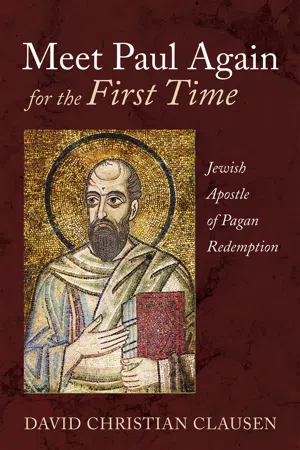
eBook - ePub
Meet Paul Again for the First Time
Jewish Apostle of Pagan Redemption
- 268 pages
- English
- ePUB (mobile friendly)
- Available on iOS & Android
eBook - ePub
About this book
This bold, new look at the apostle Paul will challenge longtime thinking about the "apostle to the gentiles." Unfortunately, common misperceptions and outdated characterizations continue to prevail in mainstream teaching and preaching about Paul. Meet Paul Again for the First Time introduces readers to a brand-new Paul which, as it turns out, was the original Paul all along. With clarity and purpose, Clausen rejects unfounded preconceptions about the apostle. For example, he did not teach a "law-free gospel," he did not reject Judaism or the law, and he did not see himself as a miserable sinner who found forgiveness only in Christ. Based on a reappraisal of first-century Judaism, recognition of the pagan targets of Paul's mission, and an appreciation for Paul's skill as a Greco-Roman rhetorician and interpreter of Jewish scripture, Meet Paul Again brings consistency and clarity to critical Pauline concepts including the new covenant, works of the law, preservation and deliverance, the future of Israel, and the status of gentiles in God's family. Paul's was a mission of inclusiveness. His primary objective was to preserve sinning gentiles from God's wrath, and welcome them in worship beside their Jewish brothers and sisters, before the imminent arrival of the great and terrible Day of the Lord.
Information
Topic
Theology & ReligionSubtopic
Biblical StudiesPart 1
How to Meet Paul Again for the First Time
Chapter 1
What was Old is New Again
It may come as a surprise to many but Paul has been misunderstood and his teachings challenged, altered, ignored, or misinterpreted ever since he first began preaching his “good news” (Greek = euaggelion; “gospel”)1 message to gentiles throughout the first-century Roman Empire. We can easily demonstrate this by citing some of the situations Paul discussed in his letters.
In the First Century
In Antioch
Early in Paul’s missionary career, certain Jews, possibly but not necessarily Christ-following2 Jews, visited the Christ-following assembly (Greek: ekklēsia)3 in Antioch in the Roman province of Syria (Gal 2:12; Acts 15:1). They were taken aback to find Paul and other Jews teaching non-Jewish men that they did not need to be circumcised in order to be made righteous (become justified) by God. Instead, they could attain a righteous status equal to Jews through their trust in Jesus as the Messiah. Dissension erupted. Paul took his case to Jerusalem.
In Jerusalem
In Jerusalem, certain Jews, possibly but not necessarily Christ-following Jews, interrupted the discussions between the Christ-following representatives from Antioch, including Paul, and the Jerusalem apostles, including Peter and James the brother of Jesus (Gal 2:1–2; Acts 15:2–4). These uninvited “false brothers” insisted that gentiles must be circumcised and become Torah-observant in order to be declared righteous before God. Key apostles sided with Paul’s delegation insofar as not insisting that gentiles be circumcised. They may not have agreed that gentiles could achieve righteous equality with Jews, however.4 Later, when the mixed Jewish-gentile dining arrangements in Antioch were challenged, Peter and Barnabas, who were at the discussions in Jerusalem, removed themselves from the tables occupied by gentiles.
In Galatia
After Paul had founded a gentile Christ-following assembly in the Roman province of Galatia (in modern Turkey), other evangelists began to challenge Paul’s gospel with a gospel of their own (Gal 1:6). Paul was wrong or shortsighted, they said, to tell gentile men that they did not need to be circumcised. Paul had to write a letter to those baptized Galatians in order to defend his gospel against that of his rivals.
In Thessalonica
Paul also had to write to the gentile Christ-following assembly he founded in Thessalonica in the Roman province of Macedonia (in modern Greece) to correct their apparent misunderstanding about the return of Christ. The Thessalonians were under the impression from Paul’s teaching that Christ would return before any of them had died. That turned out not to be the case; some had died (1 Thess 4:13–14). Paul was forced to reformulate his end-time scenario to accommodate the changing situation.5
In Corinth
Paul wrote several letters to the mostly gentile Christ-following assembly(ies) he founded in Corinth in the Roman province of Achaia (also in modern Greece). They had fallen into dissension almost as soon as he left. A number of followers interpreted, or developed, Paul’s teaching in such a way that they were celebrating their spiritual resurrection while denying the future, bodily resurrection (1 Cor 4:8, 15:22–23). Paul had to compose a more complete exposition regarding the resurrection process. Meanwhile, other Jewish, Christ-following evangelists arrived in Corinth (1 Cor 1:12; 2 Cor 11:4–5) and attempted to “correct” Paul’s gospel. Paul had to push back both rhetorically, and then with a personal visit, to defend his gospel and his apostolicity.
In Philippi
In Philippi, in the Roman province of Macedonia, some religious teachers were threatening the Christ-followers there (Phil 3:2). Paul wrote to warn his Philippians to beware their teachings and their influence. He even had to defend his Jewish privilege as a response to some of their practices (Phil 3:3–6).6
In the Second Century
1 Timothy
After Paul’s death, Christ-followers began composing letters in Paul’s name. At least one such letter banned women preachers and, in fact, silenced women altogether. It was shameful, the writer of First Timothy declared, for a woman to ask questions when being taught (1 Tim 2:11; cf. 1 Cor 14:34).7 These instructions seem contrary to evidence from earlier letters which highlight the important leadership and support roles held by women working side-by-side with Paul.
Marcion
A popular, second-century Christian preacher named Marcion from the Roman province of Bithynia-Pontus (in modern Turkey) read Paul’s letters with enthusiasm. In his view, the gospel of Paul, not to mention the teaching of Jesus before him, proclaimed a new God, one more sublime than the God of the Jewish Scriptures. The heretofore unknown God revealed by Jesus and Paul was merciful and loving while the God of the Jews was full of wrath, fallible, and mercilessly just. Jesus’s God, Maricon taught, was superior to the God of the Jews. Marcion set about compiling the first-ever collection of Christian texts, featuring edited versions of Paul’s letters excised of al...
Table of contents
- Title Page
- Permissions
- List of Abbreviations
- Introduction
- Part 1: How to Meet Paul Again for the First Time
- Part 2: The Gospel of Paul . . .What Was Paul’s Message?
- Part 3: Paul, the Apostle . . . Who Was He?
- Part 4: The Teaching of Paul . . . Let’s Dig Into the Details
- Part 5: The Key Passages . . . Where Did He Say That?
- Epilogue: What Torah Rules Were Gentiles Supposed to Follow?
- Bibliography
Trusted by 375,005 students
Access to over 1.5 million titles for a fair monthly price.
Study more efficiently using our study tools.
Frequently asked questions
Yes, you can cancel anytime from the Subscription tab in your account settings on the Perlego website. Your subscription will stay active until the end of your current billing period. Learn how to cancel your subscription
No, books cannot be downloaded as external files, such as PDFs, for use outside of Perlego. However, you can download books within the Perlego app for offline reading on mobile or tablet. Learn how to download books offline
Perlego offers two plans: Essential and Complete
- Essential is ideal for learners and professionals who enjoy exploring a wide range of subjects. Access the Essential Library with 800,000+ trusted titles and best-sellers across business, personal growth, and the humanities. Includes unlimited reading time and Standard Read Aloud voice.
- Complete: Perfect for advanced learners and researchers needing full, unrestricted access. Unlock 1.5M+ books across hundreds of subjects, including academic and specialized titles. The Complete Plan also includes advanced features like Premium Read Aloud and Research Assistant.
We are an online textbook subscription service, where you can get access to an entire online library for less than the price of a single book per month. With over 1.5 million books across 990+ topics, we’ve got you covered! Learn about our mission
Look out for the read-aloud symbol on your next book to see if you can listen to it. The read-aloud tool reads text aloud for you, highlighting the text as it is being read. You can pause it, speed it up and slow it down. Learn more about Read Aloud
Yes! You can use the Perlego app on both iOS and Android devices to read anytime, anywhere — even offline. Perfect for commutes or when you’re on the go.
Please note we cannot support devices running on iOS 13 and Android 7 or earlier. Learn more about using the app
Please note we cannot support devices running on iOS 13 and Android 7 or earlier. Learn more about using the app
Yes, you can access Meet Paul Again for the First Time by David Christian Clausen in PDF and/or ePUB format, as well as other popular books in Theology & Religion & Biblical Studies. We have over 1.5 million books available in our catalogue for you to explore.