eBook - ePub
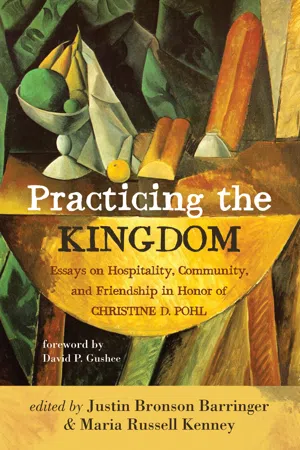
Practicing the Kingdom
Essays on Hospitality, Community, and Friendship in Honor of Christine D. Pohl
- 236 pages
- English
- ePUB (mobile friendly)
- Available on iOS & Android
eBook - ePub
Practicing the Kingdom
Essays on Hospitality, Community, and Friendship in Honor of Christine D. Pohl
About this book
Throughout her academic career, Christine D. Pohl has helped the church rediscover practices that used to be central to its life, like hospitality, community, and friendship. Perhaps best known for her groundbreaking Making Room: Recovering Hospitality as a Christian Tradition, she has also contributed significantly to discussions on Christian community, feminism and the academy, and the practice of friendship. Yet behind this lies a lifetime of "lived theology" that informs her life and her work, both inside and outside the academy.
Containing biblical, systematic, and moral theology, these essays are scriptural and liturgical, multidisciplinary and missional. Several of them could be described as offering essays of "lived theology," writing and reflecting from within years of action and contemplation. They build upon particularly fruitful aspects of Pohl's work, through expansion, clarification, and occasional disagreement. A mix of scholars and practitioners, colleagues, former students, and friends, the contributors represent a wide variety of theoretical and practical expertise. This volume honors Pohl most when its readers choose to take the wisdom within its pages and embody that in life together.
Information
Topic
Theology & ReligionSubtopic
Christian MinistryPart One
Practicing Hospitality
Engaging the Fragilities
Intellectual Hospitality
“Making Room” for the Ideas of Others
In a presentation to a conference focusing on business practices from a Christian perspective, I touched on the subject of entrepreneurship. I told a story about asking a friend, an entrepreneur, how his work was going. He responded that he was looking for a new challenge. A few years earlier he had bought a company that was not making a profit, but now it was doing well. “So I’m bored with it,” he said. “I’m looking for another loser company to work on!”
I used that anecdote to point out that entrepreneurs are typically not motivated primarily by a desire to make money. Rather, they like to exercise creativity by solving problems and they get excited about risk-taking. And then I moved in a theological direction, reporting on another conversation shortly after the one with the entrepreneur. This one was with a theologian friend, who told me he was exploring the idea of divine hospitality. The God of the Bible, he said, is the ultimate host. “Did you ever think of this?” he asked. “Creation itself was a marvelous act of hospitality. God did not need the likes of us. The triune God would have been missing nothing if we had not been created. But God made room for us, inviting us into a relationship with him.”
My friend was touching upon the central feature of hospitality that Christine Pohl explores at length in her important work Making Room: Recovering Hospitality as a Christian Tradition. In the light of the loose use of the term these days by “the hospitality industry,” she insists on recovering the basic theme of hospitality as “making room” (and in a manner that does not necessitate the use of credit cards!). And it is clear throughout her discussion that our efforts as Christians to “make room” for others should be grounded in our profound gratitude for the ways in which God has made room for us through the atoning work of Jesus Christ, as captured in the refrain of the old hymn: “There’s room at the Cross for you.”
In my conference address, I took that point about divine hospitality a step further than my theologian friend: I said that God—like the entrepreneur—is a risk-taker. In order to genuinely invite us into a relationship with himself, I said, God had to take the risk of our rejection of his “making room.” Heads nodded in my audience when I laid that out. Afterwards, several people told me that the idea of a risk-taking God cast a new light on entrepreneurship for them. But one person—a fellow Calvinist—was upset with me. “God as risk-taker? Mouw, that’s simply bad theology! God is sovereign. He knew all along what would happen. There was no risk involved.” What really hurt was his going on to accuse me of subscribing to “open theism.” But I kept my calm and replied that while I understood the theological concern that he was raising, I was convinced that, with a little more work on the subject, I could maintain my Calvinist orthodoxy without giving up on the notion of divine risk-taking. I am not going to do that necessary work here. But I do want to emphasize my conviction that providing hospitality is a risky business, which means that God’s own exercises in hospitality require a commitment to taking risks.
However, my subject here is human risk-taking, and primarily those risks that are important for the Christian scholarly enterprise (although I think that much of what I say has application to what is experienced by Christians beyond the scholarly world, as such).18 I want to explore one aspect of intellectual hospitality and what that means for the life of the Christian. Most of us in the Christian community—whether or not we have advanced academic degrees—regularly encounter ideas that seem incompatible with our deepest Christian convictions. Some of them, to be sure, are not worth our time getting to understand better. But there are ways of entertaining—showing hospitality to—strange ideas that can benefit us as disciples of the One who is the Truth.
This kind of hospitality does not always come easily; nor should it. We need spiritual resources for the intellectual quest because of the vulnerability, the risk-taking character of intellectual activity. When we invite “the other” into our mental space, we are never quite sure how the encounter will go. But there are strong Christian reasons for inviting the ideas that come from others—even new and strange others—into our hearts and minds. In one of his helpful discussions of the Christian liberal arts education, Arthur Holmes argued that we should not concentrate primarily on what we can do with a liberal arts education. Instead, he urged, we should emphasize what a liberal arts education can do to us. And again, this applies to our intellectual life beyond the academy, as such. The kind of wisdom that is necessary for effective Christian service in today’s world involves wrestling with different realities, a making room in our hearts and minds for new ideas and experiences.
The kinds of things we Christians disagree about with others fall into two general categories: our disagreements with other Christians and our disagreements with those who are not Christians. In a sense, of course, the categories themselves deserve some critical attention. Our intra-Christian disagreements can be quite heated, even when the differences do not seem so great to persons looking in from outside. Freud’s handy term for this phenomenon was “the narcissism of minor differences.” Indeed, this is one of those areas of disagreement where the “Christian” versus “non-Christian” borders are themselves quite fluid: what I take to be an interesting disagreement about the sacraments with my Catholic brothers and sisters in Christ is viewed by some other evangelicals as a difference between “real Christians” and persons who have embraced a very different faith.
And, of course, non-Christian thought itself divides into various sub-categories: other self-identified faith communities (Muslim, Buddhist); belief-systems that claim no religious ties at all, such as a naturalistic worldview; and explicitly anti-Christian perspectives, such as an aggressive atheism or a thoroughgoing Marxism. The question of what we can learn from, say, Islamic thought raises somewhat different issues than concerns about finding positive lessons about the human condition in a university course on feminist novels or about possible insights to be culled from reading “the new atheists.”
While I cannot address each of these categories here, I can emphasize the importance of a general theological disposition to taking seriously the deliverances of “the unregenerate mind.” The history of theology has provided rich resources for cultivating that disposition, with John Calvin’s work as a good case in point. While the great Reformer...
Table of contents
- Title Page
- Foreword
- Contributors
- Introduction
- Part One: Practicing Hospitality
- Part Two: Practicing Community
- Part Three: Practicing Friendship
- Part Four: Practicing in Context
- Conclusion
Trusted by 375,005 students
Access to over 1.5 million titles for a fair monthly price.
Study more efficiently using our study tools.
Frequently asked questions
Yes, you can cancel anytime from the Subscription tab in your account settings on the Perlego website. Your subscription will stay active until the end of your current billing period. Learn how to cancel your subscription
No, books cannot be downloaded as external files, such as PDFs, for use outside of Perlego. However, you can download books within the Perlego app for offline reading on mobile or tablet. Learn how to download books offline
Perlego offers two plans: Essential and Complete
- Essential is ideal for learners and professionals who enjoy exploring a wide range of subjects. Access the Essential Library with 800,000+ trusted titles and best-sellers across business, personal growth, and the humanities. Includes unlimited reading time and Standard Read Aloud voice.
- Complete: Perfect for advanced learners and researchers needing full, unrestricted access. Unlock 1.5M+ books across hundreds of subjects, including academic and specialized titles. The Complete Plan also includes advanced features like Premium Read Aloud and Research Assistant.
We are an online textbook subscription service, where you can get access to an entire online library for less than the price of a single book per month. With over 1.5 million books across 990+ topics, we’ve got you covered! Learn about our mission
Look out for the read-aloud symbol on your next book to see if you can listen to it. The read-aloud tool reads text aloud for you, highlighting the text as it is being read. You can pause it, speed it up and slow it down. Learn more about Read Aloud
Yes! You can use the Perlego app on both iOS and Android devices to read anytime, anywhere — even offline. Perfect for commutes or when you’re on the go.
Please note we cannot support devices running on iOS 13 and Android 7 or earlier. Learn more about using the app
Please note we cannot support devices running on iOS 13 and Android 7 or earlier. Learn more about using the app
Yes, you can access Practicing the Kingdom by Justin Bronson Barringer, Maria Russell Kenney, Justin Bronson Barringer,Maria Russell Kenney in PDF and/or ePUB format, as well as other popular books in Theology & Religion & Christian Ministry. We have over 1.5 million books available in our catalogue for you to explore.